loader image

6 Basic Rules of Sprinting Every Beginner Should Know

Sprinting looks simple from the outside. Run as fast as possible. Try harder. Move your arms. Push. Finish.

But beginners usually get stuck because they treat sprinting like a harder version of jogging.

It is not.

Sprinting is a high-speed coordination skill. The best sprinters apply force quickly, stay elastic, strike the ground with precision, and keep their posture organized as speed increases. Research on sprint mechanics shows that higher top speeds are linked to applying greater support forces to the ground, not simply moving the legs faster through the air.

Here are the six basic rules every beginner should understand.

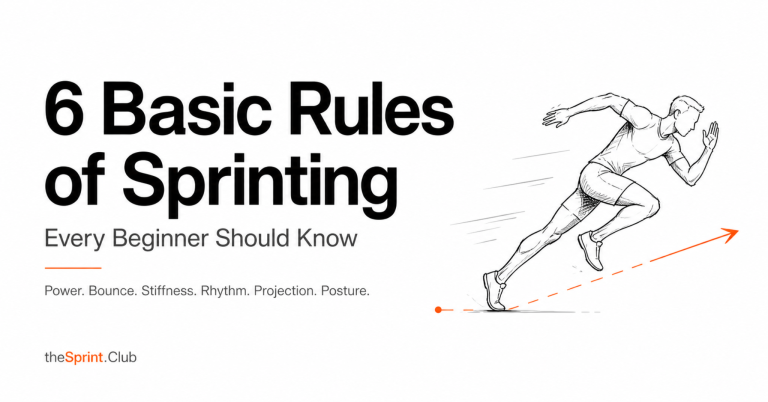
Title text "6 Basic Rules of Sprinting" with subtitle "Every Beginner Should Know" and sketch of a sprinter leaning forward.

Rule 1: Power, Put Force Into the Ground

Power is the ability to apply force quickly.

For beginners, this does not mean lifting the heaviest weight possible or trying to “muscle” every stride. In sprinting, power shows up as explosive ground contact.

The ground is where speed is created. World Athletics describes the support phase, when the foot is on the ground, as critical because ground reaction forces are what influence horizontal velocity.

Push the ground away.

Beginner cue

DrillPurpose
Wall drivesTeaches forward force and body angle
Falling startsTeaches projection
Sled pushes or light sled sprintsTeaches force into the ground
Hill sprintsTeaches aggressive pushing without overstriding
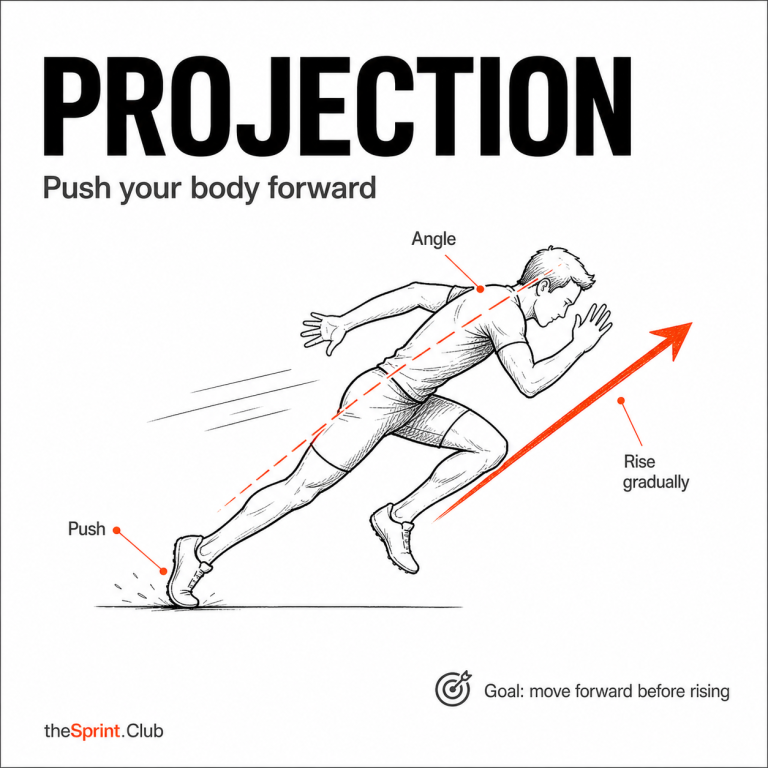
Runner leaning forward in a sprint start with dashed line showing forward body angle and arrow showing gradual rise forward.

The mistake is trying to spin the legs fast before learning how to apply force.

Fast legs without force are just noise.

Rule 2: Bounce, Don’t Grind

Bounce is the elastic quality of sprinting.

When a beginner sprints, they often stay on the ground too long. Every step looks like effort. The body sinks. The foot pushes late. The stride becomes heavy.

World Athletics describes effective modern sprinting as “light,” “fast,” and involving an active striking action of the foot on the track.

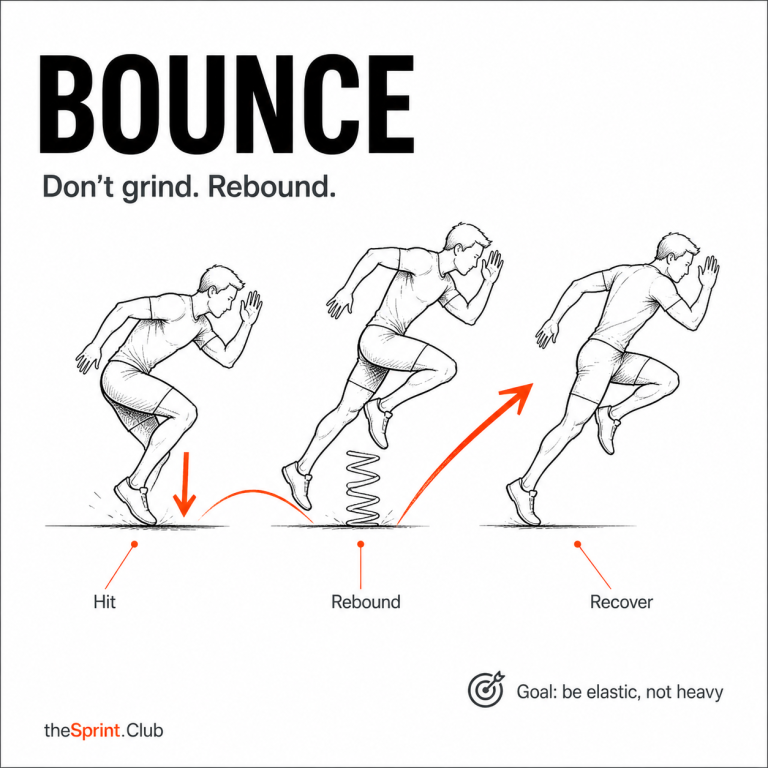
Bounce does not mean jumping upward. It means using the ground contact like a spring.

DrillPurpose
PogosTeaches elastic ankle response
AnklingTeaches quick foot contact
Low skipsTeaches rhythm and rebound
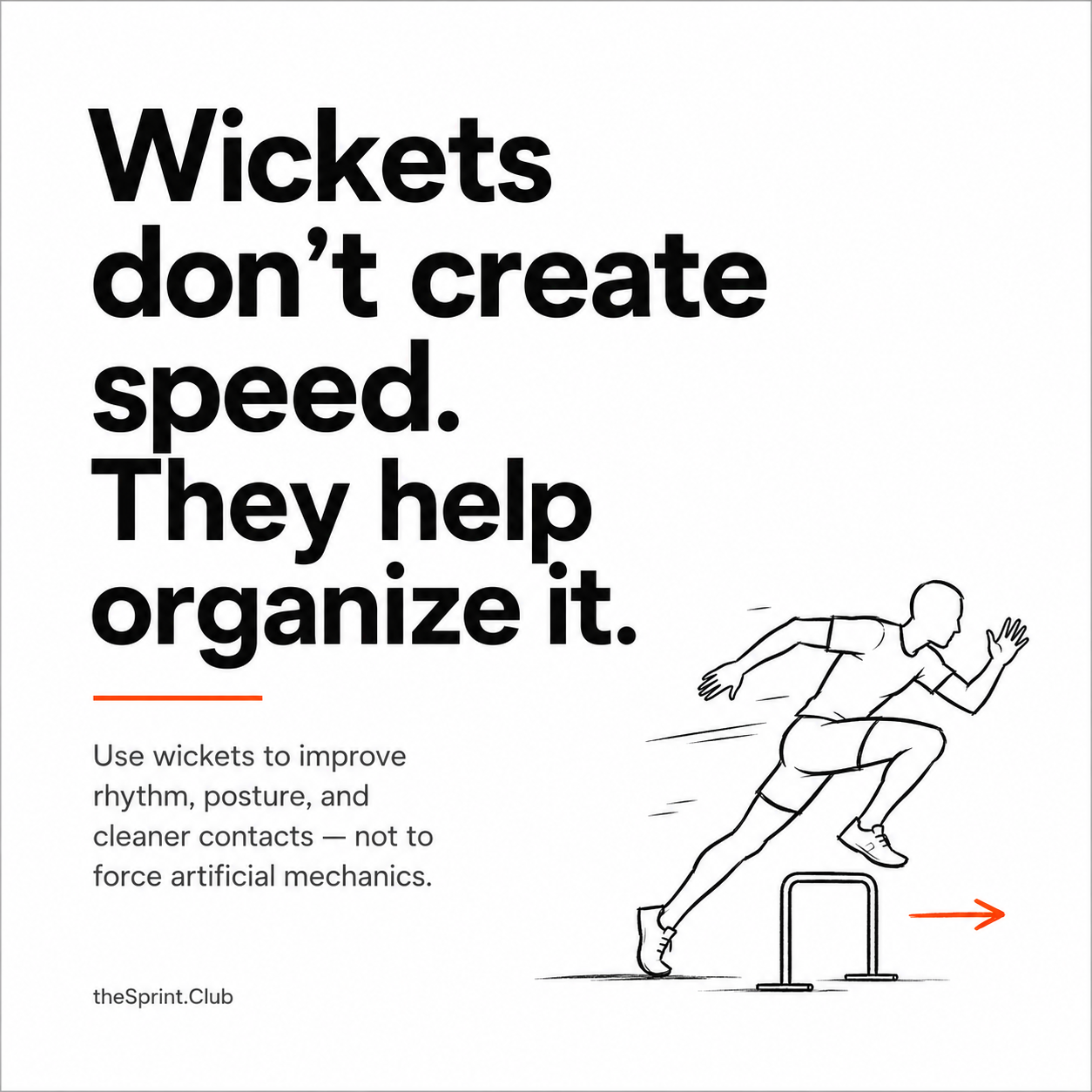
Wicket runsTeaches bounce with posture
Three-panel sketch of a runner demonstrating "Hit" (ground contact), "Rebound" (springy push-off), and "Recover" phases.

Rule 3: Stiffness, Stay Springy at Contact

Stiffness is one of the most misunderstood sprinting ideas.

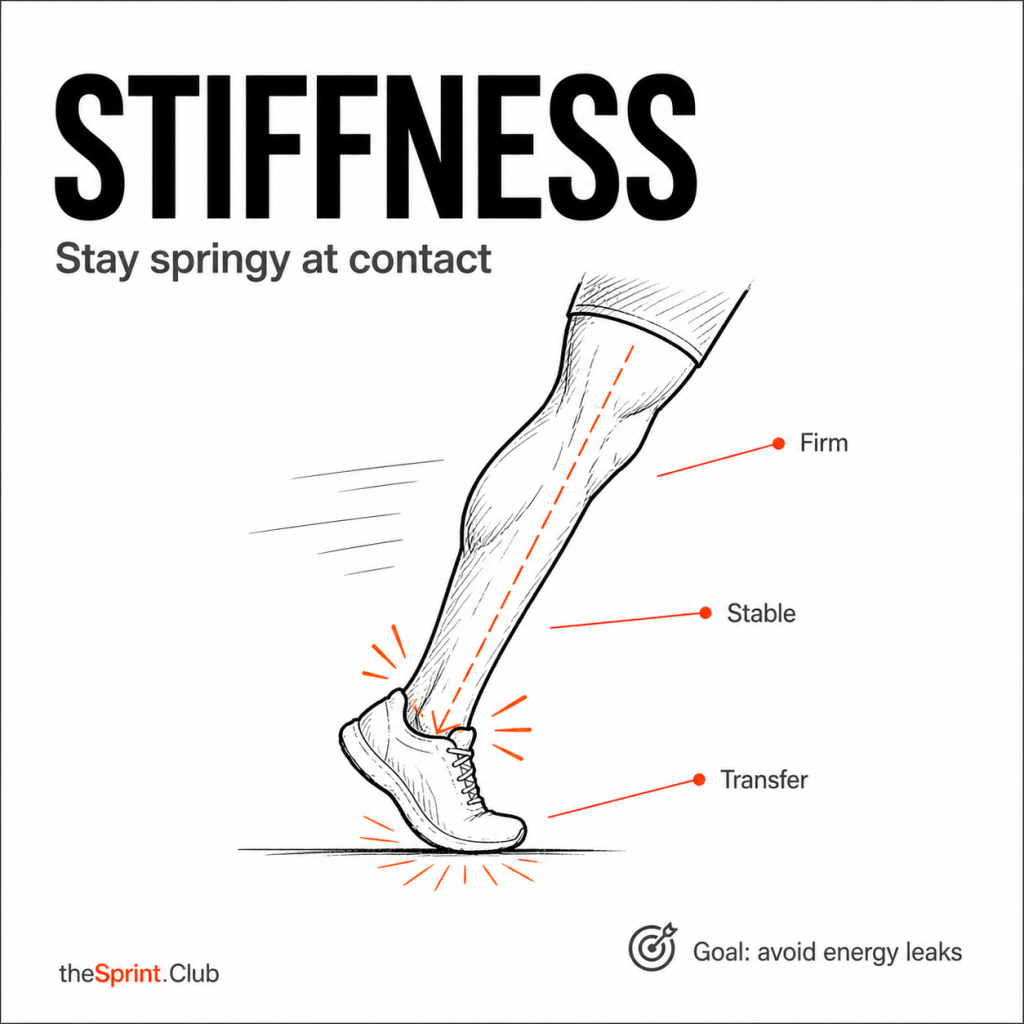
It does not mean being tense everywhere. It means the ankle, foot, leg, and trunk are firm enough at ground contact to transfer force instead of leaking it.

Think of the difference between a basketball and a flat tire.

The basketball rebounds.

The flat tire collapses.

Sprinting needs the basketball quality.

Research on running often models the body like a spring during ground contact, where the leg compresses and rebounds during stance. Plyometric training has also been shown in a systematic review and meta-analysis to improve reactive strength index, a measure commonly used to assess fast stretch-shortening ability.

Stylized sketch of a runner's lower leg and foot striking ground with labels "Firm," "Stable," "Transfer" and caption "Stiffness."

Be relaxed in the air, stiff on the ground.

Beginner cue

DrillPurpose
Snap-downsTeaches bracing and foot strike
PogosBuilds ankle stiffness
BoundsTeaches elastic force transfer
Low hurdle hopsTeaches stiffness under rhythm

Rule 4: Rhythm, Sprint With Timing

Rhythm is the hidden skill in sprinting.

Beginners often sprint with panic. The arms rush. The feet reach. The first few steps are chaotic. They try to accelerate by moving everything faster.

But sprinting is not random effort. It is timed force.

Acceleration has a rhythm. Maximum velocity has a rhythm. Even the transition between the two has a rhythm.

World Athletics describes sprinting as a cyclic movement with neuromuscular regulation, where maximum velocity depends on the relationship between stride length and stride frequency.

DrillPurpose
MarchesTeaches positions
A-skipsTeaches timing
WicketsTeaches rhythm at speed
Build-up sprintsTeaches gradual speed increase

Speed science that makes you faster.

Weekly sprint science, training insights, and speed culture. Free.
white thesprint.club sprinter tee tshirt
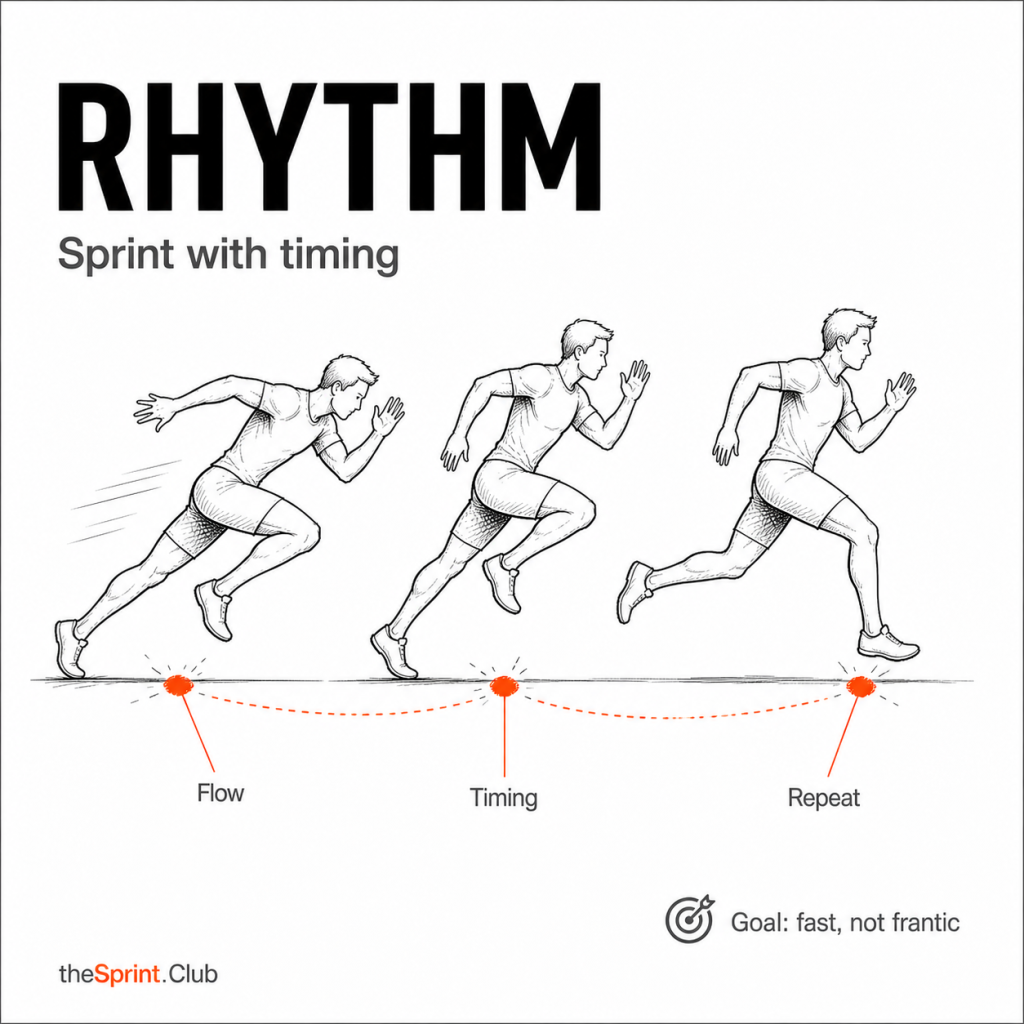
Three-step sketch of a sprinter showing flow, timing, and repeat with orange markers and caption "Rhythm: Sprint with timing."


A beginner should learn to feel acceleration as a sequence:

  1. Push

  2. Rise

  3. Strike

  4. Float

  5. Repeat


The faster you get, the less rushed it should look.

Rule 5: Projection, Push Your Body Forward

Projection is the ability to launch your body in the right direction.

This matters most at the start and during acceleration.

Many beginners pop straight up too early. They stand tall immediately, spin their legs, and lose the chance to push horizontally.

During acceleration, the body should gradually rise as stride length increases. The NSCA describes acceleration as a phase where the body gradually straightens and strides lengthen.


DrillPurpose
Falling startsTeaches forward projection
3-point startsTeaches low acceleration angle
Hill sprintsTeaches forward push
Sled sprintsTeaches horizontal force application
Bad AccelerationBetter Acceleration
Pops up earlyProjects forward
Reaches with footPushes behind the body
Spins legsDrives body forward
Tall too soonRises gradually

Unlock
Speed

Speed is is unlocked by building the right qualities in the right order.
theSprint.Club logo with handwritten BOOKS above a grid of four book covers titled Bounce, Programming, Wickets, and Hurdle Hops, each showing sprint-training illustrations

Rule 6: Posture, Keep the System Organized

Posture is the frame that lets everything else work.

If posture collapses, power leaks. Bounce disappears. Stiffness becomes tension. Rhythm turns into scrambling. Projection turns into stumbling.

At maximum velocity, World Athletics describes modern sprinting posture as almost upright, “very tall,” with an active foot strike and relaxed hands, shoulders, neck, jaw, and face.

AreaWhat to Look For
HeadNeutral, not thrown back
ShouldersRelaxed, not shrugged
TorsoTall, not folded
PelvisStable, not dumped backward
HipsHigh, not sitting
ArmsActive, not crossing the body

Good posture does not mean standing straight during acceleration. It means keeping the body organized for the phase you are in.

Acceleration posture is angled.

Max velocity posture is tall.

Both need control.

Beginner Sprinting Checklist

Use this before every sprint session.


RuleBeginner Question
PowerAm I pushing the ground with intent?
BounceAm I rebounding or grinding?
StiffnessAm I firm at contact but relaxed in the air?
RhythmDo my steps feel timed or rushed?
ProjectionAm I pushing forward before rising?
PostureAre my hips, trunk, and head organized?

Common Beginner Mistakes

1. Trying to sprint hard before learning sprint positions

Effort matters, but effort without position usually creates sloppy speed.

2. Overstriding

Reaching in front of the body increases braking. World Athletics notes that effective technique includes foot touchdown close to the center of mass and an active foot plant.

3. Standing up too early

Acceleration should rise gradually. Beginners often skip the projection phase.

4. Staying tense

A clenched jaw, tight shoulders, and stiff arms do not create speed. They usually interfere with rhythm.

5. Doing too much volume

Speed work needs quality and rest. World Athletics describes maximum speed training as requiring high intensity, short duration, long rest periods, and good technique.

TL;DR

Sprinting is not just effort. Beginners need six rules: power, bounce, stiffness, rhythm, projection, and posture. Power creates force. Bounce keeps the stride elastic. Stiffness transfers energy. Rhythm organizes timing. Projection drives acceleration. Posture keeps the whole system connected.

FAQ

What is the most important rule of sprinting for beginners?

The most important rule is learning to apply force into the ground without losing posture. Beginners usually try to move their legs faster before they can project and strike well.

Should beginners focus on stride length or stride frequency?

Beginners should focus on rhythm and good positions first. Maximum speed depends on the relationship between stride length and stride frequency, not one in isolation.

Why do beginners feel slow even when trying hard?

Many beginners use too much tension, overstride, or stay on the ground too long. Sprinting rewards fast, well-timed force, not just effort.

How often should beginners sprint?

A simple starting point is 2 sprint sessions per week with full recovery between high-speed reps. Quality matters more than volume.

Is stiffness good for sprinting?

Yes, when it means spring-like stiffness at ground contact. It should not mean full-body tension.

What does projection mean in sprinting?

Projection means pushing the body forward during acceleration instead of popping upright too early.


theSprint.Club training tool

6 Rules Sprint Session Builder

Turn power, bounce, stiffness, rhythm, projection, and posture into a focused sprint session. Select your level, time, and goal. The tool builds a simple session with cues, drills, rest guidance, and a quality checklist.

Build Your Sprint Session

Pick the rule you want to emphasize

Session Quality Score

Check these before and during the session. If the score drops, reduce volume before you add more effort.

0%

Training note: sprint quality usually matters more than adding extra tired reps. Stop or reduce the session when posture, rhythm, or ground contact quality declines.

Session Plan

Acceleration + Power Session

Select your settings and build a session.

Block Prescription
Coaching Focus

Power

Power means applying useful force into the ground quickly.

    Weekly Placement

    Where this session fits

    Sprint sessions need enough recovery to keep outputs high.

    Day Focus
    Progression Rule

    How to progress safely

    • Add speed quality before adding volume.
    • Add only one stressor at a time: distance, reps, intensity, or complexity.
    • Keep technical cues simple and observable.
    • End the fastest work when sprint shape clearly changes.

    Related Posts

    Bold title reading "Best Exercises for Sprint Strength" with a sketch of a sprinter launching forward and a tagline about building force, stiffness, and speed.

    Best Exercises for Sprint Strength

    Build sprint strength that actually transfers to speed. Learn the best exercises for acceleration, max velocity, hamstring strength, elastic power, and single-leg force, plus how to organize them into a simple weekly plan for faster, cleaner sprinting.

    Read More
    Two sprinters in motion with bold orange accents, surrounded by sprint club apparel (hoodie, tees, jacket) and slogan "Finish Strong."

    The Rise of the Challenger: Coolest Sprinting Brands

    This article breaks down why challenger sprinting brands are gaining traction, how culture and performance are converging, what the science actually says about apparel and performance, and what trends are shaping sprint gear from race-day kits to post-race identity wear.

    Read More
    the sprint club thesprint.club logo

    theSprint.Club

    Join theSprint.Club

    The Science, Art, & Love of Speed in your inbox.
    Man standing against a pale gray background wearing a navy T-shirt printed with a large white silhouette of a running figure, hands in his pockets, head tilted and forearm tattoos visible.

    Systems + Programs = Measurable Results

    Train with confidence. Know exactly what to work on and why it matters

    Tools & Calculators

    Stop Guessing. Start Measuring.

    Access free tools & calculators built to help coaches and athletes train smarter.

    thesprintclub logo

    theSprint.Club

    Join the squad.
    Explore the gear.
    Get faster.
    white thesprint.club sprinter tee tshirt