The Body Is Faster Than the Mind
One of the biggest breakthroughs in sports performance may be this:
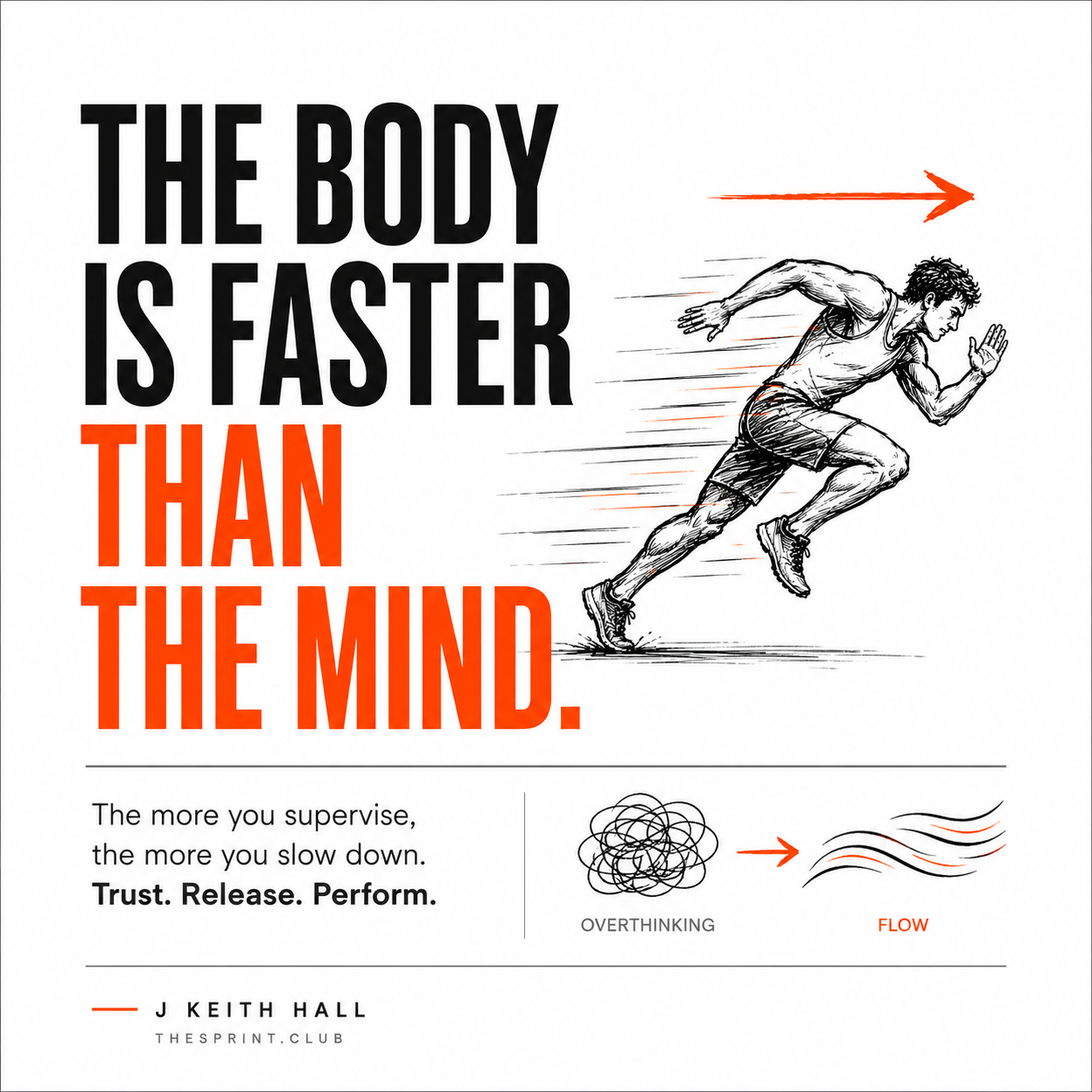
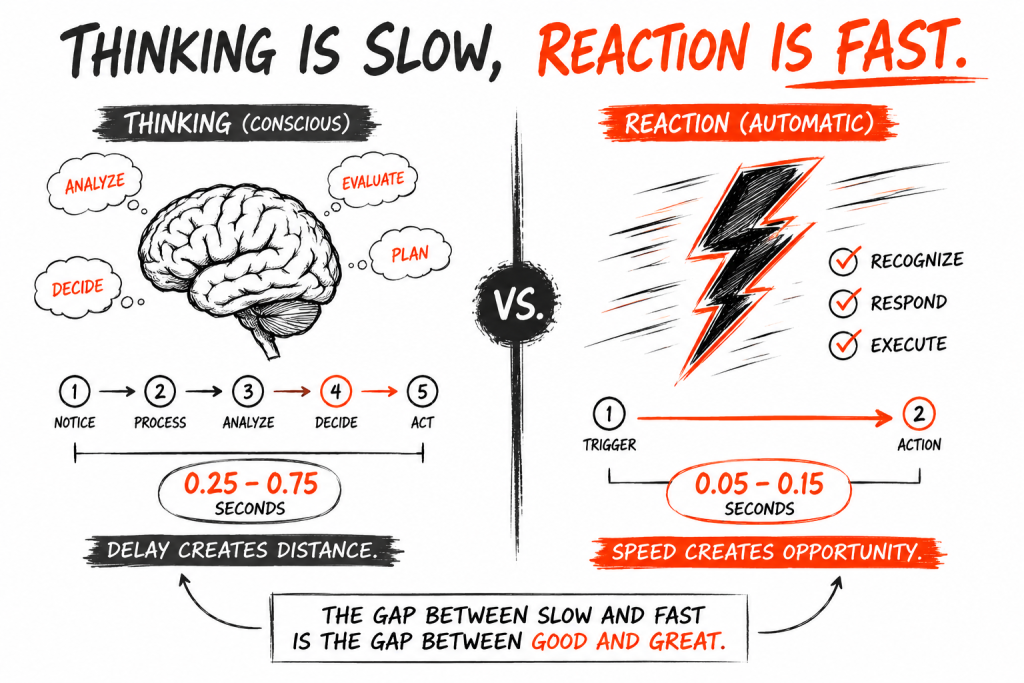
The body is faster than the mind.
Not the conscious mind.
Not the analytical mind.
Not the internal narrator trying to supervise every movement in real time.
The deeper system is faster.
The trained system.
The unconscious system.
The system built through thousands of repetitions under speed, rhythm, timing, and pressure.
The athletes who move with the most speed, explosiveness, rhythm, and fluidity are often not consciously controlling themselves the most.
They are controlling themselves the least.
That sounds backwards until you understand what pressure does to the nervous system.
Why Elite Performance Feels Automatic
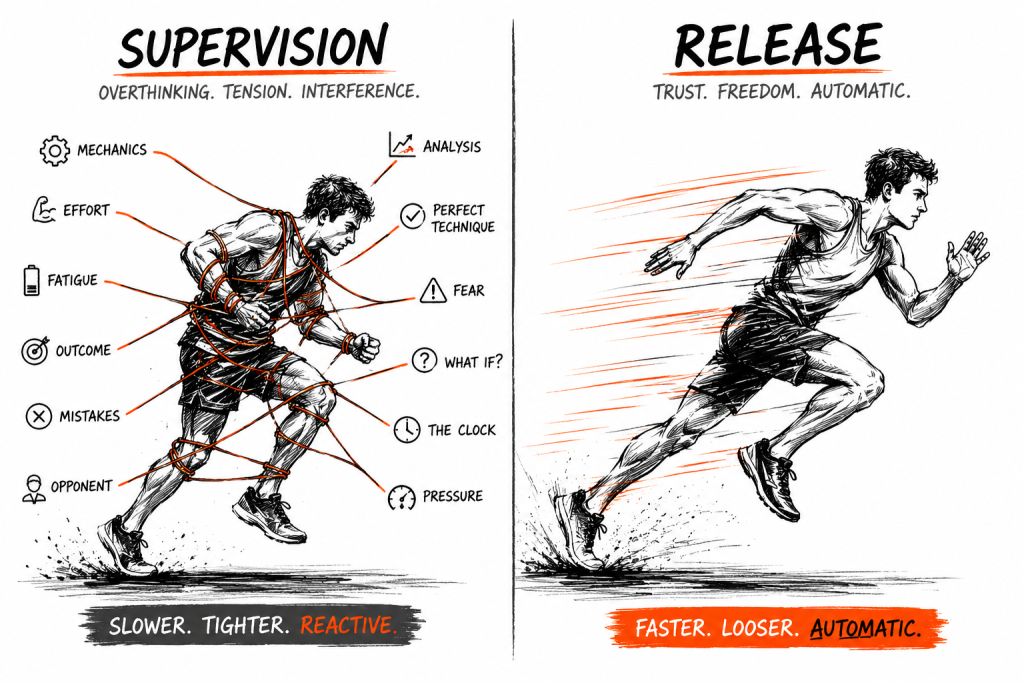
The moment stakes rise, most athletes begin supervising themselves.
They monitor mechanics.
They monitor effort.
They monitor mistakes.
They monitor outcomes.
They monitor fatigue.
They monitor the opponent.
They monitor the clock.
And as supervision increases, movement quality often decreases.
Why?
Because conscious thought is slow compared to trained reaction.
A baseball swing occurs too quickly for conscious correction.
A sprint ground contact happens in fractions of a second.
An elite soccer touch unfolds before analytical thought can fully organize it.
By the time the conscious mind decides what to do, the moment is already gone.
This is why elite performance often feels automatic.
The nervous system is relying on deeply learned movement solutions that operate below conscious awareness.
What Pressure Actually Does to Athletes
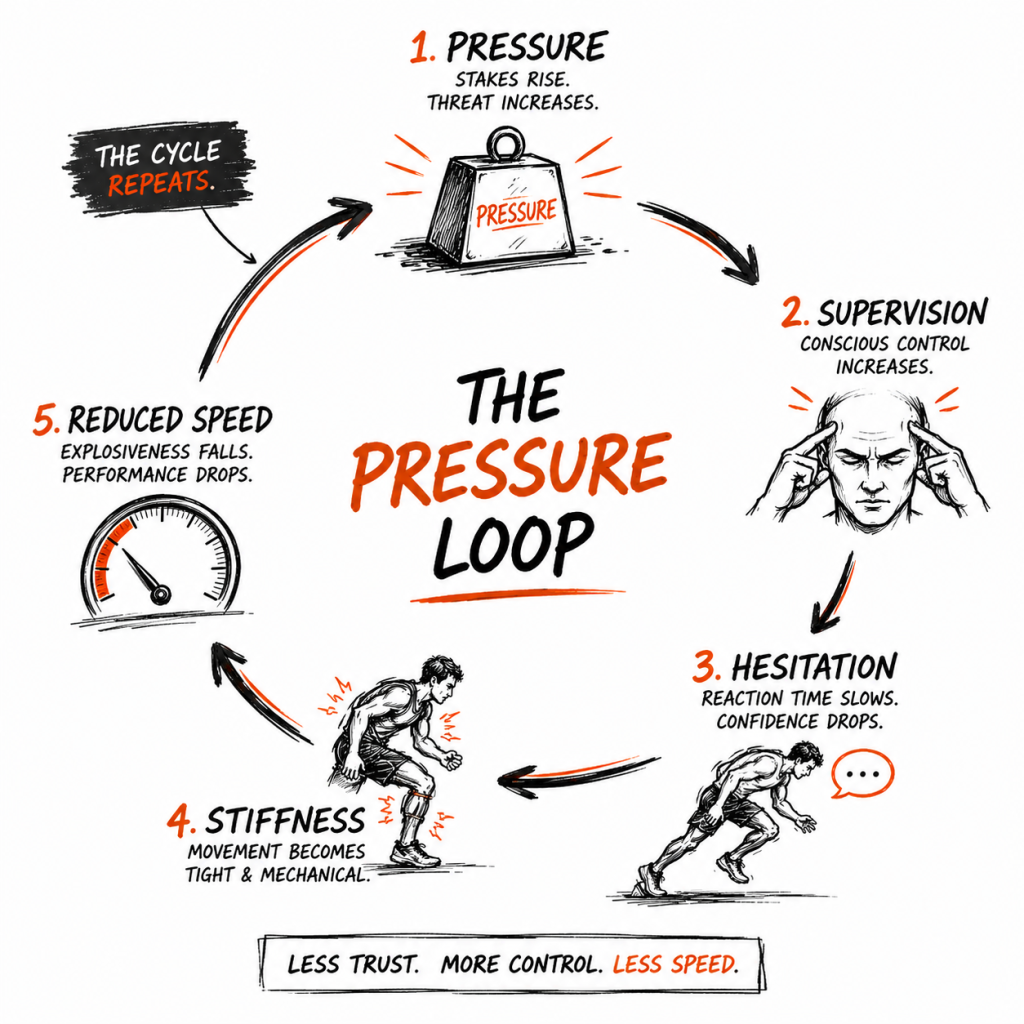
Pressure does not always destroy performance through physical fatigue alone.
Often, pressure changes behavior by increasing conscious control.
The athlete begins tightening movement.
Second-guessing reactions.
Attempting to consciously manufacture precision.
That tightening appears everywhere:
- Stride loses elasticity
- Arms stop flowing naturally
- Decision-making slows
- Ground contacts lengthen
- Aggression decreases
- Rhythm disappears
- Movements become mechanical
The athlete shifts from reacting to supervising.
And that shift can be devastating for speed.
In sprinting, for example, excessive conscious control often creates stiffness that disrupts timing and projection. In basketball, overthinking can delay shot release. In combat sports, hesitation creates openings. In soccer, over-analysis interrupts fluid perception-action coupling.
The irony is brutal:
The harder athletes consciously try to control elite performance, the more they interfere with the system capable of producing it.
The Hidden Cost of Internal Supervision
Elite movement depends heavily on timing and coordination operating automatically.
The nervous system organizes thousands of muscular actions simultaneously:
- force production
- stabilization
- rhythm
- balance
- sequencing
- visual processing
- spatial prediction
Conscious thought cannot micromanage all of this in real time.
When athletes attempt excessive conscious intervention during execution, movement often becomes fragmented.
Researchers studying motor learning frequently distinguish between:
- explicit control, conscious rule-based execution
- implicit control, automatic learned execution
Under pressure, athletes often “reinvest” conscious control back into automated skills. This phenomenon, sometimes called reinvestment theory, has been associated with choking under pressure in skilled performers.
The Science of Automatic Movement
Several areas of neuroscience and motor learning point toward the same principle:
Automatic systems execute skilled movement more efficiently than conscious supervision during high-speed performance.
Implicit Motor Learning
Implicit learning develops skills without requiring athletes to consciously verbalize every movement component.
Skills learned implicitly tend to hold up better under pressure because execution depends less on conscious reconstruction.
External Focus Research
Research by Gabriele Wulf has repeatedly shown that focusing externally, such as on movement outcome or environment, often improves performance more than focusing internally on body mechanics. External focus has been linked to improved coordination, efficiency, and automaticity.
An athlete thinking:
- “push the ground away”
may perform better than: - “extend the knee harder”
Why?
Because external focus tends to preserve automatic coordination.
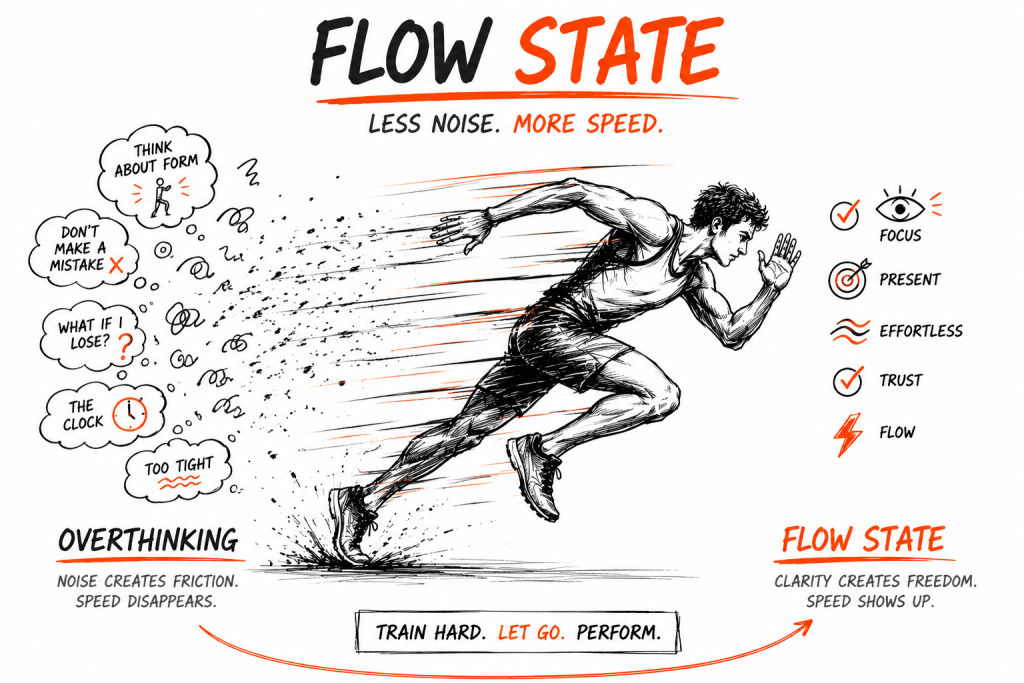
Flow States
Psychologist Mihaly Csikszentmihalyi described flow as a state of deep absorption where action feels automatic, attention narrows, and self-conscious monitoring decreases.
Athletes often describe this state with phrases like:
- “I wasn’t thinking.”
- “Everything slowed down.”
- “I just reacted.”
- “It happened automatically.”
These are not meaningless clichés.
They are descriptions of altered attentional and neurological states.
Why Great Athletes Say “I Wasn’t Thinking”
No elite sprinter reaches maximum velocity by consciously placing every footstep.
No elite shooter calculates release mechanics mid-shot.
No elite fighter scripts exchanges in real time.
The body already knows what to do.
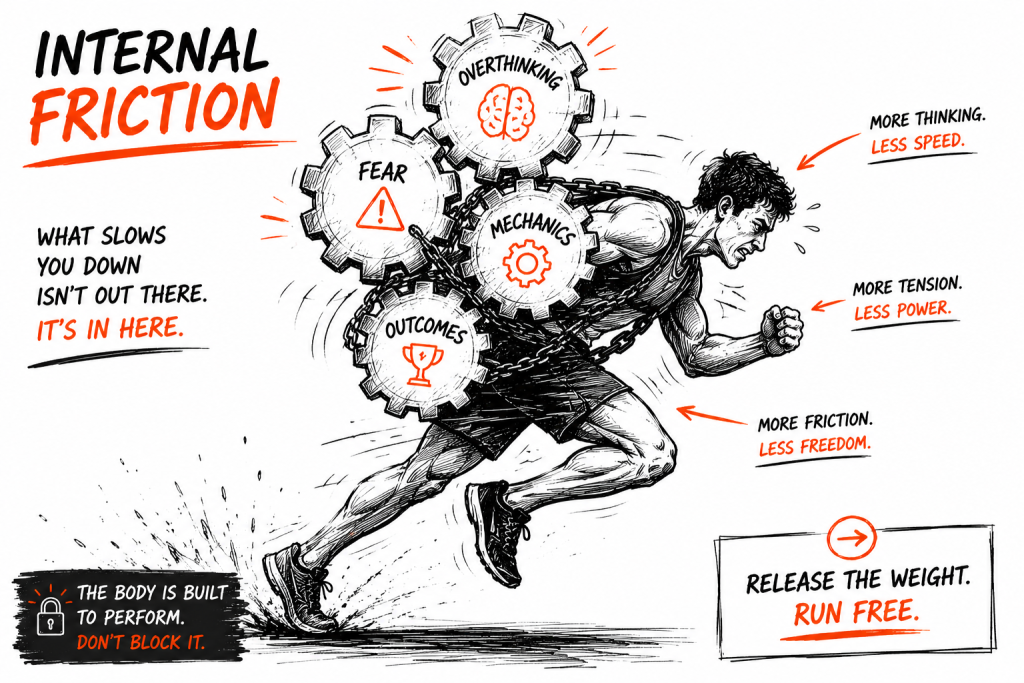
The problem is often interference.
At the highest levels of sport, performance becomes less about adding thought and more about removing friction.
Removing hesitation.
Removing excessive correction.
Removing internal noise.
Speed often emerges from release.
Explosion often emerges from trust.
Fluidity often emerges when trained systems operate without interruption.
This reframes trust entirely.
Trust is not motivational language.
Trust is neurological efficiency.
The Coaching Mistake That Slows Athletes Down
One of the most common coaching mistakes is attempting to consciously correct athletes during high-speed execution.
Technical learning matters.
Mechanics matter.
Cueing matters.
But there is a difference between:
- building a movement pattern
and - consciously supervising that movement during competition.
Mechanics belong primarily in practice environments where athletes can explore, adapt, and refine.
Competition requires execution speed.
Too many internal cues during performance can overload conscious attention and disrupt automatic coordination.
That does not mean athletes should become mindless.
It means the conscious mind should guide preparation more than execution.
Training the Ability to Let Go
“Letting go” is not accidental.
It can be trained.
1. Build Automaticity Through Repetition
High-quality repetition reduces the need for conscious reconstruction under pressure.
2. Use Constraints-Led Training
Training environments that force adaptation naturally can reduce overthinking and improve reactive behavior.
3. Limit Internal Cueing During Competition
Simple external cues often preserve rhythm better than technical checklists.
4. Train Under Pressure
Athletes need exposure to consequence and stress without learning to panic or overcontrol.
5. Reduce Fear of Mistakes
Fear increases supervision.
Supervision increases hesitation.
Hesitation reduces fluidity.
The Real Meaning of Trust in Sport
The best athletes are not always those with the greatest conscious control.
Often, they are the athletes most capable of releasing unnecessary control.
That does not mean careless execution.
It does not mean lack of discipline.
It means trusting the system already built through training.
The conscious mind cannot organize elite movement quickly enough during explosive sport.
The body can.
And at the highest levels of performance, the difference between hesitation and explosion is often the difference between supervision and release.
The fastest athletes are rarely the most internally controlled.
They are often the most free.
TL;DR
Elite athletic performance depends heavily on automatic execution rather than conscious supervision. Under pressure, athletes often begin over-monitoring mechanics, effort, and outcomes, which disrupts fluidity, timing, and explosiveness. Research on implicit motor learning, attentional focus, reinvestment theory, and flow states suggests that high-speed skilled movement works best when trained patterns operate automatically. Great performance is often less about thinking harder and more about removing interference.
Performance Interference Framework
| State | Nervous System Behavior | Movement Outcome |
|---|---|---|
| Trust | Automatic execution | Fluid, elastic, explosive |
| Supervision | Conscious monitoring | Mechanical, delayed, rigid |
| Fear | Overcontrol and hesitation | Slower reactions |
| Flow | Reduced self-monitoring | Efficient coordination |
| Pressure + Overthinking | Reinvestment into conscious control | “Choking” or tightening |
FAQ
Is overthinking really enough to slow athletes down?
Yes. Research on attentional focus, choking under pressure, and reinvestment theory suggests excessive conscious control can interfere with automatic motor execution in skilled performers.
What is flow state?
Flow is a psychological state characterized by deep absorption, reduced self-consciousness, and highly efficient execution.
Should athletes stop thinking completely?
No. Conscious thought is critical during preparation, learning, strategy, and reflection. The issue is excessive conscious control during rapid execution.
Why do athletes tighten up late in races?
[Inference] Fatigue contributes, but pressure and threat perception may also increase muscular tension and conscious supervision, disrupting rhythm and elastic movement.
What kind of cues help athletes perform better?
Research often supports external focus cues that emphasize movement outcome or environment rather than internally micromanaging body parts.


- How to Progress in Nordic Curls: A Step-by-Step Guide for Stronger Hamstrings
- The Body Is Faster Than the Mind: Why Overthinking Slows Athletic Performance
- The Science of Anthropometrics and Sprinting
- How to Jump Higher: A Complete Guide to Explosive Leg Training
- Best Exercises for Sprint Strength
- 6 Basic Rules of Sprinting Every Beginner Should Know