Why Nordic Curls Are So Difficult
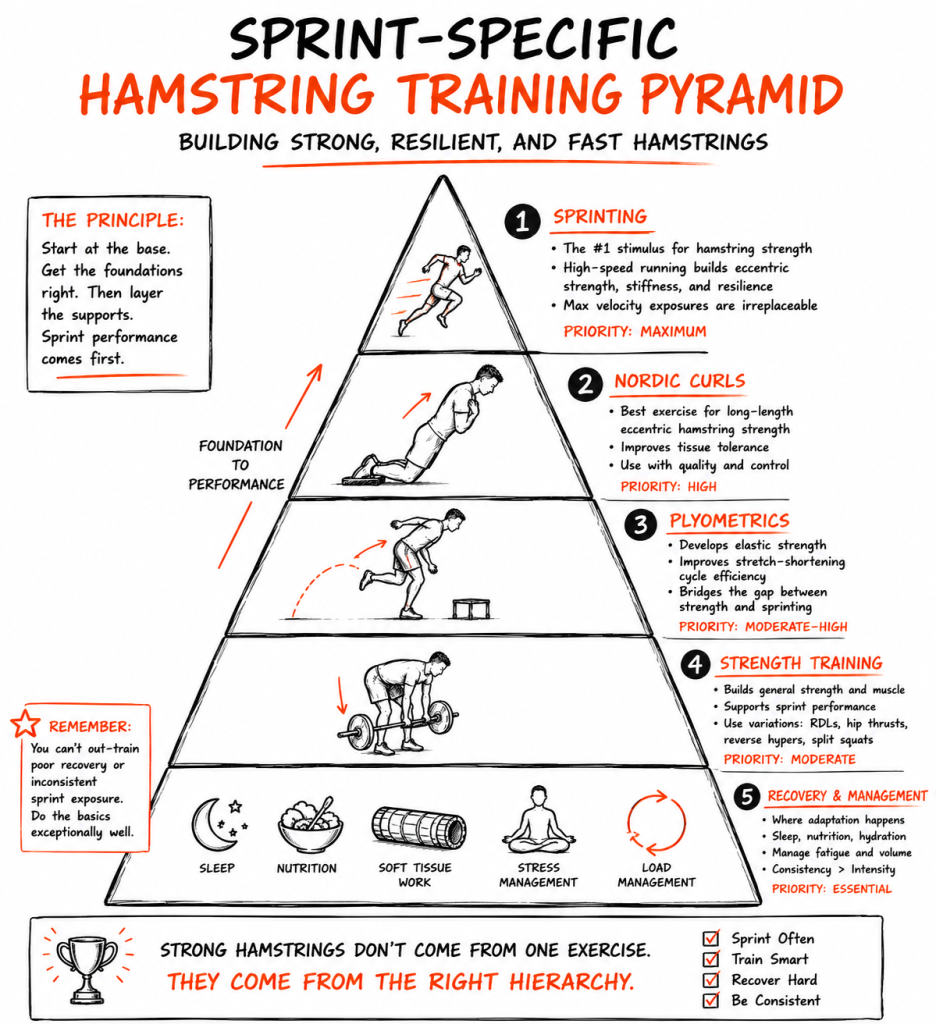
Nordic curls create extremely high eccentric forces on the hamstrings, especially the biceps femoris long head, which is commonly injured during sprinting.
Research consistently shows Nordic hamstring training can:
- Increase eccentric hamstring strength
- Increase fascicle length
- Reduce hamstring injury rates in field and sprint sports
But Nordics are difficult because they:
- Load the hamstrings at long lengths
- Require high force production without momentum
- Demand lumbo-pelvic control
- Expose weaknesses in coordination and stiffness
For many athletes, bodyweight alone is already too advanced.
The Biggest Nordic Curl Mistake
Most athletes progress by trying to:
- go lower
- fall faster
- add reps
Too early.
That often creates:
- hip collapse
- lumbar extension
- loss of trunk stiffness
- excessive soreness
- compensation through the low back
The hamstrings stop being the primary limiter.
Progression should be based on:
- Control
- Range
- Tissue tolerance
- Sprint recovery capacity
Not ego.
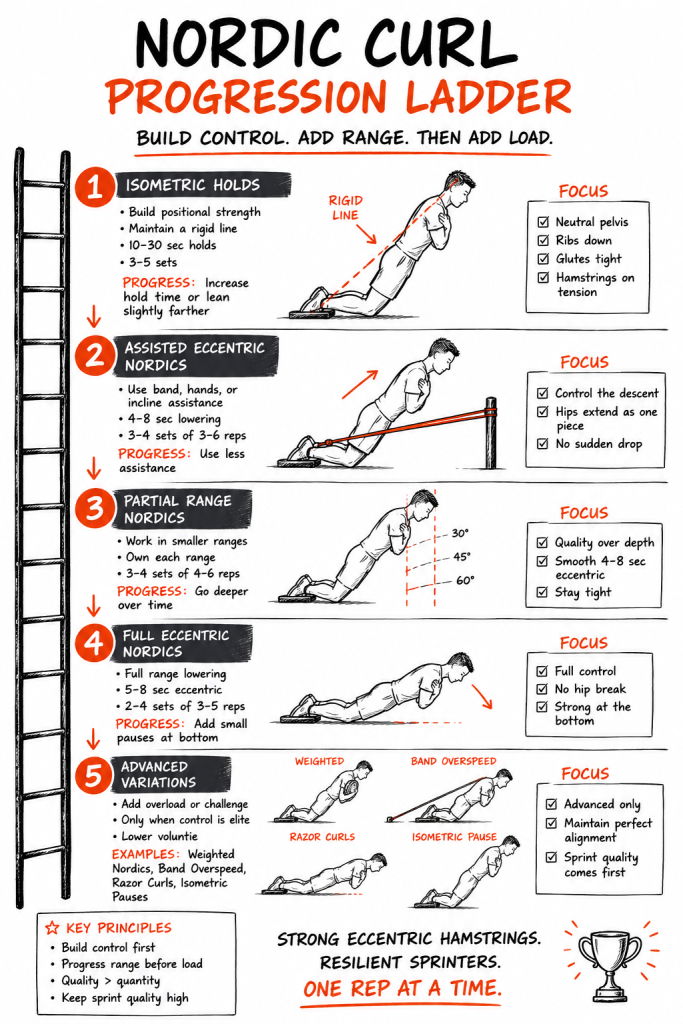
The 5-Stage Nordic Curl Progression System
Stage 1: Isometric Holds
Before full Nordics, develop positional strength.
Goal
Learn to maintain:
- neutral pelvis
- stiff trunk
- tension through the hamstrings
Method
Hold the top Nordic position:
- 10-30 seconds
- 3-5 sets
Progress by:
- increasing hold duration
- leaning slightly farther forward
Coaching Cue
“Move as one rigid line.”
Stage 2: Assisted Eccentric Nordics
This is the best starting point for most athletes.
Assistance Options
- Resistance band
- Hands on boxes
- TRX support
- Incline torso setup
Goal
Control the descent slowly.
Tempo
4-8 second lowering phase.
Key Standard
No sudden collapse.
If the athlete drops in the final third:
- reduce range
- increase assistance
Do not force full range early.
Stage 3: Partial Range Nordics
Instead of chasing full ROM immediately:
- own smaller ranges first
Example
Work only:
- first 30°
- then 45°
- then deeper ranges
Why This Works
Strength gains are angle-specific.
Progressive range exposure:
- improves tendon tolerance
- reduces excessive soreness
- improves motor control
Stage 4: Full Eccentric Nordics
Now the athlete can:
- descend under control
- maintain alignment
- tolerate long-length loading
Standard
5-8 second eccentric with minimal hip break.
Volume
Low volume works best:
- 2-4 sets
- 3-5 reps
More is not better.
For sprinters, excessive Nordic volume can interfere with:
- sprint stiffness
- elasticity
- neural freshness
Stage 5: Advanced Nordic Variations
Only progress here if:
- sprint performance is unaffected
- recovery is manageable
- control remains excellent
Advanced Variations
- Weighted Nordics
- Band overspeed eccentric Nordics
- Razor curls
- Isometric pauses
- Alternating eccentric/isometric reps
These are advanced eccentric overload methods, not general fitness exercises.
A Simple Nordic Curl Progression Ladder
| Level | Variation | Goal |
|---|---|---|
| 1 | Isometric Hold | Positional control |
| 2 | Band-Assisted Eccentric | Controlled lowering |
| 3 | Partial ROM | Own deeper angles |
| 4 | Full Eccentric | Long-length strength |
| 5 | Advanced Variations | Overload and specificity |
How Sprinters Should Use Nordic Curls
Nordics are supportive.
They are not the main sprint stimulus.
Max velocity sprinting itself creates enormous eccentric hamstring demands. Nordic curls should help support:
- tissue tolerance
- long-length strength
- force absorption capacity
Without reducing sprint quality.
Best Timing
Off-Season
Higher Nordic emphasis works well.
Preseason
Moderate exposure:
- maintain strength
- avoid excessive soreness
In-Season
Minimal effective dose:
- 1 session weekly
- low volume
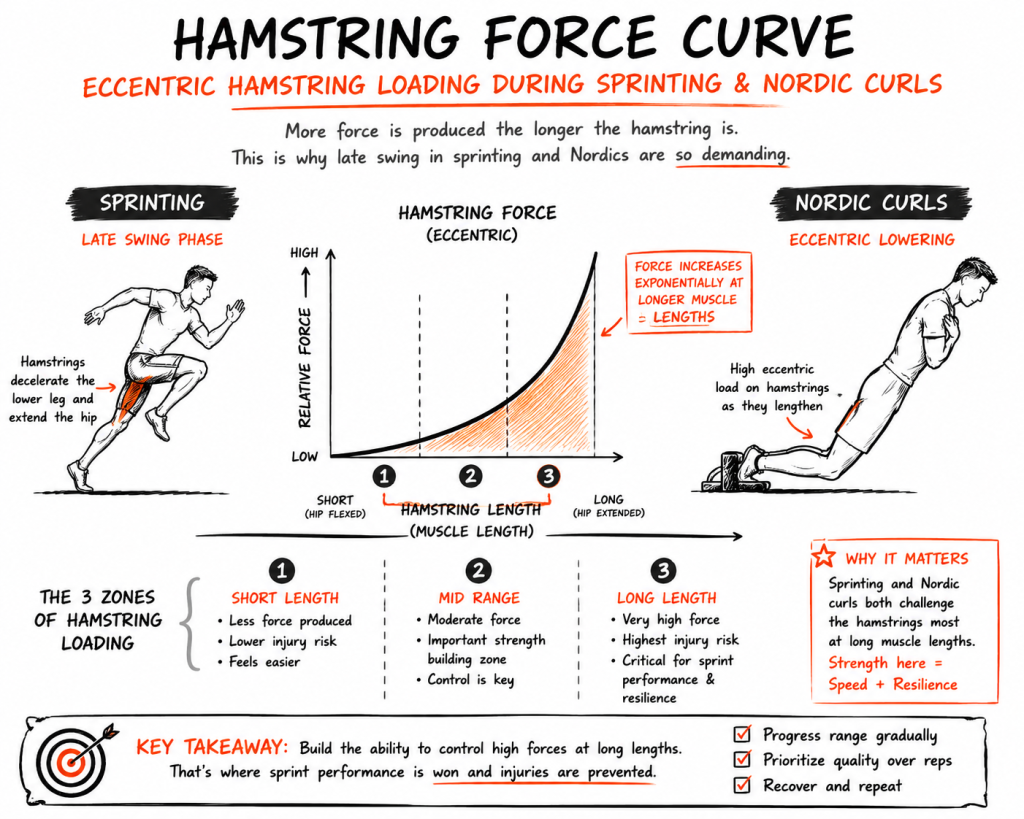
Recommended Sprint Athlete Volumes
Beginner
- 2 sets x 3 reps
- 1-2x/week
Intermediate
- 3 sets x 4-5 reps
- controlled eccentrics
Advanced
- 2-4 sets x 3-5 reps
- high quality only
Do not chase fatigue.
The hamstrings recover slowly from heavy eccentric loading.
Signs You Progressed Too Fast
Warning Signs
- lingering soreness >72 hours
- reduced sprint stiffness
- slower fly times
- posterior pelvic discomfort
- excessive cramping
- low back dominance
If sprint quality declines:
- reduce Nordic volume first
Not sprinting volume first.
What Actually Matters Most
Nordics are useful.
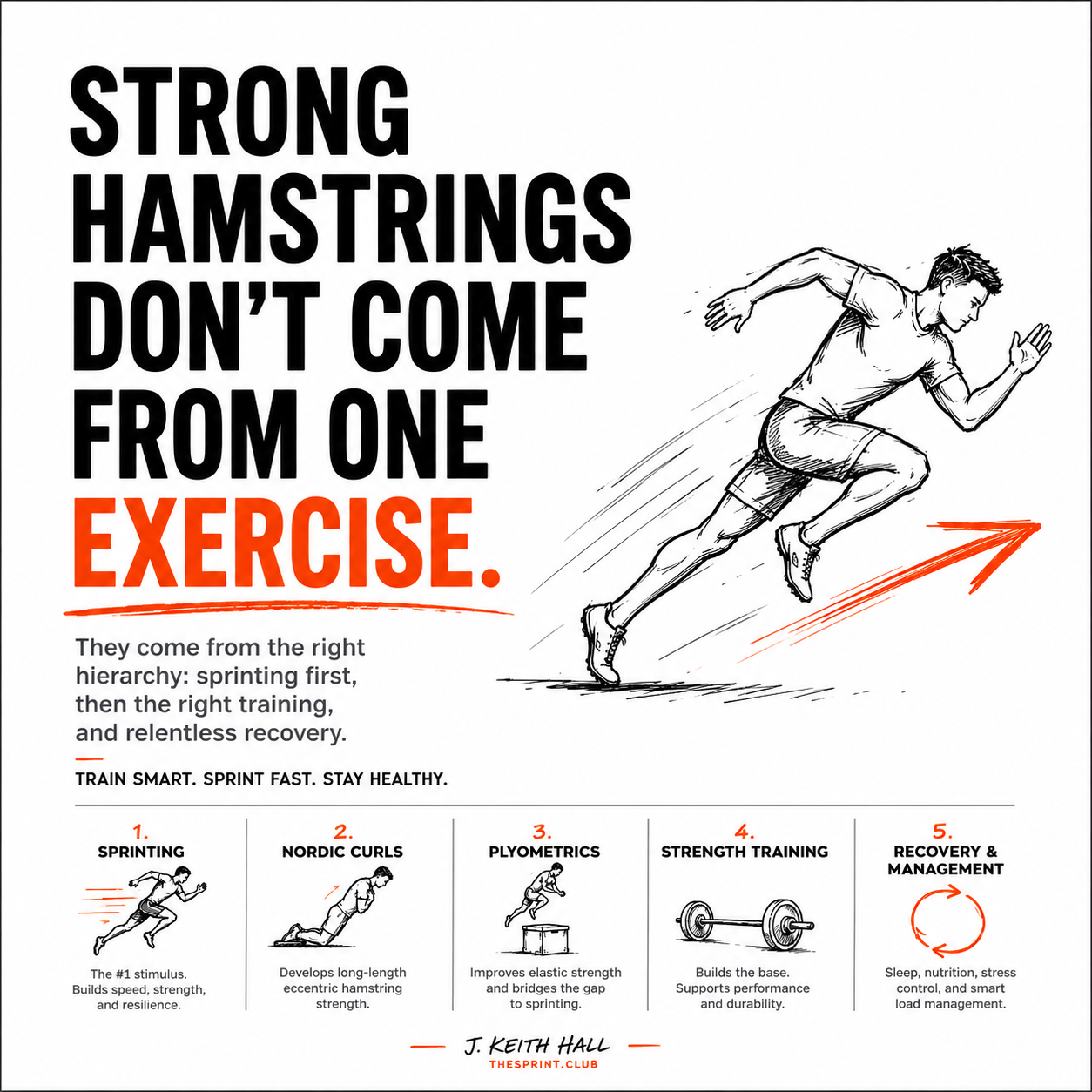
But sprint resilience is broader than one exercise.
Hamstring durability also depends on:
- sprint exposure
- mechanics
- pelvic organization
- tissue stiffness
- recovery
- weekly load management
- progressive speed exposure
Nordics help build one important piece:
eccentric long-length hamstring strength.
They are not a complete hamstring solution by themselves.
TL;DR
- Most athletes progress Nordic curls too aggressively
- Start with isometrics and assisted eccentrics
- Progress range before adding load
- Own control before chasing full ROM
- Sprinters should keep Nordic volume relatively low
- Sprinting itself is still the primary hamstring-specific stimulus
- Nordics are best used as support for eccentric strength and injury resilience
FAQ
Are Nordic curls good for sprint speed?
Indirectly, yes. They improve eccentric hamstring strength and long-length force tolerance, which supports sprint mechanics and resilience.
How many Nordic curls should sprinters do?
Usually low volume:
- 2-4 sets
- 3-5 reps
is sufficient.
Why do Nordic curls make you so sore?
They create extremely high eccentric tension at long muscle lengths, which produces significant tissue stress.
Can beginners do Nordic curls?
Most beginners need assistance:
- bands
- partial range
- isometric holds
Bodyweight full Nordics are advanced.
Are Nordic curls enough to prevent hamstring injuries?
No. Sprint exposure, mechanics, recovery, and load management are also critical.
- Do Wicket Drills Improve Sprint Speed? What the Evidence Says

- How to Progress in Nordic Curls: A Step-by-Step Guide for Stronger Hamstrings
- The Body Is Faster Than the Mind: Why Overthinking Slows Athletic Performance

- The Science of Anthropometrics and Sprinting
- How to Jump Higher: A Complete Guide to Explosive Leg Training
- Best Exercises for Sprint Strength