
Am I training the elastic system (tendons, fascia, foot strength) or just muscles?

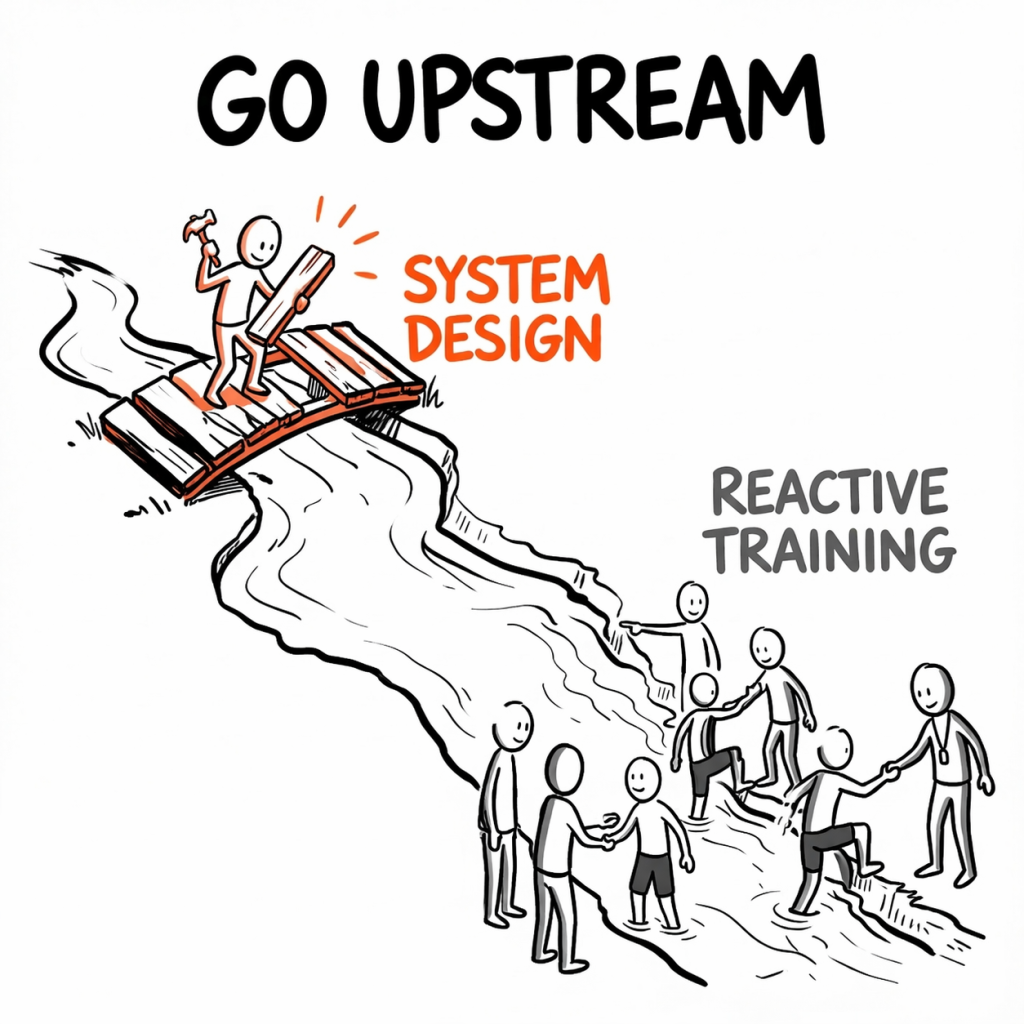
There’s a parable in Dan Heath’s book Upstream that every coach and athlete needs to hear.
Imagine standing by a river. You see someone struggling in the water. You jump in, pull them out. Before you catch your breath, another person floats by. You jump in again. Then another. And another.
You’re so busy rescuing people that you never think to walk upstream and ask: who keeps pushing them in?
This is how most speed training works.
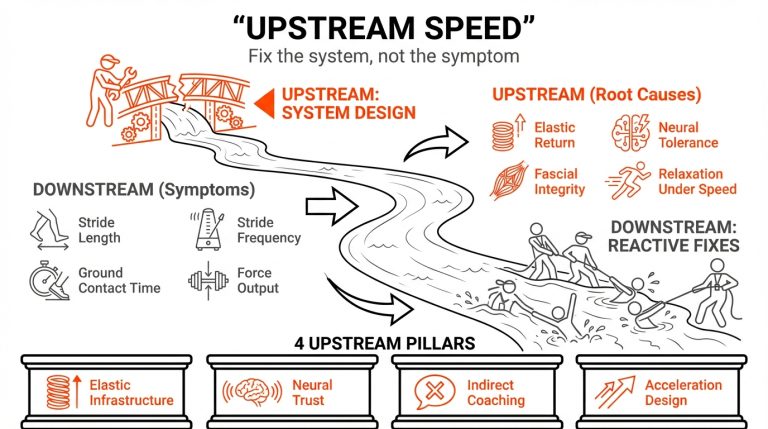
An athlete is slow out of the blocks — so you drill starts. They tie up at 70 meters — so you add speed endurance. Their stride is short — so you cue “bigger steps.” Every intervention is downstream: reacting to symptoms instead of designing the system that prevents them.
The fastest athletes and the best coaches in the world do something different. They go upstream.
Dan Heath’s insight is simple: every system is perfectly designed to get the results it gets.
If your athletes keep getting injured, your training system is designed to produce injuries. If they plateau at the same speed year after year, your system is designed to produce that plateau. If they quit before they ever reach their potential, your system is designed to push them out.
The upstream coach asks different questions:
The answers are not what most people expect.
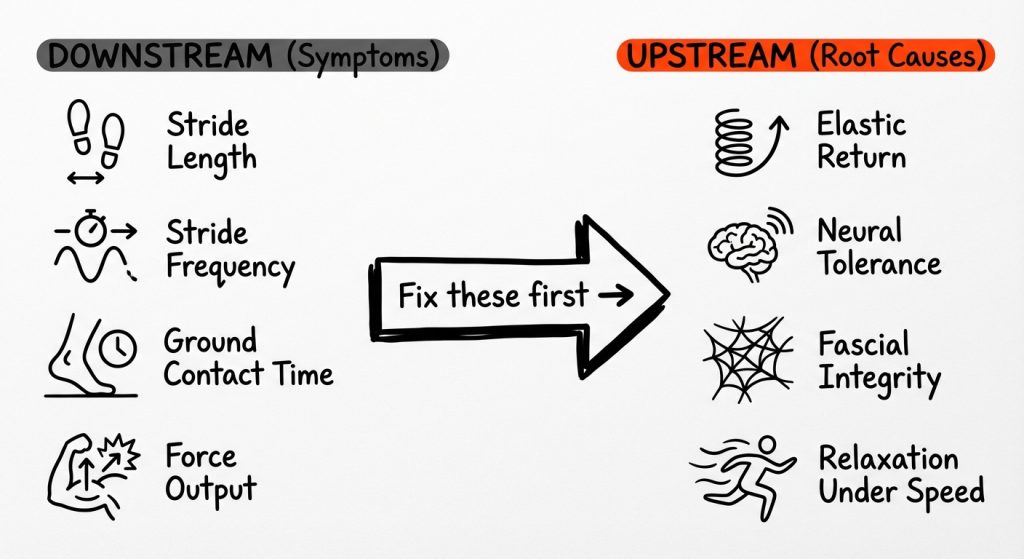
Most sprint analysis focuses on the obvious metrics:
These are real. They’re measurable. And they’re downstream indicators — not root causes.
The upstream truth is that elite sprinting is governed by two things most coaches never directly train:
Understand these two, and every other sprint metric falls into place.
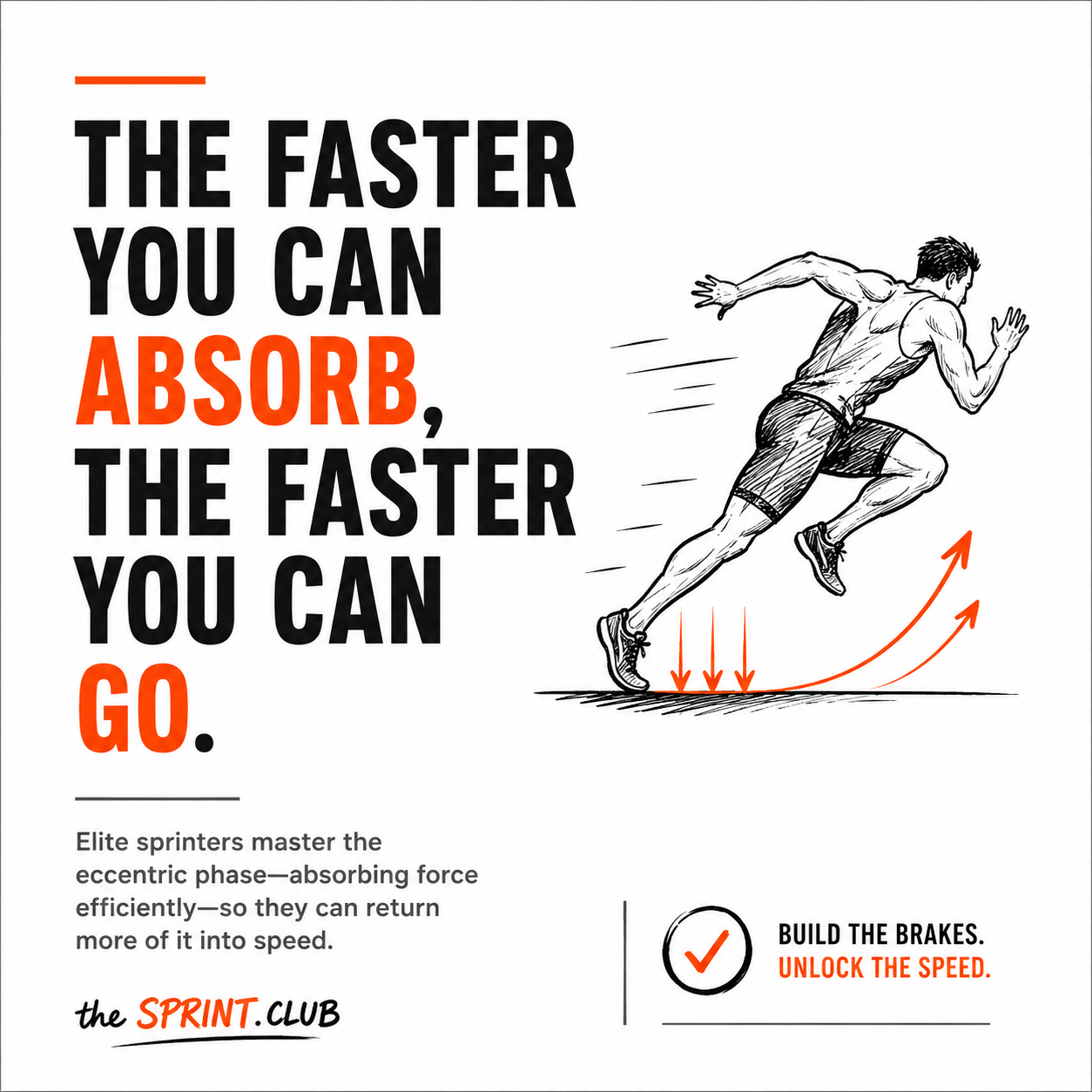
At maximum velocity, ground contact lasts less than 90 milliseconds. That’s less time than it takes to blink.
In that window, there is no time to “apply force.” The body can only:
This is an elastic event, not a muscular one.
There are only two types of ground contact at top speed:
The athlete may feel identical effort in both cases. But the outcome is completely different.
Sprint speed is not defined by how much force you produce. It is defined by how much force the body allows you to return to the ground.
The moment the body starts absorbing instead of returning, speed is already gone — even if effort increases.
Every coach has seen it. The athlete looks great through 60 meters, then suddenly tightens. Shoulders rise. Jaw clenches. Speed vanishes.
The downstream diagnosis: “They need more speed endurance.” Or: “They need to relax.”
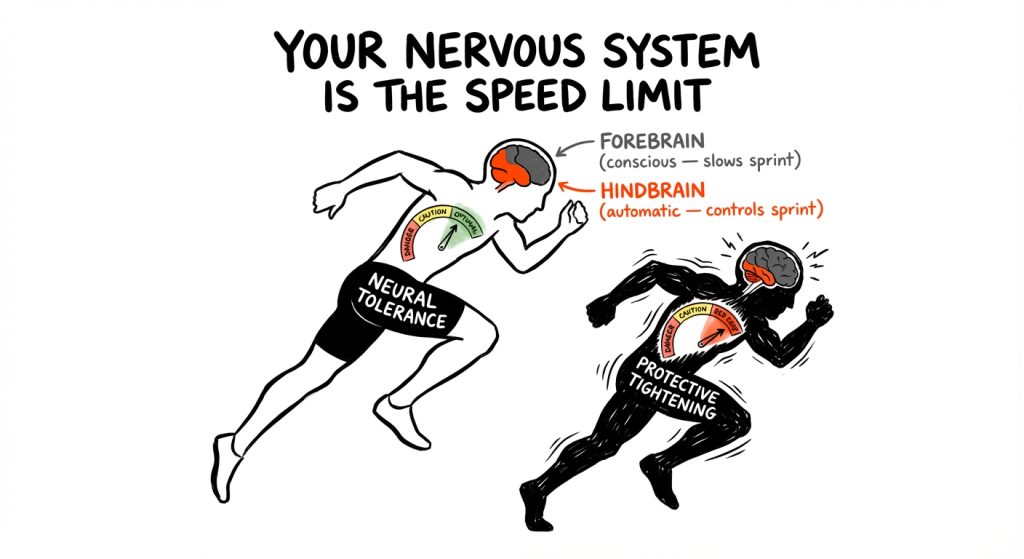
The upstream reality: this is predictive neural protection.
At maximum velocity, the body is in controlled chaos:
The nervous system constantly asks one question: “Can we handle this impact and return it safely?”
When the answer is yes → full elastic return. Speed holds.
When the answer shifts to uncertain → the system tightens. Hip stiffness increases. Trunk locks up. Arm amplitude shrinks. Stride shortens.
The athlete didn’t get weak. Their nervous system pulled the emergency brake.
And here’s the part that matters for coaches: you cannot override this with willpower. The regulation happens in the hindbrain — the automatic, primitive part of the nervous system that operates far faster than conscious thought.
Charlie Francis understood this decades ago. He called sprinting a “hind brain activity” and warned that voluntary forebrain input — over-thinking mechanics, forcing relaxation, cueing technique at full speed — only makes the problem worse.
Want a simple way to read neural state in real time? Watch the face.
The muscles of the face, jaw, and neck are tightly linked to the central nervous system’s regulation of total-body tension. When the jaw clenches or facial muscles tighten:
This stiffness propagates through the entire kinetic chain in milliseconds.
Now watch the greatest sprinters at maximum velocity. Their face looks almost effortless. Jaw relaxed. Eyes stable. Cheeks soft.
This is not cosmetic. It is neurological. Their nervous system is allowing full elastic rebound because it trusts the body to handle the instability.
When the face tightens, the legs slow down.
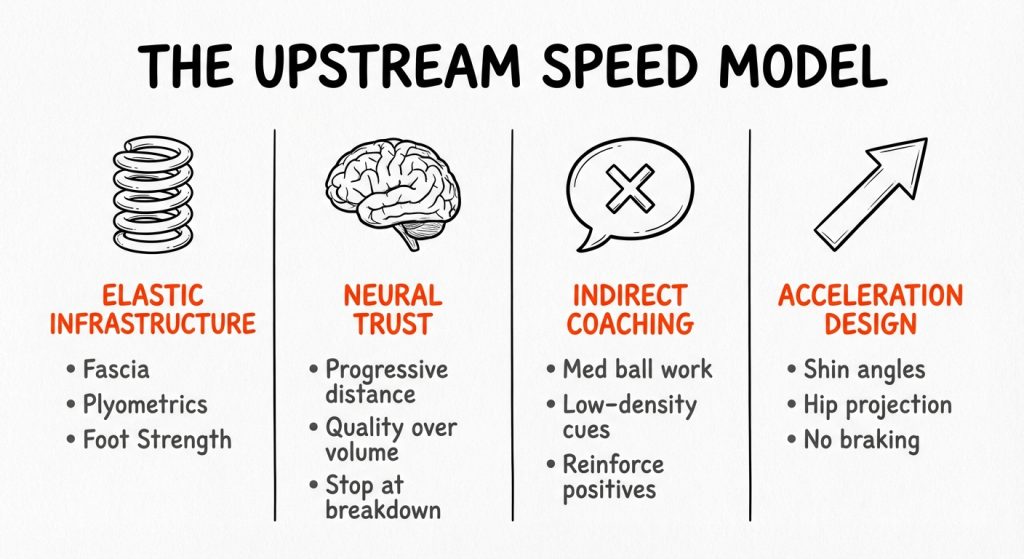
If downstream training chases symptoms, upstream training builds the system. Here’s what that looks like across four pillars:
The 22 kilograms of fascia in your body is not filler — it’s your largest sensory organ, containing 10× more sensory receptors than muscles. It has piezoelectric properties (generating electrical charges under tension), viscoelasticity, and rapid remodeling capability.
Upstream coaches train the fascial system directly:
You cannot force relaxation. You build it through progressive exposure:
This is Charlie Francis’s core principle: quality over quantity, always. If an athlete can’t sprint 30 meters efficiently, having them run 200s is not conditioning — it’s programming dysfunction.
Because sprinting is a hindbrain activity, direct technical cueing at full speed creates “paralysis by analysis.” The upstream approach:
Proper acceleration isn’t about leg speed. It’s about body projection:
Here’s the uncomfortable truth about traditional sprint training.
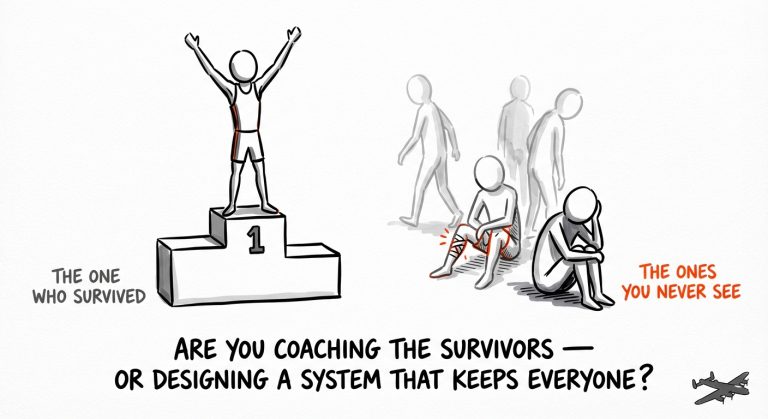
In World War II, the military studied returning bombers to decide where to add armor. They reinforced the areas that were shot up. A statistician named Abraham Wald pointed out the fatal flaw: they were only looking at the planes that survived. The planes that were shot in other areas never came back. The damage on survivors showed where planes could take hits — not where they were vulnerable.
Sprint coaching has the same problem.
When a coach says “this training works — look at my fastest athlete,” they’re looking at the planes that came back. What about:
Tony Holler calls these athletes “cats” — fast-twitch, explosive, neurologically gifted athletes who will not tolerate pointless suffering. A system that selects for pain tolerance instead of speed potential is designed to lose its best athletes.
The upstream solution: make training neurologically rewarding from day one. Build speed first. Add endurance on top of quality. Never program dysfunction in the name of “toughness.”
The fastest sprinters don’t produce more effort than everyone else. They lose less energy. Their nervous system trusts the body at the edge of instability. Their fascia and tendons return force instead of absorbing it. Their coaches designed a system that built speed from the ground up — literally.
You don’t slow down because you’re weak. You slow down because your nervous system tightens at the edge of speed.
Stop rescuing drowning runners. Walk upstream. Fix the bridge.
This checklist is built around sprint and motor-learning themes that have support in the literature, including force orientation during acceleration, elastic function of the muscle-tendon system, progressive loading, and external focus coaching. Items with weaker direct evidence are labeled as coaching heuristics rather than proven markers.
Use the checklist before the session. The goal is not perfection. It is higher quality decisions before speed work starts.
Check each statement only when the session plan genuinely reflects it.
Am I training the elastic system (tendons, fascia, foot strength) or just muscles?
Am I building nervous system trust through progressive quality, or forcing volume too early?
Am I coaching indirectly, letting strength and drills shape mechanics, or over-cueing at full speed?
Am I designing acceleration from body projection and shin angles, or just telling athletes to “drive harder”?
Am I watching the face for signs of neural tightening?
Am I stopping sessions at first breakdown, or pushing through dysfunction?
Am I selecting for speed potential or just pain tolerance?
Write the one adjustment that makes this session more upstream.
The strongest support sits behind force application, progressive exposure, elastic contribution of the muscle-tendon unit, and external-focus coaching. Monitoring the face as a sign of tightening is included as a practical observation cue, but it should be treated as a heuristic, not a validated standalone diagnostic.
Running and sprinting rely on storage and return of elastic energy in the muscle-tendon unit. Foot and ankle structures also contribute to stiffness and propulsion.
During acceleration, the orientation of force relative to the ground is a key performance determinant, which is why projection and shin angle are more useful than generic “push harder” cues.
External-focus instruction tends to outperform internal-focus instruction for sprint execution and skill performance. That supports indirect coaching, especially near full speed.

Learn how sprinters develop elastic strength by mastering force absorption and reapplication. Includes plyometric progressions, coaching cues, and training templates.

Learn a speed-first sprint training system that protects mechanics under fatigue, improves rep quality, and helps athletes train for acceleration and max velocity.

Most athletes never truly train max velocity. Learn how to get faster by improving top-end sprint speed with science-backed methods.
Train with confidence. Know exactly what to work on and why it matters
Access free tools & calculators built to help coaches and athletes train smarter.