

For decades, athletes have been taught that success comes from working harder than everyone else.
More reps.
More conditioning.
More sprint volume.
More grinding.
That mindset builds toughness, but it doesn’t always build speed.
Sprint performance depends on producing the highest possible force in the shortest possible time. When fatigue accumulates faster than recovery, the systems responsible for explosive movement begin to shut down. Athletes continue working harder while adapting less.
This is the Volume Trap.
Many coaches mistake fatigue for productive training and slower performances for a lack of effort. The result is often the opposite of what they intended: slower athletes, poorer mechanics, and higher injury risk.
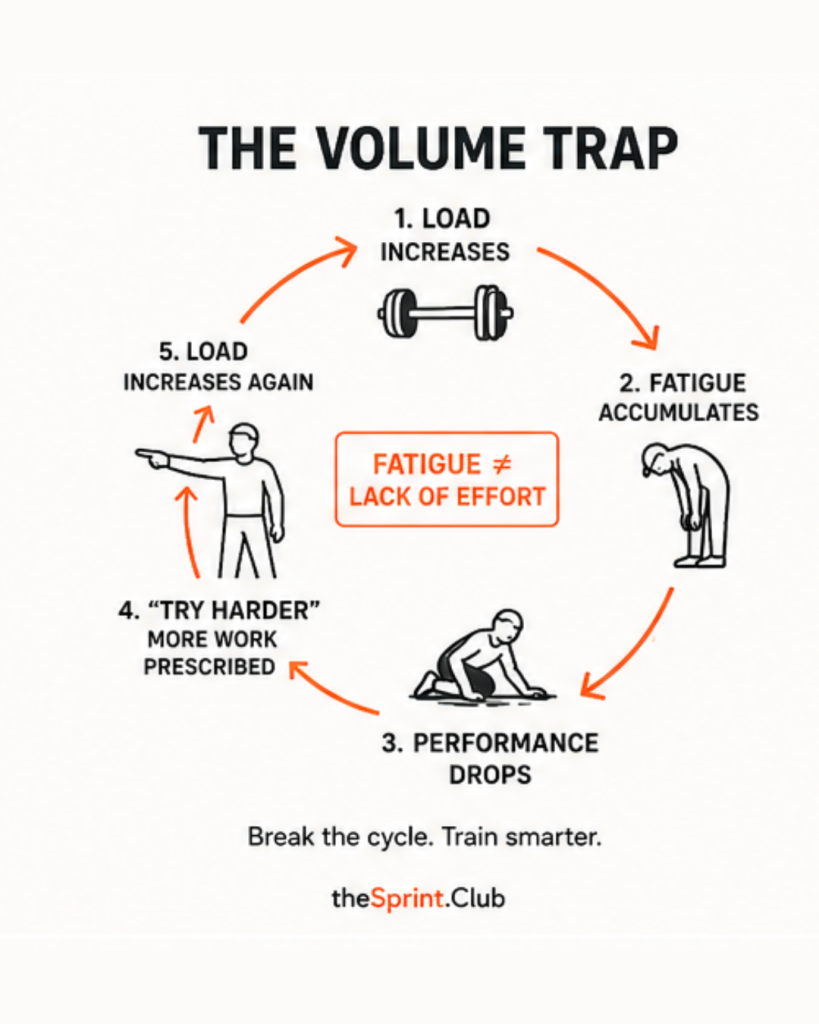
What Is the Volume Trap?
The Volume Trap happens when training stress consistently exceeds an athlete’s ability to recover.
Instead of adapting, the body spends more time managing accumulated fatigue.
The cycle usually looks like this:
| Step | Result |
|---|---|
| Training volume increases | Fatigue accumulates |
| Fatigue accumulates | Sprint performance declines |
| Performance declines | Coach assumes athlete isn’t working hard enough |
| More work is prescribed | Fatigue increases even further |
Every additional session becomes less productive because the athlete is trying to express speed through a fatigued nervous system.
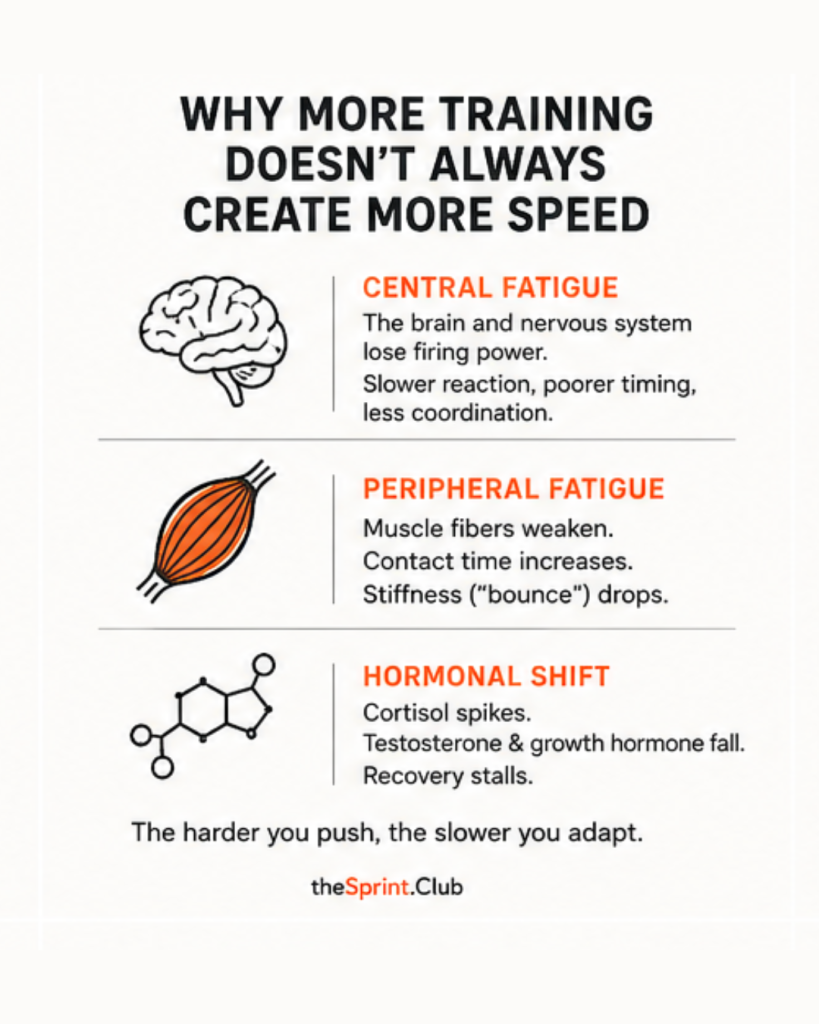
Why More Training Doesn’t Always Produce More Speed
Elite sprinting is primarily a neural activity.
The goal isn’t simply to make muscles stronger.
The goal is to teach the nervous system to produce force rapidly and efficiently.
Central Nervous System Fatigue
Repeated high-intensity work reduces neural drive.
Athletes experience:
- Slower reaction times
- Less explosive contractions
- Reduced coordination
- Decreased movement precision
When the brain cannot recruit muscle efficiently, sprint performance declines even if the athlete feels motivated.
Peripheral Fatigue
Fatigue also develops within the muscles themselves.
As muscular fatigue increases:
- Force production decreases.
- Ground contact times become longer.
- Tendon stiffness declines.
- Elastic energy storage becomes less effective.
Sprinters often describe this feeling as losing their “bounce.”
This is exactly what many coaches observe late in overly demanding training blocks.
Hormonal Recovery Matters
Heavy training without sufficient recovery can shift the body’s hormonal environment.
Recovery slows as stress hormones remain elevated while anabolic hormones responsible for repair and adaptation are reduced.
The result is simple:
More work does not automatically equal better adaptation.
How Fatigue Changes Sprint Mechanics
Fatigue rarely announces itself first through soreness.
It usually appears in movement quality.
Experienced coaches notice athletes beginning to:
- Spend longer on the ground
- Strike farther ahead of the body
- Lose posture
- Produce less vertical stiffness
- Exhibit slower limb velocities
- Appear heavy despite maximal effort
These changes represent a decline in force production rather than a decline in motivation.
The athlete isn’t lazy.
The athlete is fatigued.
Five Signs You’re Doing Too Much
Many athletes don’t realize they’re accumulating excessive fatigue until performance has already dropped.
Watch for these warning signs:
| Sign | What It Usually Means |
|---|---|
| Sprint times plateau or worsen | Fatigue exceeds adaptation |
| Warm-ups feel unusually difficult | Nervous system isn’t recovered |
| Ground contacts become louder | Reduced stiffness |
| Technique falls apart early | Coordination is declining |
| Motivation decreases | Recovery resources are exhausted |
When several of these occur together, adding more volume is rarely the answer.
What Smart Coaches Do Instead
Successful sprint coaches don’t avoid hard work.
They define it differently.
1. Measure Instead of Guess
Use objective feedback whenever possible.
Examples include:
- Flying 10-meter times
- 30-meter acceleration splits
- Reactive Strength Index (RSI)
- Jump testing
- Heart rate variability (HRV)
- Daily readiness questionnaires
Numbers identify fatigue before athletes can feel it.
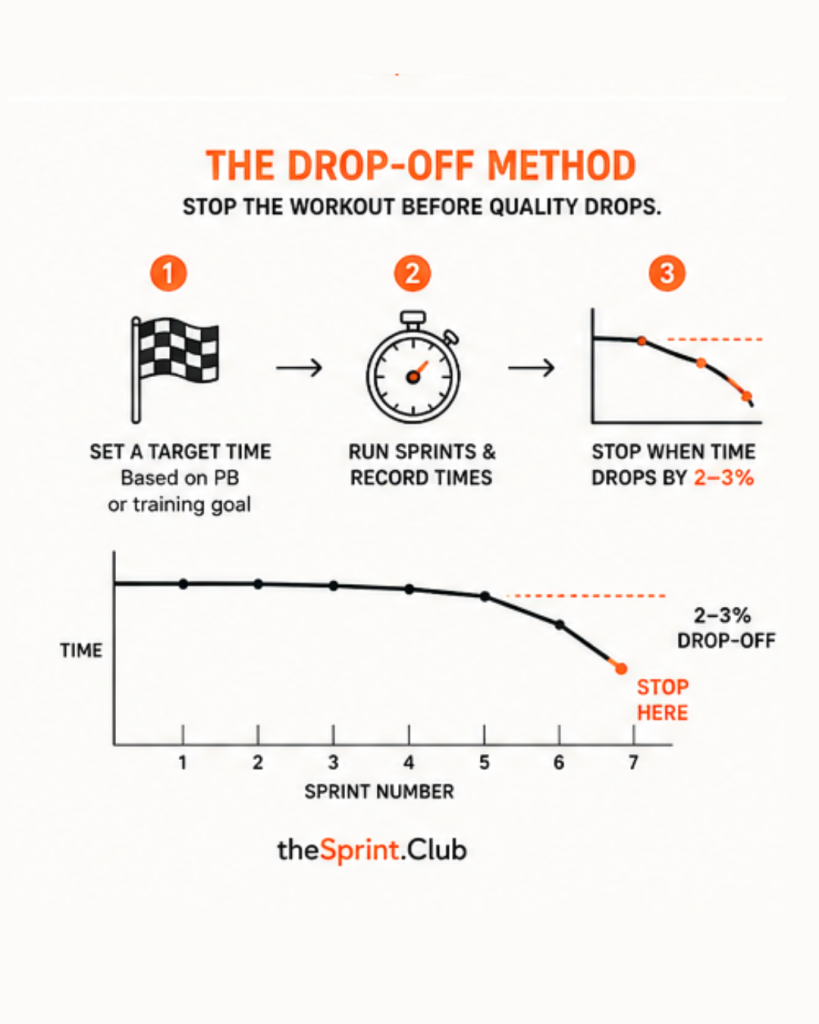
2. Stop Before Quality Declines
One of the most effective strategies is using a sprint drop-off threshold.
Instead of prescribing a fixed number of repetitions, athletes continue sprinting only while performance remains within a predetermined range.
For example:
- Record the fastest sprint.
- Continue repetitions.
- End the session when times slow by approximately 2 to 3 percent.
This keeps training focused on speed development rather than fatigue accumulation.
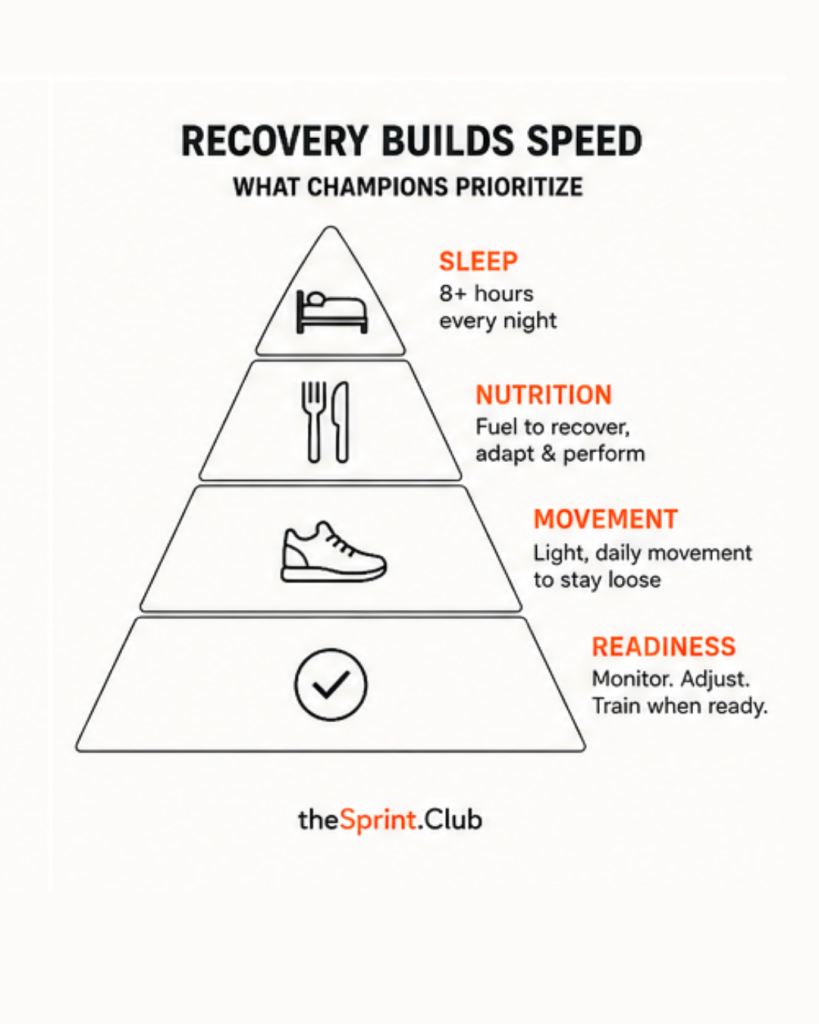
3. Treat Recovery as Training
Adaptation occurs after the session.
Not during it.
Recovery should include:
- 8 or more hours of quality sleep
- Sufficient carbohydrate intake
- Adequate protein consumption
- Hydration
- Light movement between hard sessions
- Appropriate spacing between maximal sprint days
Elite athletes don’t simply recover better.
They prioritize recovery.
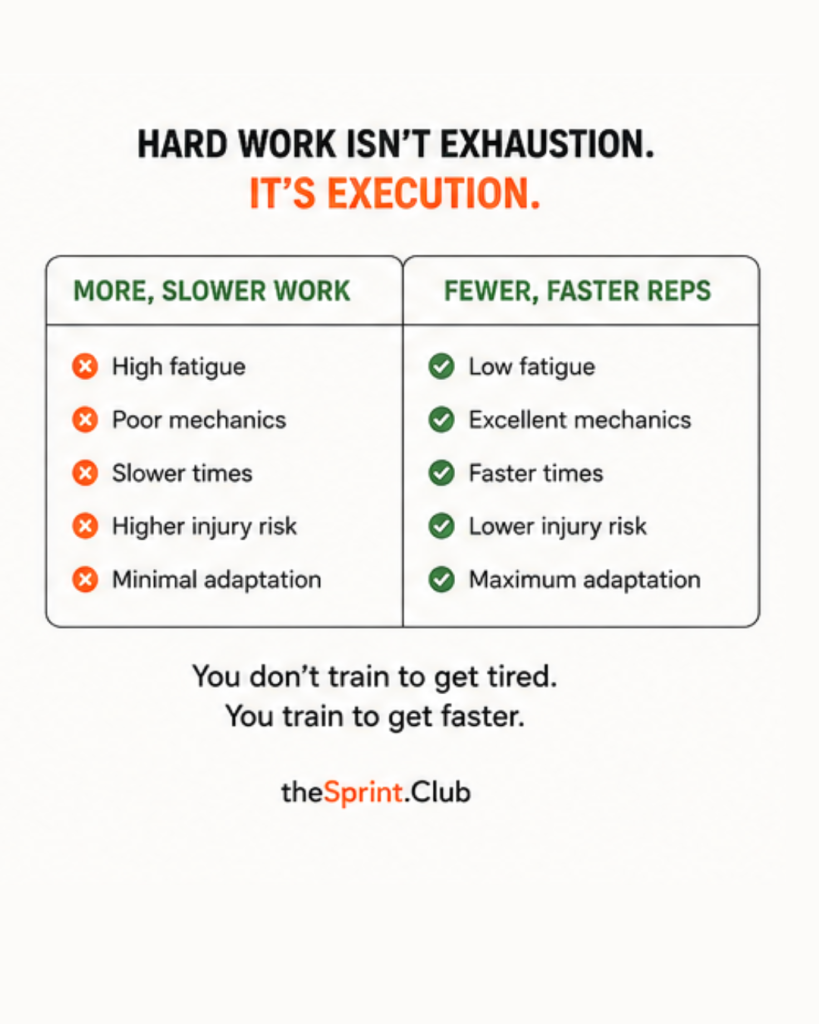
4. Redefine Hard Work
Many athletes believe the hardest session is the one that leaves them exhausted.
Speed training follows a different rule.
Hard work means:
- Executing every repetition with intent
- Maintaining excellent mechanics
- Producing maximal force
- Stopping before quality deteriorates
The goal is not to survive training.
The goal is to become faster.
The Sprint Club Speed Decision Framework
Before adding another sprint repetition, ask four questions:
| Question | Continue? |
|---|---|
| Are sprint times staying fast? | Yes |
| Are mechanics remaining clean? | Yes |
| Is posture consistent? | Yes |
| Is intent still maximal? | Yes |
If the answer becomes “no” for multiple questions, the highest-quality work is likely complete.

Common Coaching Mistakes
Avoid these common traps:
- Rewarding exhaustion instead of quality
- Using conditioning to solve every performance problem
- Ignoring objective timing data
- Assuming slower athletes need more volume
- Training fatigue instead of training speed
- Believing soreness equals adaptation
Great sprint programs prioritize quality before quantity.
TL;DR
The Volume Trap occurs when training load increases faster than recovery.
As fatigue accumulates, sprint mechanics deteriorate, neural output decreases, and athletes become slower despite working harder.
The best coaches focus on:
- Measuring performance objectively
- Ending sessions before quality declines
- Prioritizing recovery
- Training for maximal speed instead of maximal fatigue
Speed develops from high-quality repetitions performed in a recovered state, not from accumulating endless volume.
- Elementor #3659

- The Volume Trap: Why More Training Can Make You Slower

- Do Wicket Drills Improve Sprint Speed? What the Evidence Says

- How to Progress in Nordic Curls: A Step-by-Step Guide for Stronger Hamstrings

- The Body Is Faster Than the Mind: Why Overthinking Slows Athletic Performance

- The Science of Anthropometrics and Sprinting