Why Eccentric Strength Makes Athletes Faster
1. Shorter Ground Contact Times
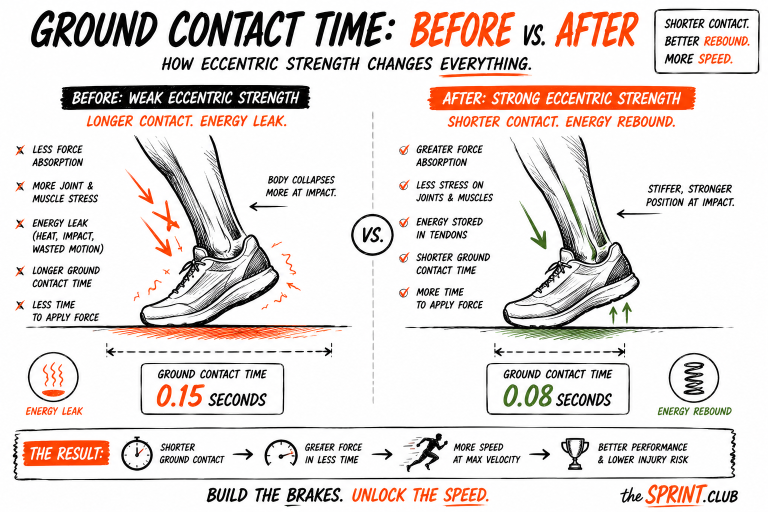
Fast sprinters do not stay on the ground longer to produce more force.
They produce force more quickly.
Better eccentric strength allows the body to become stiff immediately after touchdown.
Instead of collapsing into the ground, the athlete creates an immediate platform for force production.
This reduces contact time while increasing force application.
Think of the difference between bouncing a basketball on concrete versus soft sand.
The surface that deforms less returns more energy.
Your body works the same way.
2. Better Elastic Energy Storage
Muscles are only part of the equation.
Your tendons behave like biological springs.
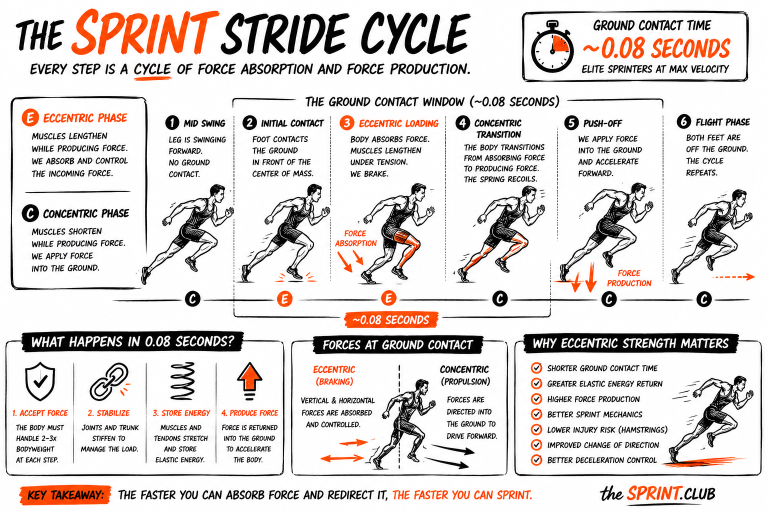
During the eccentric phase, these springs stretch.
If the body controls that loading efficiently, the tendons return much of that stored energy during push-off.
This is one reason elite sprinters often appear effortless.
They are not creating all of their speed with muscular effort alone.
They are recycling energy.
The better the eccentric loading, the greater the return.
3. Higher Force Production
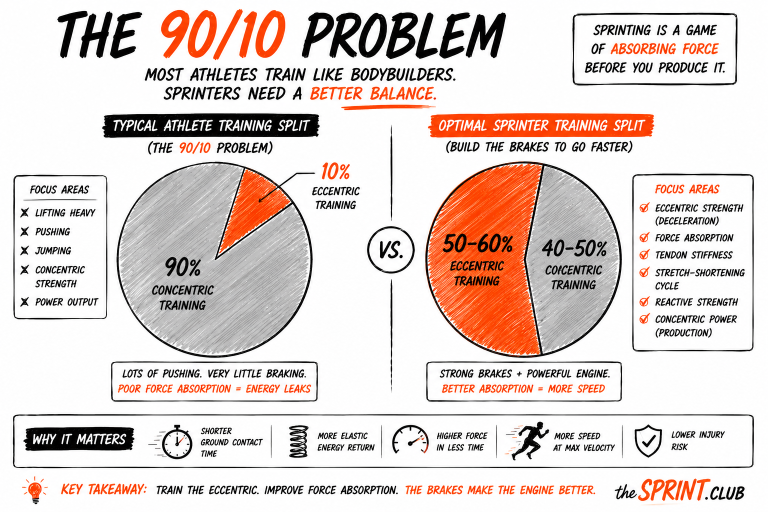
Many athletes think concentric strength creates speed.
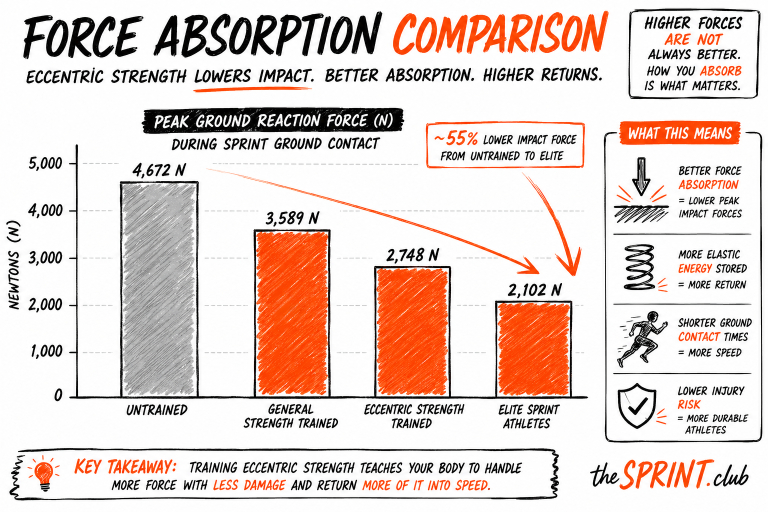
In reality, concentric force is often limited by how well the body handles the eccentric phase that came immediately before it.
A stronger landing produces a stronger rebound.
Poor eccentric control limits the entire stretch-shortening cycle.
4. Better Sprint Mechanics
Good mechanics are not simply coached.
They are supported by physical qualities.
Athletes lacking eccentric strength often show:
- Longer ground contacts
- Excessive knee collapse
- Pelvic instability
- Poor posture
- Reduced vertical stiffness
- Loss of front-side mechanics
Improving eccentric strength often improves these qualities without adding dozens of technical cues.
The body naturally adopts more efficient positions when it has the capacity to tolerate the required forces.