
Physics of Sprinting: Forces, Posture, and the Foot–Ankle Advantage
A coach-tested, research-backed guide to the physics of sprinting—forces, posture, foot–ankle stiffness, and drills for start, acceleration, MaxV, and speed.

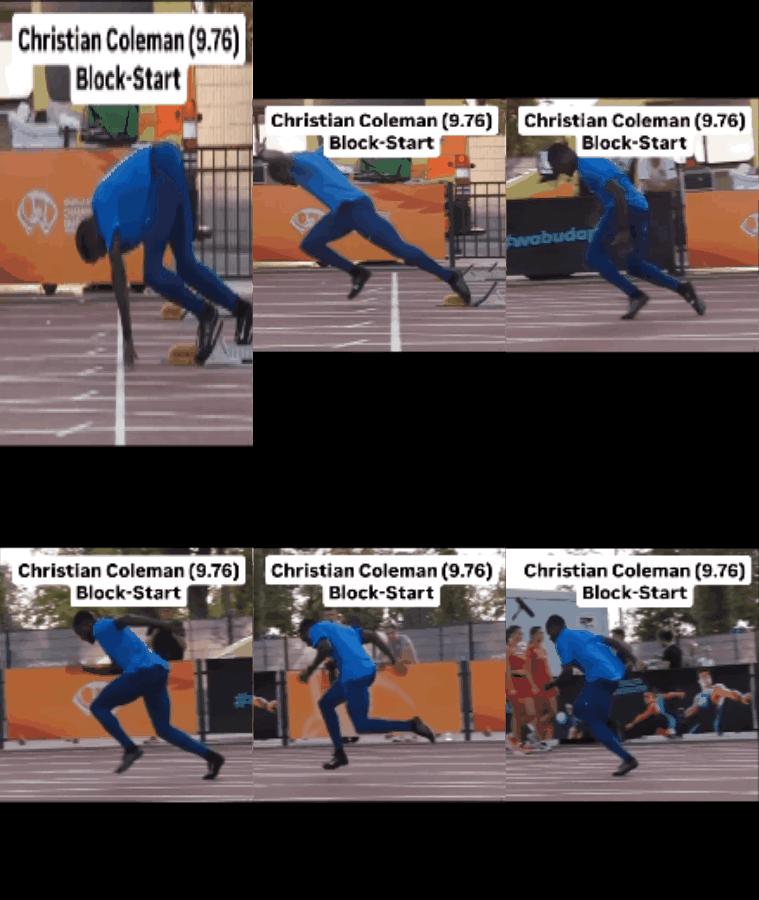
If you watch elite sprinters closely during their first two steps, one feature separates them from every intermediate athlete on the track:
their foot lands behind their center of mass (COM), not ahead of it.
This is the negative step.
It is not a stylistic preference. It is not “just good projection.” It is not something you cue by telling athletes to preset shin angles. It is the result of forces, physics, and neuromuscular organization that allows an athlete to apply almost pure propulsive impulse during the earliest steps of acceleration.
Most athletes will never create a negative step unless their training specifically develops the force, stiffness, timing, and retraction mechanics needed to produce it.
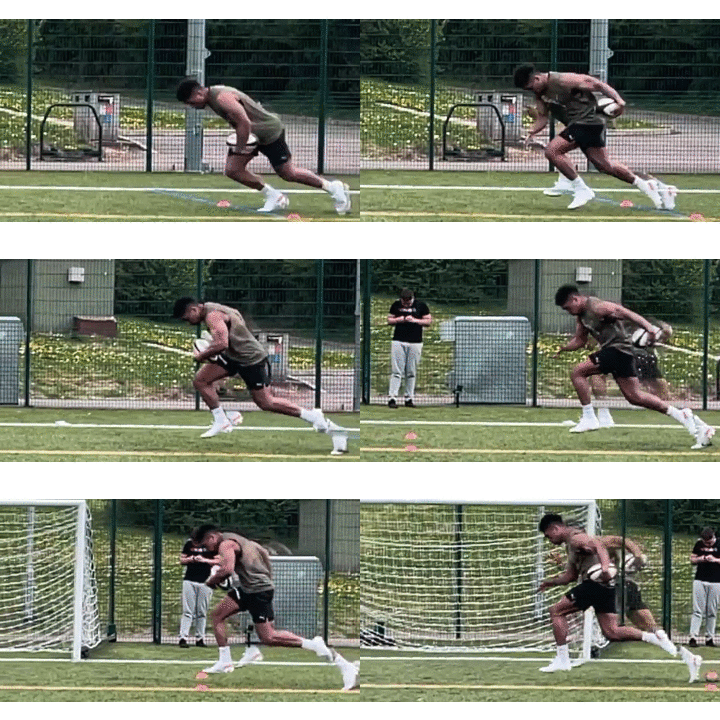
A negative step occurs when the foot lands slightly behind the athlete’s center of mass at touchdown during early acceleration.
It is defined by three characteristics:
This is fundamentally different from “overstriding,” where the foot lands ahead of the COM and creates a braking impulse before propulsion begins.
The negative step produces:
It is the mechanical signature of elite acceleration.
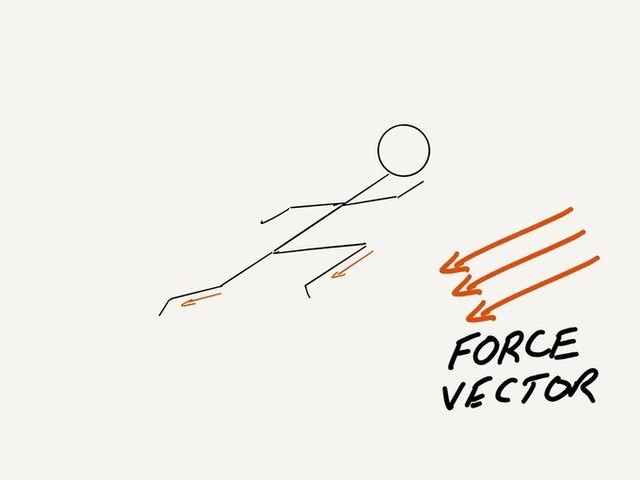
When the foot lands behind the COM, the ground reaction force (GRF) vector aligns more horizontally.
Research consistently shows:
The negative step optimizes that ratio.
If the foot lands ahead of the COM:
If the foot lands behind the COM:
To land behind the COM, the athlete must have:
This is why strong athletes with higher RFD (Rate of Force Development) more consistently achieve negative steps.
Morin & Samozino’s work reveals that elite accelerators differ not in magnitude of force alone, but in force orientation.
The negative step is the visible expression of optimized force orientation.
Coaches often tell athletes to “keep the shin positive,” but this reverses the causality.
The shin angle occurs because the thigh is aggressively punched downward and backward.
Trying to preset shin positions leads to:
Aggressive retraction solves all of these organically.
The best accelerators demonstrate:
This aligns with Hunter & Bezodis (2012) findings that elite sprinters maintain forward trunk lean without losing stiffness.
Elite sprinters achieve negative steps for 2–3 steps.
Good sprinters typically do it once, then revert to neutral or overstride patterns.
Why?
Because each step demands:
It is a skill that must be trained, not a technique that simply “happens.”
Negative foot speed refers to the downward velocity of the swing leg exceeding the horizontal velocity of the athlete.
In max velocity:
Negative foot speed in max velocity depends heavily on:
This is essentially the max-velocity analogue of the negative step.
Without explosive vertical force in a very short contact window, athletes cannot:
Most athletes place the foot instead of punching it.
Retracting aggressively is what:
Shin angle follows retraction.
Flight time follows RFD.
Projection follows impulse.
Negative step follows all three.
To consistently execute negative steps and negative foot speed, athletes need:
Explosive strength, not just max strength.
Supports fast thigh recovery and punch-down mechanics.
Controls ground contact and enables pre-tension.
Prevents collapse during forward projection.
Ability to push the COM forward, not upward.
Technical skill + neuromuscular timing.
A negative step is when the foot lands slightly behind the center of mass at touchdown, reducing braking forces and maximizing horizontal propulsion.
It removes the braking impulse, allowing the entire ground contact phase to contribute to propulsion.
Through retraction drills, projection work, sled pulls, assisted accelerations, and improved RFD.
Weak RFD, slow thigh retraction, improper shin cueing, and trunk collapse.

A coach-tested, research-backed guide to the physics of sprinting—forces, posture, foot–ankle stiffness, and drills for start, acceleration, MaxV, and speed.

Discover how modern biomechanics is reshaping sprint training, replacing outdated “base building” with max velocity and acceleration-first methods.

Unlock sprinting speed with proven mental training. Learn visualization, mindfulness, and sports psychology techniques to boost explosive performance.