loader image

Contents

Speed is not built by force alone, but by how well you control it before you use it.

Sprinting Is Absorb Then Reapply

Sprinting is not just about how much force you can produce. It is about how well you can absorb force, maintain position, and reapply it in a fraction of a second.

Most performance breakdowns happen here.

Athletes who struggle with speed often show:

  • Collapsing posture at top speed
  • Overstriding to “find” force
  • Excessive strain on hamstrings and tendons

These are not strength problems. They are coordination and absorption problems.


The shift is simple: absorption is the skill, reapplication is the output.

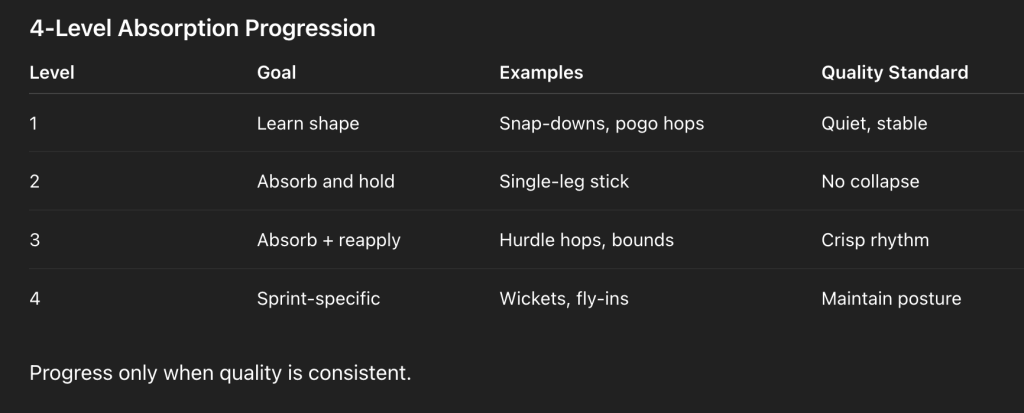
Level Goal Examples Quality Standard
1 Learn shape Snap-downs, pogo hops Quiet, stable
2 Absorb and hold Single-leg stick No collapse
3 Absorb + reapply Hurdle hops, bounds Crisp rhythm
4 Sprint-specific Wickets, fly-ins Maintain posture
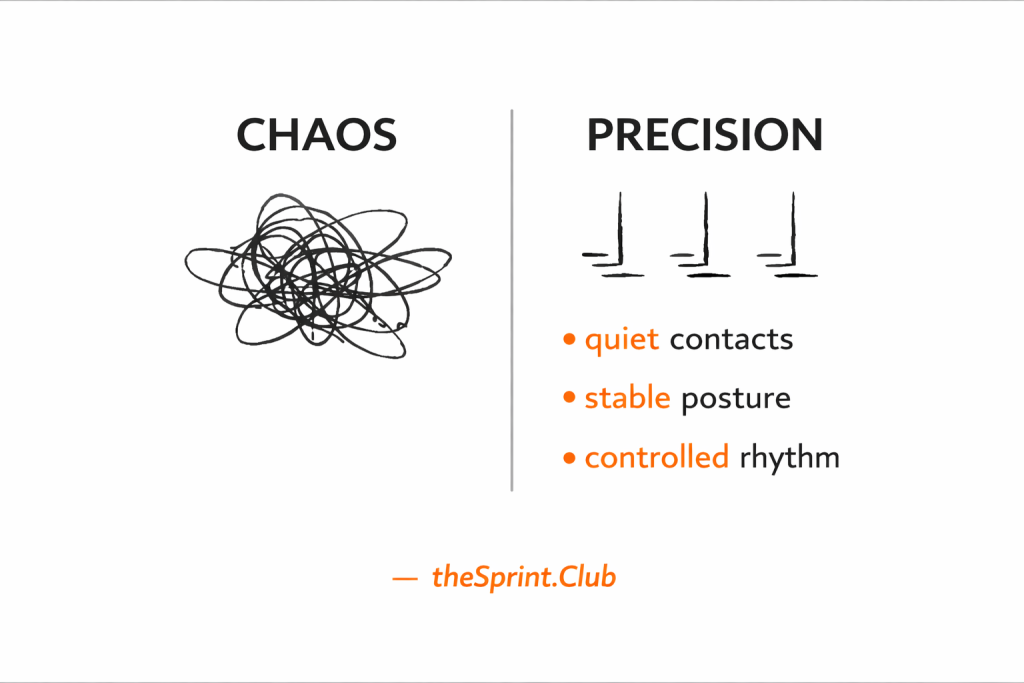
Left side shows a chaotic scribble under "CHAOS"; right side labeled "PRECISION" with three vertical marks and bullet points: quiet contacts, stable posture, controlled rhythm.

Why Most Athletes Train This Wrong

When athletes hear “absorb force,” they often default to more plyometrics, more contacts, and more fatigue.

That approach usually creates chaos, not adaptation.

Chaos looks like:

  • Loud, uncontrolled contacts
  • Knee valgus and unstable pelvis
  • Loss of rhythm
  • Degrading mechanics

Precision, not chaos, builds speed.

High-quality absorption requires:

  • Quiet ground contact
  • Stable pelvis and trunk
  • Proper foot strike under the center of mass
  • Consistent rhythm
 

If those break down, the training is reinforcing failure patterns.

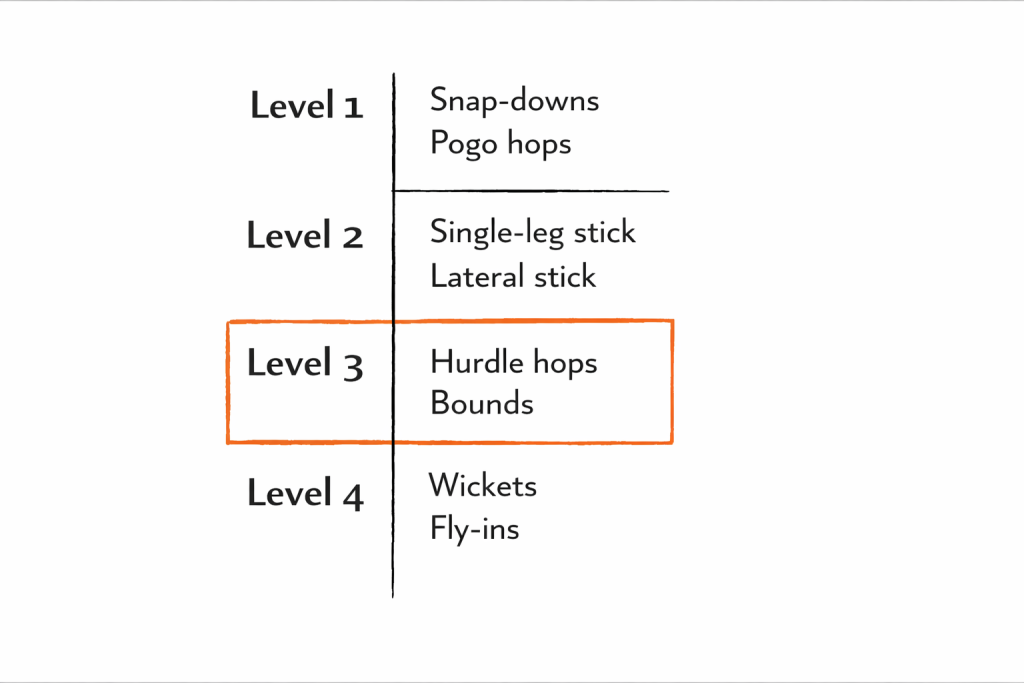
Three-column diagram listing plyometric levels: Level 1 snap-downs/pogo hops; Level 2 single-leg/lateral stick; Level 3 (orange) hurdle hops/bounds; Level 4 wickets/fly-ins.

The Hidden Limiter: Connective Tissue Readiness

Muscles adapt relatively quickly. Tendons and connective tissues do not.

When training intensity increases faster than tissue capacity, the system responds with:

  • Pain and irritation
  • Protective stiffness
  • Reduced output
  • Missed training time

This is why many athletes plateau or get injured when trying to “push speed.”

The goal is to build tissue tolerance progressively without compromising speed exposure.

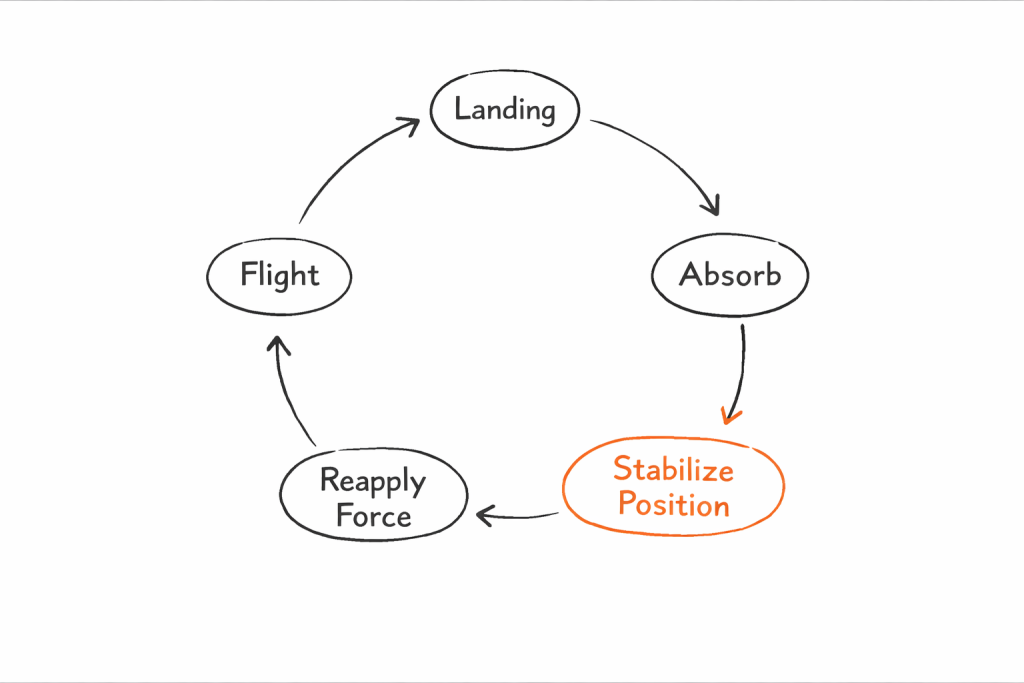
Circular flowchart with five ovals: Landing → Absorb → Stabilize Position (orange) → Reapply Force → Flight, connected by arrows.

The Absorb → Stabilize → Reapply Model

High-level sprinting requires a balance of two qualities:

  • Stiffness at ground contact
  • Relaxation during flight

These are not opposites. They are timed.

The sequence:

  1. Land
  2. Absorb force
  3. Stabilize position
  4. Reapply force

The critical step is stabilization.

If position is lost, force leaks. If force leaks, speed drops.

Training should emphasize maintaining shape under increasing demand.

Plyometric Progression for Real Speed TransferUse a structured progression to build absorption capacity.

Table titled "4-Level Absorption Progression" showing four levels: 1 Learn shape (examples: snap-downs, pogo hops; quality: Quiet, stable), 2 Absorb and hold (single-leg stick; No collapse), 3 Absorb + reapply (hurdle hops, bounds; Crisp rhythm), and 4 Sprint-specific (wickets, fly-ins; Maintain posture), with note "Progress only when quality is consistent."

Session Design: Minimum Effective Dose

It is maximum quality.

General Structure Warm-up with positional drills
One absorption-focused drill
One reapplication drill
Sprint exposure
Stop while quality is high

Volume Guidelines Beginner: 30–60 contacts Intermediate: 60–100 contacts Advanced: volume is secondary to output qualityIf sprint performance drops, reduce plyometric volume first.
Coaching Checklist for Real-Time Feedback

During training, focus on observable markers:

  • Contact sound: quiet vs loud
  • Pelvis: stable vs collapsing
  • Foot strike: under body vs reaching
  • Rhythm: smooth vs frantic

If quality declines, stop or regress the drill.

Do not train through breakdown.

Why Less Is More for Speed Development

Speed is highly sensitive to signal quality.

More reps do not guarantee better adaptation.

High-quality reps, full recovery, and strict standards produce better results than high-volume fatigue work.

The fastest athletes are not doing more. They are doing better.

TL;DR

Sprinting is not just about producing force. It is about absorbing force, maintaining position, and reapplying it efficiently. Train absorption as a skill using precise, high-quality plyometric progressions. Focus on connective tissue readiness, not just muscle strength. Reduce volume when quality drops. Speed improves when the system becomes more efficient, not more fatigued.

FAQs

What is force absorption in sprinting?

It is the ability to handle ground contact forces while maintaining posture and preparing for rapid reapplication.

Why are plyometrics important for sprinters?

They train the stretch-shortening cycle, improving stiffness, timing, and force transfer.

How many plyometric contacts should I do?

It depends on level, but quality matters more than total number.

What causes hamstring injuries in sprinting?

Often poor force absorption and timing, not just lack of strength.

Unlock
Speed

Speed is is unlocked by building the right qualities in the right order.
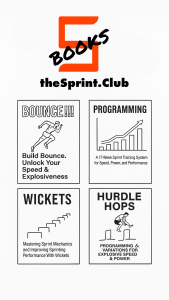
theSprint.Club logo with handwritten BOOKS above a grid of four book covers titled Bounce, Programming, Wickets, and Hurdle Hops, each showing sprint-training illustrations
Share the Post:

Related Posts

the sprint club thesprint.club logo

theSprint.Club

Join theSprint.Club

The Science, Art, & Love of Speed in your inbox.
Man standing against a pale gray background wearing a navy T-shirt printed with a large white silhouette of a running figure, hands in his pockets, head tilted and forearm tattoos visible.

Systems + Programs = Measurable Results

Train with confidence. Know exactly what to work on and why it matters

Tools & Calculators

Stop Guessing. Start Measuring.

Access free tools & calculators built to help coaches and athletes train smarter.

thesprintclub logo

theSprint.Club

Join the squad.
Explore the gear.
Get faster.
white thesprint.club sprinter tee tshirt