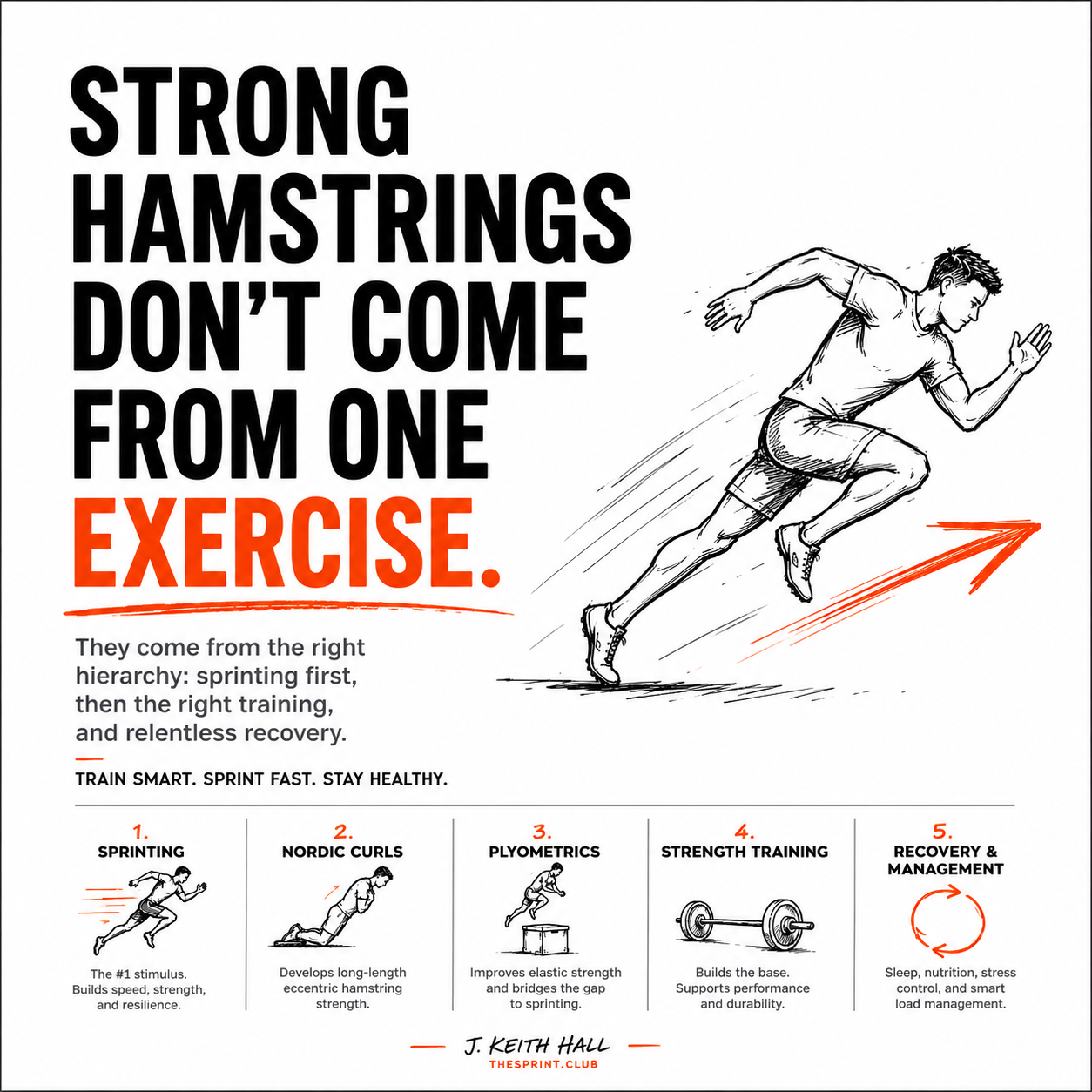
loader image

Why absorbing force efficiently is the missing link to faster sprint times, shorter ground contacts, and better performance.

Most athletes focus on producing force.

Elite sprinters also master absorbing it.

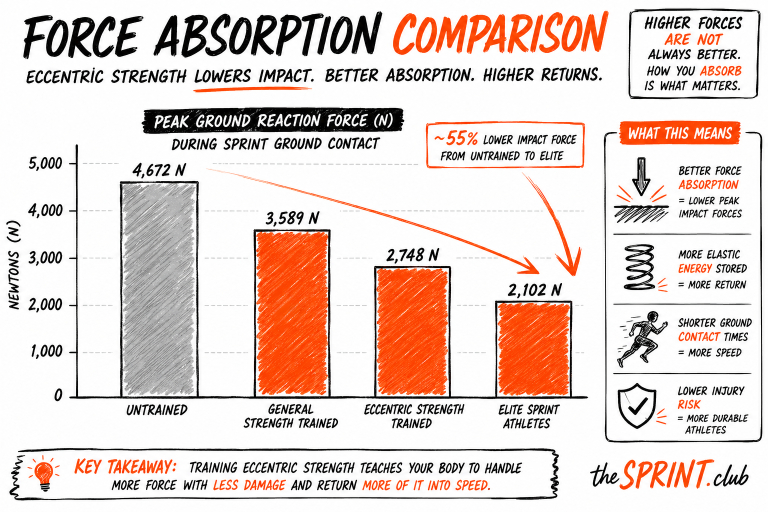
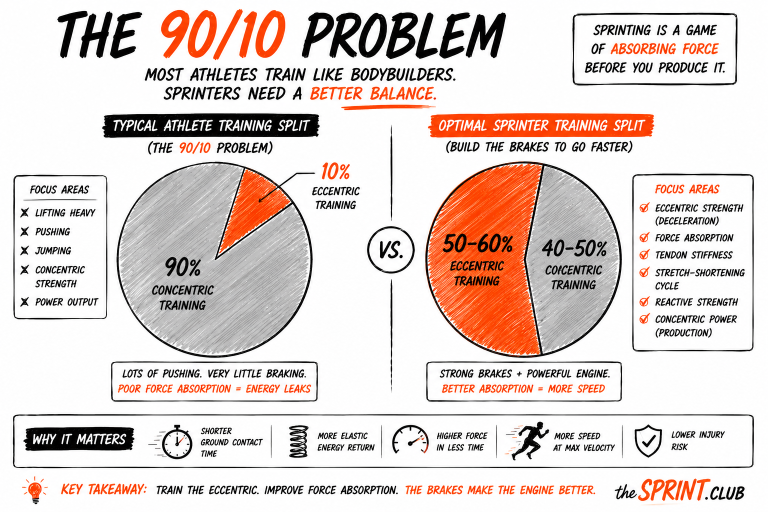
Every sprint step begins with a collision between the foot and the ground. Before you can produce force, your body must accept it. Athletes who develop exceptional eccentric strength can absorb larger forces, store more elastic energy, reduce ground contact time, and return more of that energy into forward propulsion.

The result is better acceleration, higher maximum velocity, improved change of direction, and fewer injuries.

Why the Fastest Athletes Have Great Brakes

When coaches talk about speed, the conversation usually revolves around explosive power.

Jump higher.

Push harder.

Lift heavier.

Produce more force.

Those qualities matter, but they only tell half the story.

Imagine driving a Formula 1 car with a massive engine but terrible brakes. Every corner becomes inefficient because the car cannot control speed before accelerating again.

The same principle applies to sprinting.

Your ability to absorb force determines how effectively you can produce force.

Elite sprinters understand that every step starts with control before it ends with propulsion.

That control comes from eccentric strength.


What Is Eccentric Strength?

Muscles produce force in three primary ways.


Muscle ActionWhat HappensSprint Example
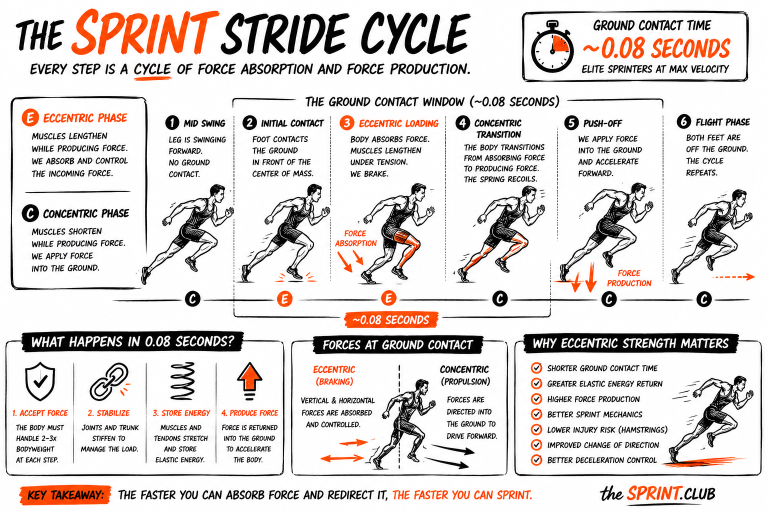
ConcentricMuscle shortens while producing forcePush off the ground
IsometricMuscle length stays the sameStabilizing posture
EccentricMuscle lengthens while producing forceAccepting force at touchdown

Eccentric contractions occur whenever the body controls an external load instead of simply resisting it.

Examples include:

  • Landing from a jump
  • Decelerating before changing direction
  • Lowering into a squat
  • Controlling the lower limb during sprinting
  • Preparing the body to rebound off the ground

Contrary to popular belief, eccentric muscles are not “absorbing” force passively.

They are actively producing enormous amounts of force while lengthening.

That distinction matters.

Sprinting Is a Series of Controlled Collisions

Every stride is essentially a high-speed collision with the ground.

During maximum velocity, elite sprinters may spend only about 0.08 seconds on the ground.

Within that incredibly small window, the body must complete four jobs.

  1. Accept the incoming force.
  2. Stabilize the joints.
  3. Store elastic energy.
  4. Produce force back into the ground.

There is no extra time.

Everything happens almost simultaneously.

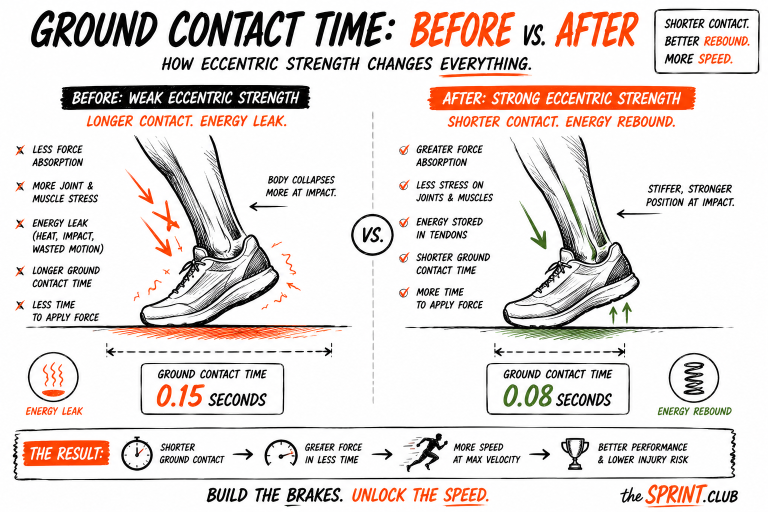
Athletes who cannot tolerate these forces leak energy through unnecessary movement.

Their hips drop.

Their trunk rotates.

Ground contact gets longer.

Stride frequency decreases.

Speed disappears.

Why Eccentric Strength Makes Athletes Faster

1. Shorter Ground Contact Times

Fast sprinters do not stay on the ground longer to produce more force.

They produce force more quickly.

Better eccentric strength allows the body to become stiff immediately after touchdown.

Instead of collapsing into the ground, the athlete creates an immediate platform for force production.

This reduces contact time while increasing force application.

Think of the difference between bouncing a basketball on concrete versus soft sand.

The surface that deforms less returns more energy.

Your body works the same way.


2. Better Elastic Energy Storage

Muscles are only part of the equation.

Your tendons behave like biological springs.

During the eccentric phase, these springs stretch.

If the body controls that loading efficiently, the tendons return much of that stored energy during push-off.

This is one reason elite sprinters often appear effortless.

They are not creating all of their speed with muscular effort alone.

They are recycling energy.

The better the eccentric loading, the greater the return.


3. Higher Force Production

Many athletes think concentric strength creates speed.

In reality, concentric force is often limited by how well the body handles the eccentric phase that came immediately before it.

A stronger landing produces a stronger rebound.

Poor eccentric control limits the entire stretch-shortening cycle.


4. Better Sprint Mechanics

Good mechanics are not simply coached.

They are supported by physical qualities.

Athletes lacking eccentric strength often show:

  • Longer ground contacts
  • Excessive knee collapse
  • Pelvic instability
  • Poor posture
  • Reduced vertical stiffness
  • Loss of front-side mechanics

Improving eccentric strength often improves these qualities without adding dozens of technical cues.

The body naturally adopts more efficient positions when it has the capacity to tolerate the required forces.


 

The Hidden Role of Eccentric Strength in Maximum Velocity

Maximum velocity places enormous demands on the hamstrings.

During late swing, the hamstrings rapidly lengthen while simultaneously attempting to slow the forward-moving lower limb.

Milliseconds later, the foot strikes the ground.

The hamstrings immediately transition into stabilizing the hip and knee before helping reverse the movement.

This requires exceptional eccentric strength.

Without it, athletes often struggle to tolerate the loads experienced at high speeds.


Injury Prevention Starts Before the Foot Hits the Ground

Hamstring strains remain one of the most common injuries in sprinting.

While no exercise guarantees injury prevention, improving eccentric hamstring capacity increases an athlete’s ability to tolerate the high forces experienced during sprinting.

Stronger eccentric muscles also help:

  • Improve deceleration control
  • Reduce excessive joint motion
  • Increase tissue capacity
  • Improve confidence at maximal speeds

Rather than avoiding high-speed sprinting, athletes should gradually build the physical qualities necessary to tolerate it.


Eccentric Strength Beyond Sprinting

These benefits extend well beyond track.

Football players must decelerate before cutting.

Basketball players repeatedly land and explode.

Soccer players brake before changing direction.

Baseball players accelerate out of the batter’s box before stopping suddenly.

Nearly every field and court sport rewards athletes who can rapidly absorb and redirect force.


Common Coaching Mistakes

Mistake 1: Only Training the Push

Many programs prioritize:

  • Heavy squats
  • Olympic lifts
  • Jumps
  • Sled pushes

These exercises develop valuable concentric qualities.

However, they often underemphasize the braking abilities needed to support high-speed movement.


Mistake 2: Progressing Too Quickly

Eccentric training produces higher muscle tension than traditional lifting.

Adding excessive volume too early often creates soreness that interferes with sprint quality.

Progress gradually.


Mistake 3: Separating Strength From Speed

The goal is not to become good at lowering weights.

The goal is to improve sprint performance.

Strength training should support sprint mechanics rather than replace sprinting itself.


Best Eccentric Exercises for Sprinters

Nordic Hamstring Curl

Perhaps the best-known eccentric hamstring exercise.

Focus on controlling the lowering phase as long as possible.


Tempo Romanian Deadlifts

Use a three to five second lowering phase.

Maintain posture throughout.


Split Squats With Slow Eccentrics

Excellent for unilateral control while developing hip stability.


Depth Drops

Step from a box.

Land quietly.

Hold the position.

Master force acceptance before progressing to reactive jumps.


Flywheel Training

Flywheel devices overload the eccentric phase naturally by requiring athletes to decelerate the returning resistance.

This provides an excellent bridge between traditional lifting and explosive sport movement.

Speed science that makes you faster.

Weekly sprint science, training insights, and speed culture. Free.
white thesprint.club sprinter tee tshirt

Related Posts

The Volume Trap: Why More Training Can Make You Slower

Working harder doesn’t always make you faster. In sprinting, excessive training volume can quietly reduce speed by increasing fatigue, disrupting recovery, and degrading mechanics. This “Volume Trap” causes longer ground contact times, lower force production, and slower sprint performances, even when athletes are putting in maximum effort. Learn why quality beats quantity, how overtraining affects the nervous system, and the practical strategies elite coaches use to keep athletes fresh, explosive, and consistently improving. Discover how objective testing, the sprint drop-off method, and smarter recovery practices can help you build speed without burning out.

Read More

How to Progress in Nordic Curls: A Step-by-Step Guide for Stronger Hamstrings

Learn how to progress in Nordic curls with a proven step-by-step progression that builds eccentric hamstring strength, improves sprint performance, and reduces injury risk. Discover the best Nordic curl variations for beginners through advanced athletes, common technique mistakes to avoid, and how to integrate Nordics into a sprint training program without compromising speed.

Read More
the sprint club thesprint.club logo

theSprint.Club

Join theSprint.Club

The Science, Art, & Love of Speed in your inbox.
Man standing against a pale gray background wearing a navy T-shirt printed with a large white silhouette of a running figure, hands in his pockets, head tilted and forearm tattoos visible.

Systems + Programs = Measurable Results

Train with confidence. Know exactly what to work on and why it matters

Tools & Calculators

Stop Guessing. Start Measuring.

Access free tools & calculators built to help coaches and athletes train smarter.

thesprintclub logo

theSprint.Club

Join the squad.
Explore the gear.
Get faster.
white thesprint.club sprinter tee tshirt