

Football Combine Score Simulator
Enter your 40-yard dash, vertical jump, and pro shuttle to get a simple football performance profile.
Your combine profile will appear here.
How the score is calculated
This simulator uses a normalized scoring approach based on typical performance ranges seen in football testing environments. Each metric is scaled from 0–100 using:
- Faster sprint times → higher score
- Higher jump height → higher score
- Faster shuttle times → higher score
The final score is a weighted combination:
- Speed (40-yard dash): 45%
- Explosion (vertical jump): 30%
- Change of direction (shuttle): 25%
These weights reflect the relative importance of acceleration and speed in many football positions, while still accounting for power and agility.
How to interpret your results
Speed score (40-yard dash)
What it represents:
- Acceleration mechanics
- Force production in early sprint phases
- Neuromuscular coordination at high velocity
Scientific context:
- Sprint speed is strongly influenced by horizontal force production and rate of force development (Morin et al., 2011).
- Faster sprint times are associated with improved mechanical efficiency and force application.
Explosion score (vertical jump)
What it represents:
- Lower-body power
- Elastic energy utilization
- Rate of force development
Scientific context:
- Vertical jump performance correlates with peak power output and neuromuscular efficiency (Cormie et al., 2011).
- It is widely used as a proxy for explosive athletic ability in team sports.
Change of direction score (pro shuttle)
What it represents:
- Braking strength
- Re-acceleration ability
- Movement efficiency under directional change
Scientific context:
- Change of direction performance depends heavily on eccentric strength and braking force capacity (Dos’Santos et al., 2018).
- Athletes must rapidly decelerate and reapply force in new directions, which differs from linear sprinting demands.
Why these three tests matter together
No single test captures football performance.
- The 40-yard dash emphasizes linear speed
- The vertical jump emphasizes power and explosiveness
- The shuttle emphasizes deceleration and re-acceleration
Research shows that multidimensional testing better reflects sport performance than isolated metrics (Sheppard & Young, 2006).
Combining these metrics into a single profile helps identify imbalances that may limit on-field performance.
Understanding your “primary limiter”
The tool identifies your lowest domain score and labels it as your current limiter.
This reflects a key training principle:
- Performance is often constrained by the weakest link in the system
Examples:
- Strong vertical + slow 40 → speed limiter
- Fast 40 + poor shuttle → braking/agility limiter
- Good speed + low vertical → power limiter
Important limitations
This score is a simplified model and does not replicate official combine grading systems.
- It does not account for:
- Position-specific demands
- Body mass
- Technique quality
- Game intelligence or skill
Use it as a training feedback tool, not a prediction of recruitment outcomes.
Practical training takeaway
- If speed is lowest → prioritize sprint mechanics and max velocity exposure
- If power is lowest → prioritize jumping, strength, and elastic work
- If agility is lowest → prioritize deceleration, cutting, and re-acceleration
Improving the lowest-quality output often produces the largest overall performance gains.
References (scientific support)
- Morin, J. B., et al. (2011). Mechanical determinants of sprint acceleration performance.
- Cormie, P., McGuigan, M. R., & Newton, R. U. (2011). Developing maximal neuromuscular power.
- Dos’Santos, T., et al. (2018). Biomechanical determinants of change of direction performance.
- Sheppard, J. M., & Young, W. B. (2006). Agility literature review: classifications, training, and testing.
- Sprint Progress Tracker: Measure and Improve Your Speed
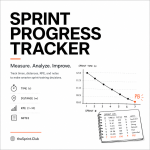 Use a sprint progress tracker to record times, monitor fatigue, identify trends, and make smarter training decisions that improve sprint performance.
 - Why absorbing force efficiently is the missing link to faster sprint times, shorter ground contacts, and better performance.
 Most athletes focus on producing force. Elite sprinters also master absorbing it. Every sprint step begins with a collision between the foot and the ground. Before you can produce force, your body must accept it. Athletes who develop exceptional eccentric strength can absorb larger forces, store more elastic energy, reduce ground contact time, and return… Read more: Why absorbing force efficiently is the missing link to faster sprint times, shorter ground contacts, and better performance.
 - The Volume Trap: Why More Training Can Make You Slower
 Working harder doesn’t always make you faster. In sprinting, excessive training volume can quietly reduce speed by increasing fatigue, disrupting recovery, and degrading mechanics. This “Volume Trap” causes longer ground contact times, lower force production, and slower sprint performances, even when athletes are putting in maximum effort. Learn why quality beats quantity, how overtraining affects the nervous system, and the practical strategies elite coaches use to keep athletes fresh, explosive, and consistently improving. Discover how objective testing, the sprint drop-off method, and smarter recovery practices can help you build speed without burning out.
 - Do Wicket Drills Improve Sprint Speed? What the Evidence Says
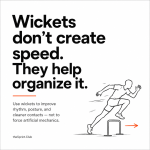 Wicket drills can improve sprint rhythm, posture, foot strike timing, and upright mechanics, but they do not create speed on their own. Learn when wickets help, why they sometimes fail, and how to use them effectively in a complete sprint training program.
 - How to Progress in Nordic Curls: A Step-by-Step Guide for Stronger Hamstrings
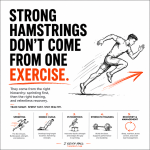 Learn how to progress in Nordic curls with a proven step-by-step progression that builds eccentric hamstring strength, improves sprint performance, and reduces injury risk. Discover the best Nordic curl variations for beginners through advanced athletes, common technique mistakes to avoid, and how to integrate Nordics into a sprint training program without compromising speed.

