
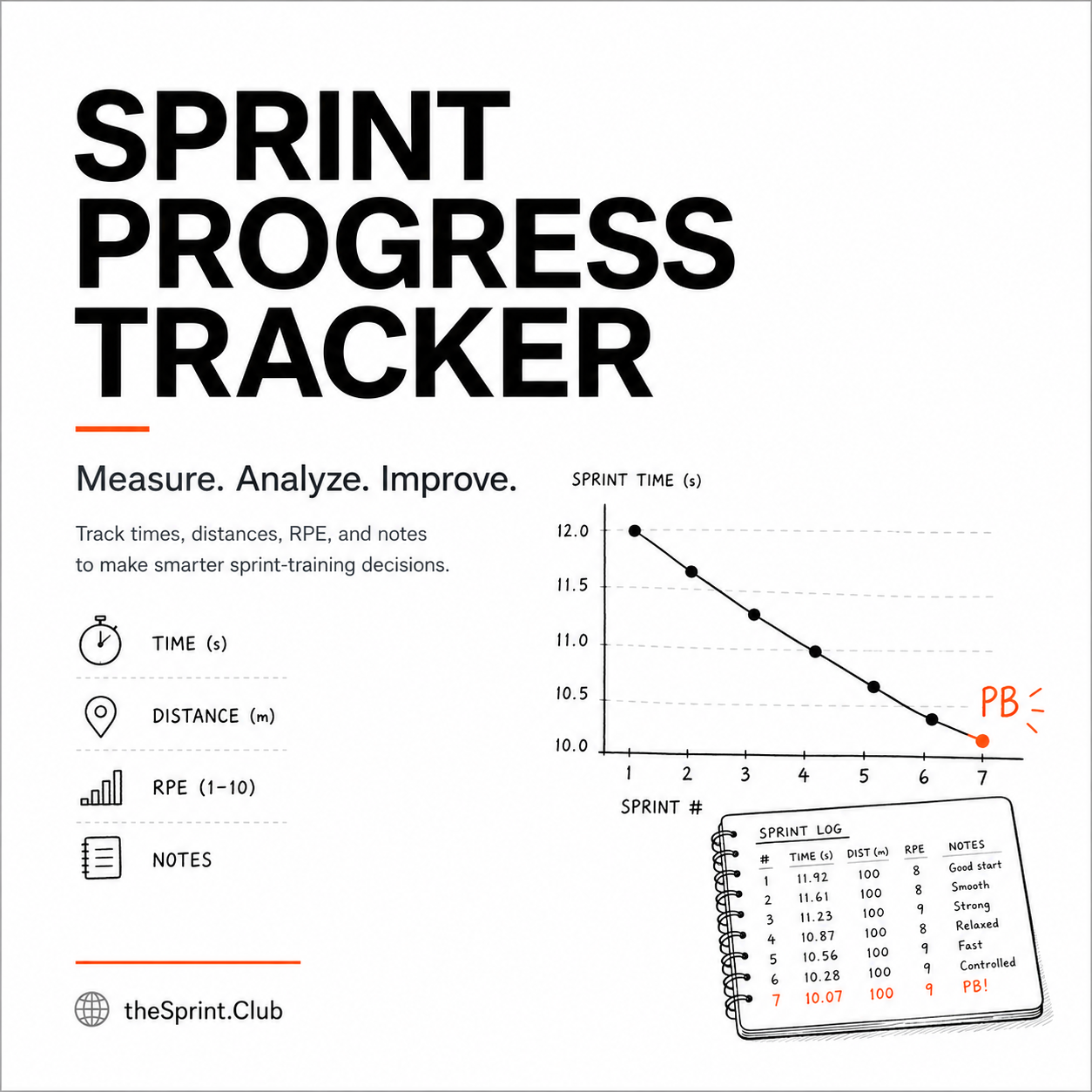
Sprint Progress Tracker: Measure and Improve Your Speed
Use a sprint progress tracker to record times, monitor fatigue, identify trends, and make smarter training decisions that improve sprint performance.

Sprint performance improves through adaptation, not effort. Adaptation only occurs when training inputs are specific and measurable. Time & metrics tellsyou what happened.
Elite sprinting is constrained by:
Metrics allow coaches and athletes to identify bottlenecks, adjust training intent, and avoid guessing.

Why it matters:
Early acceleration is dominated by horizontal force production. Short-distance splits reflect how effectively an athlete projects force forward.
The first 10 meters of a sprint represent the foundation upon which all subsequent acceleration is built. This phase is characterized by the most dramatic velocity changes of the entire sprint, with athletes typically achieving 50-60% of their maximum velocity by the 10-meter mark.
During the first 10 meters, velocity increases approximately 1-1.5 m/s per second in elite sprinters. This rate of change is significantly higher than any other phase of the sprint. The athlete transitions from a static start (0 m/s) to roughly 5-7 m/s, depending on their ability level.
The early acceleration phase establishes three critical mechanical patterns:
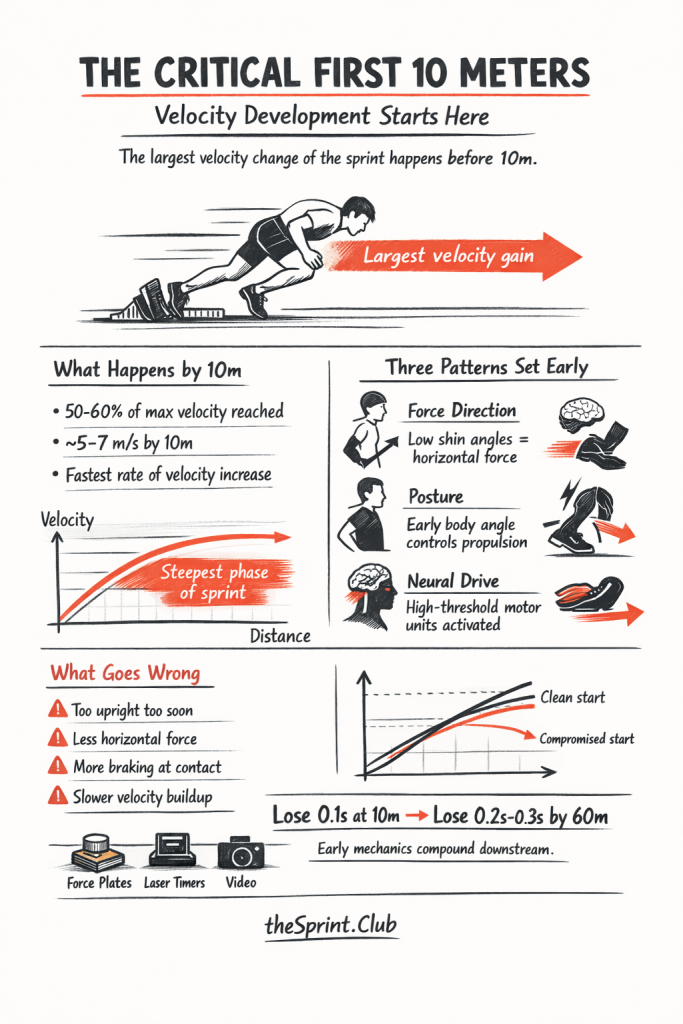
Poor execution in the first 10 meters creates cascading mechanical problems:
The first 10 meters doesn’t just contribute to total sprint time—it determines the mechanical efficiency of the entire acceleration phase. Athletes who optimize this phase through proper:
…establish conditions that allow them to continue accelerating effectively through 30-40 meters, rather than reaching a premature plateau in velocity development.
In practical terms: losing 0.1 seconds in the first 10m due to poor mechanics often results in losing 0.2-0.3 seconds by 60m, because the mechanical foundation for continued acceleration was compromised early.
How to measure:
Poor execution in the first 10 meters creates cascading mechanical problems:
The first 10 meters doesn’t just contribute to total sprint time—it determines the mechanical efficiency of the entire acceleration phase. Athletes who optimize this phase through proper:
…establish conditions that allow them to continue accelerating effectively through 30-40 meters, rather than reaching a premature plateau in velocity development.
In practical terms: losing 0.1 seconds in the first 10m due to poor mechanics often results in losing 0.2-0.3 seconds by 60m, because the mechanical foundation for continued acceleration was compromised early.
How to measure:
Improving early acceleration often requires reducing braking, not pushing harder.
Why it matters:
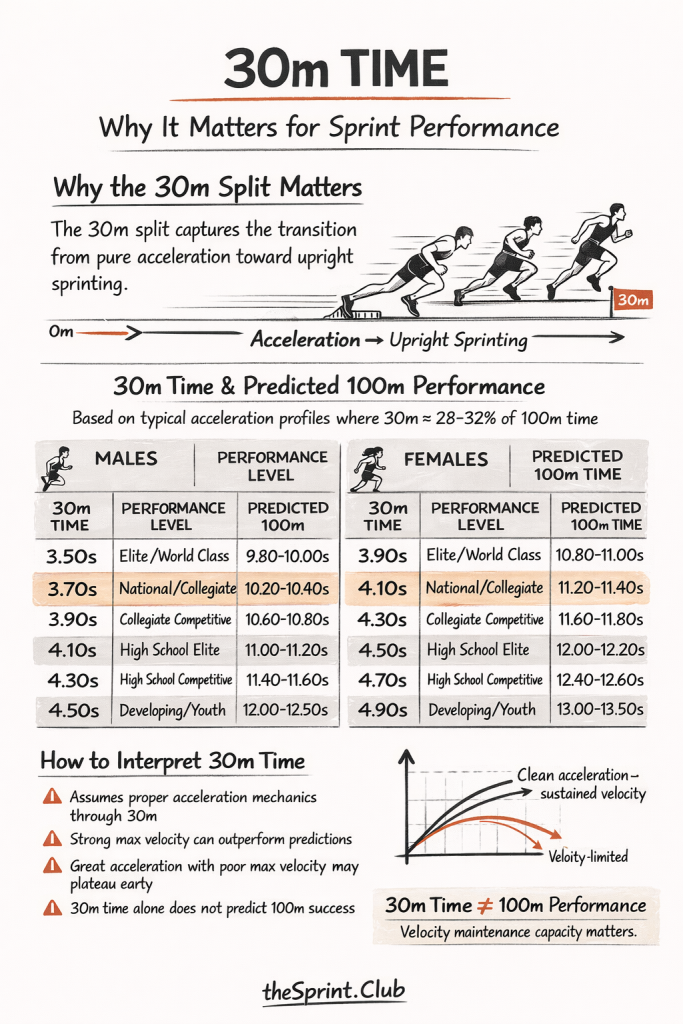
This split captures the transition from pure acceleration toward upright sprinting mechanics.
The table shows appropriate 30m times correlated with predicted 100m performance for male and female sprinters. These relationships are based on typical acceleration profiles where the 30m split represents approximately 28-32% of total 100m time.
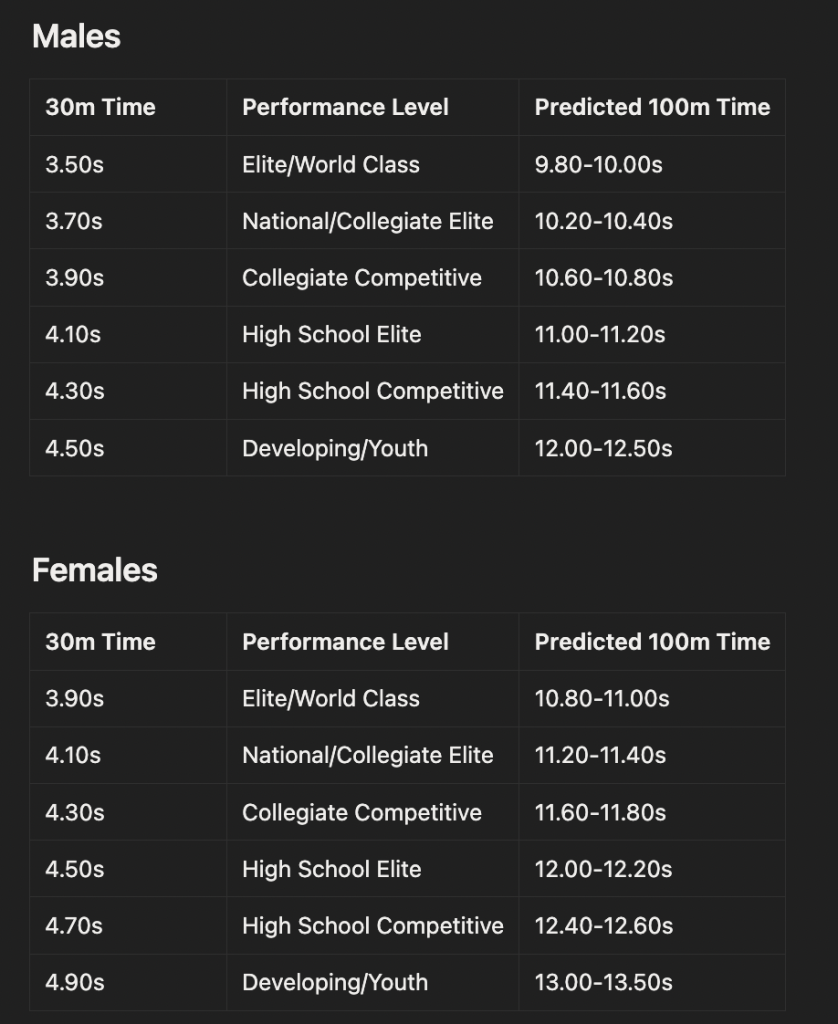
Key Interpretation Notes:
How to measure:
Research context:
Acceleration mechanics and max velocity mechanics are not the same skill set (Morin et al., 2012).
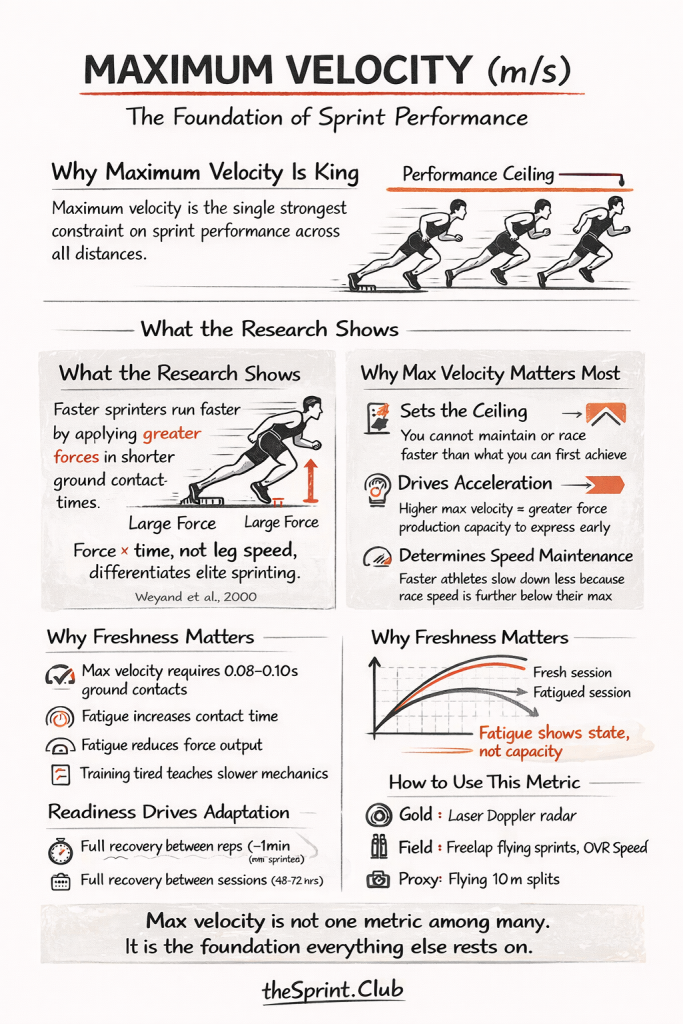
Why it matters:
Max velocity strongly correlates with sprint performance across all distances (Weyand et al., 2000).
Maximum velocity is not just another metric—it is the single most important constraint on sprint performance across all distances. Understanding why requires examining what actually determines speed at the highest level.
Maximum velocity represents the upper boundary of an athlete’s speed capability. Every other phase of sprinting—acceleration, speed endurance, race execution—is constrained by this ceiling. An athlete cannot maintain what they cannot first achieve.
1. It sets the performance ceiling
An athlete’s maximum velocity determines their potential across all sprint distances. A sprinter who can only reach 10 m/s will never run competitive times at any distance, regardless of how well they accelerate or how efficiently they maintain speed. Maximum velocity is the constraint that must be addressed first.
2. It drives acceleration capacity
While acceleration and maximum velocity require different technical skills (Morin et al., 2012), maximum velocity capacity provides the force production foundation that acceleration depends upon. Athletes with higher maximum velocities typically possess greater force production capabilities that transfer to acceleration when properly trained.
3. It determines speed maintenance
Speed endurance is not trained by running tired—it emerges from possessing speed capacity that exceeds race demands. An athlete with a maximum velocity of 11 m/s will maintain race speeds more easily than an athlete whose maximum is 10 m/s running the same race pace. The solution to “slowing down less” begins with “being faster.”
Maximum velocity development requires the nervous system to coordinate the highest levels of force production at the shortest ground contact times. This is a neurological task that demands optimal readiness.
Training quality over quantity
Maximum velocity work cannot be trained in a fatigued state. The ground contact times at max velocity (typically 0.08-0.10 seconds in elite sprinters) provide an extraordinarily narrow window to apply force. When athletes are fatigued, contact times lengthen, force production decreases, and the movement pattern being trained no longer represents maximum velocity mechanics.
Training max velocity while fatigued teaches the athlete to sprint slower with degraded mechanics. This is adaptation in the wrong direction.
Measuring maximum velocity when athletes are not fresh produces data that reflects fatigue state, not capability. A speed drop-off greater than 3% indicates neuromuscular fatigue (as noted in metric #10). Measuring in this state tells you about recovery status, not about whether maximum velocity capacity is improving.
Regular measurement when fresh allows you to track actual adaptation. Is the training improving the athlete’s speed ceiling, or are you simply monitoring their ability to perform while tired?
Readiness drives adaptation
The nervous system adapts to the demands placed on it. To improve maximum velocity, athletes must regularly expose their nervous system to maximum velocity demands under conditions where those demands can actually be met. This requires:
Maximum velocity should be trained and measured at least once per week during relevant training phases. This frequency is sufficient to drive adaptation while allowing full recovery. Sessions should occur when athletes are neurologically fresh—typically early in the week, early in the session, and following adequate rest days.
Metrics should be tracked consistently under standardized conditions: same warm-up, same measurement protocol, same environmental conditions when possible. The goal is to identify trends in capability, not day-to-day fluctuations in performance state.
The bottom line: Maximum velocity is not one metric among many—it is the foundation upon which all other sprint qualities are built. Train it fresh. Measure it consistently. Improve it systematically. Everything else follows.
How to measure:
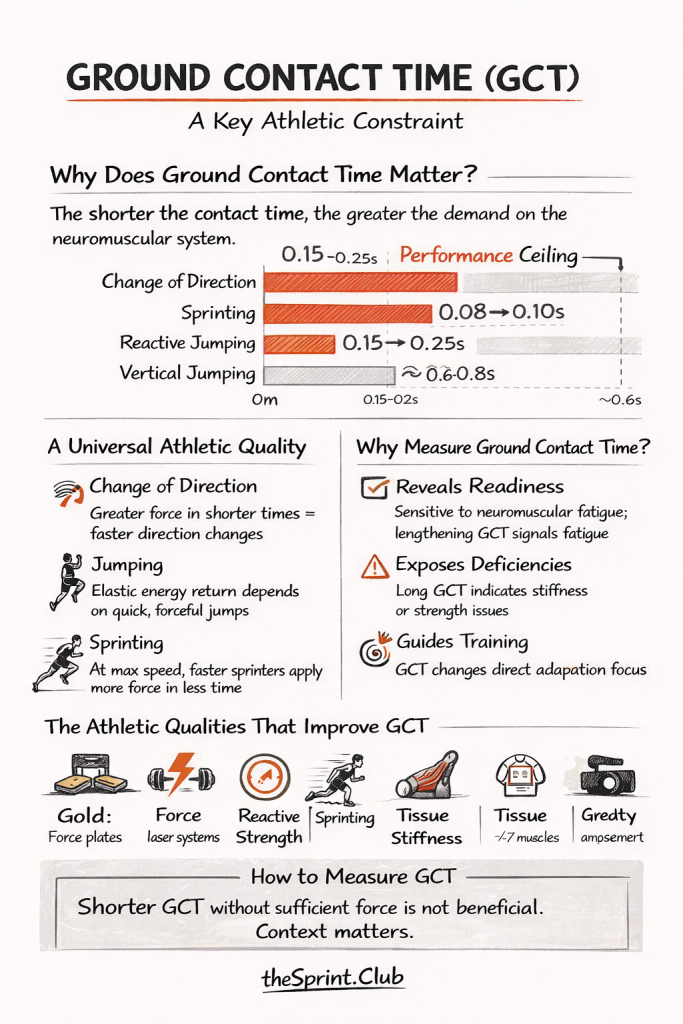
Why it matters:
At max velocity, faster sprinters apply force in less time, not more (Weyand et al., 2000).
How to measure:
Ground contact time is not just a sprinting metric—it is a fundamental constraint on explosive athletic performance across all sporting movements. Understanding why requires examining what happens during the brief moments when the foot is in contact with the ground.
All explosive athletic actions – sprinting, jumping, cutting, and change of direction – depend on the athlete’s ability to apply force to the ground in extremely short time windows. The ground contact time at maximum velocity in elite sprinters is approximately 0.08-0.10 seconds. In a countermovement jump, ground contact time is typically 0.6-0.8 seconds. In a rapid change of direction, contact times can be as brief as 0.15-0.25 seconds.
The shorter the contact time, the greater the demand on the neuromuscular system to produce force rapidly. This rate of force development (RFD) is what separates elite athletes from competitive ones across virtually all sports.
Change of direction: Athletes who can apply greater force in shorter ground contact times can decelerate and re-accelerate more efficiently during cutting movements. A soccer player or basketball player who contacts the ground for 0.20 seconds during a cut will change direction faster than one who requires 0.30 seconds—assuming equal force production. The ability to minimize ground contact time while maintaining force output is what creates separation speed in team sports.
Jumping: Vertical jump performance correlates strongly with ground contact time during reactive jumps (drop jumps, repeated bounds). Athletes who can produce high forces with shorter ground contact times demonstrate superior elastic energy storage and utilization—qualities that transfer directly to jumping ability. This is why reactive strength index (RSI), which accounts for both jump height and ground contact time, is a more useful metric than jump height alone.
Sprinting: As previously noted, faster sprinters apply greater forces in shorter contact times. The relationship is not linear—small improvements in ground contact time at maximum velocity can yield significant improvements in sprint speed, provided force production capacity is maintained or improved.
1. It reveals neuromuscular readiness
Ground contact time is highly sensitive to neuromuscular fatigue. When athletes are fatigued, contact times lengthen before force output decreases. This makes GCT a valuable early indicator of recovery status. Monitoring GCT allows coaches to identify when athletes are ready for high-intensity work and when they need additional recovery.
2. It exposes mechanical deficiencies
Excessive ground contact times often indicate technical or physical limitations: insufficient stiffness, poor posture, inadequate force production capacity, or compensatory movement patterns. Identifying these deficiencies allows for targeted intervention. An athlete with long ground contact times despite adequate strength may have an elastic quality deficit. An athlete with short contact times but low force output may need strength development.
3. It guides training emphasis
Ground contact time provides objective feedback on whether training is producing the desired adaptations. If an athlete’s GCT improves while force production is maintained, the training is working. If GCT shortens but force decreases, the athlete is becoming “bouncy” without gaining functional speed. If GCT lengthens over time, the athlete may be accumulating fatigue or losing elastic qualities.
4. It transfers across athletic qualities
Improvements in ground contact time developed through sprint training often transfer to jumping and change of direction performance, and vice versa. The neuromuscular adaptations that allow shorter contact times—improved rate of force development, enhanced elastic energy utilization, better motor unit recruitment—are not movement-specific. An athlete who improves GCT in sprinting will often see concurrent improvements in reactive jump performance without directly training jumps.
Context matters.
Improving ground contact time requires developing multiple physical qualities in combination:
The bottom line: Ground contact time is a window into the athlete’s neuromuscular system. It reveals readiness, exposes limitations, and provides objective feedback on training adaptations. For any athlete in any sport requiring explosive movement (which is virtually all sports) measuring and improving the qualities that reduce ground contact time is not optional. It is foundational.
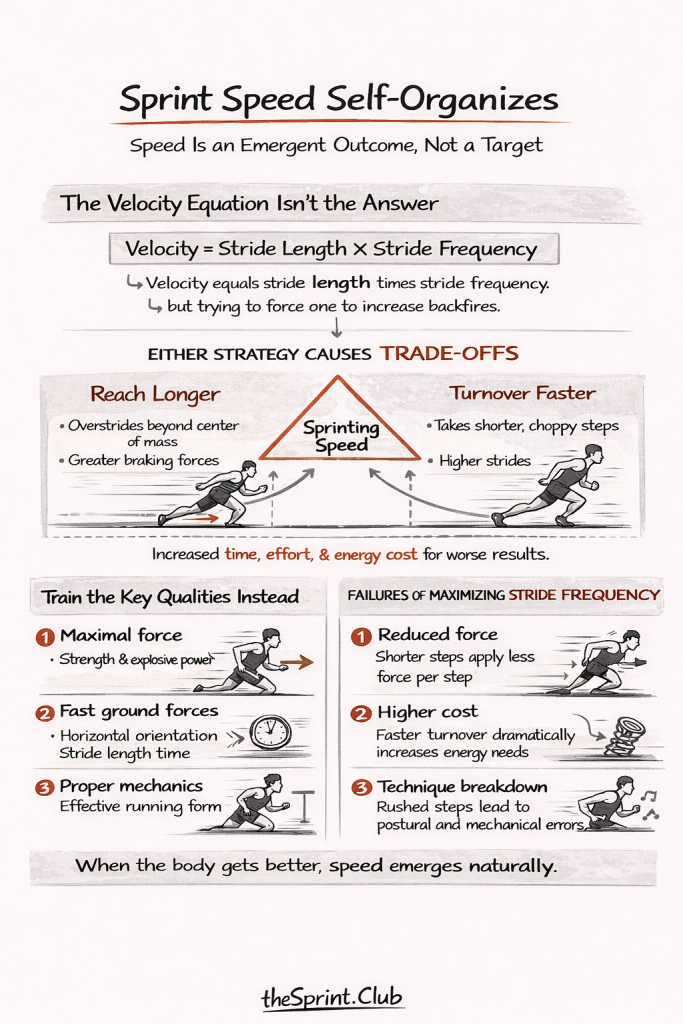
Why it matters:
Elite sprinting relies more on step rate increases than stride length increases (Hunter et al., 2004).
How to measure:
Stride frequency (also called step rate or cadence) is the number of steps a sprinter takes per second. It is one of two variables that determine sprint velocity, the other being stride length. The relationship is straightforward:
Velocity = Stride Length × Stride Frequency
While both variables contribute to speed, research consistently shows that elite sprinters achieve higher velocities primarily through increases in stride frequency rather than dramatic increases in stride length. This finding challenges the common misconception that “reaching” for longer strides is the path to faster sprinting.
The following table shows approximate stride frequencies and corresponding 100m times for male and female sprinters at different performance levels:
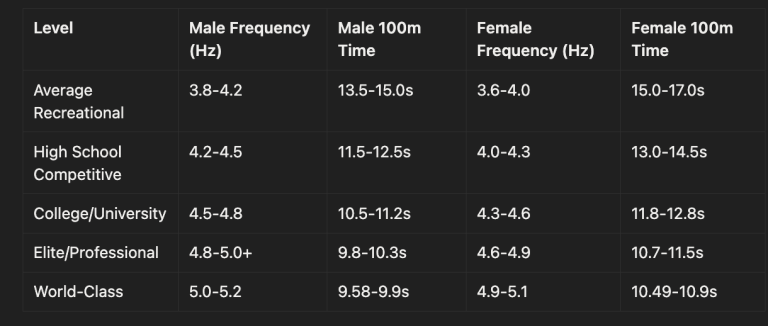
Note: Hz = Hertz (steps per second). Times and frequencies are approximate ranges based on typical performance patterns. Individual variation exists within each category.
Hunter et al. (2004) found that elite sprinters rely more heavily on increases in step rate than stride length to achieve higher velocities. This research revealed that as sprinters approach maximum velocity, further speed gains come primarily from taking steps faster, not longer.
The biomechanical constraint is clear: ground contact time at maximum velocity is extremely brief (0.08-0.10 seconds in elite sprinters). To increase stride frequency, athletes must apply sufficient force in progressively shorter contact times. This requires highly developed neuromuscular coordination.
Stride frequency is trainable, but improvements require addressing multiple systems simultaneously. Unlike stride length, which can be artificially manipulated through conscious reaching (usually with negative consequences), stride frequency cannot be “forced” through willpower alone.
Training adaptations occur across several timescales:
Research suggests that stride frequency improvements of 3-8% are achievable over a training season with appropriate interventions. However, these gains require consistent, high-quality training that prioritizes neuromuscular readiness.
Stride frequency is not a single quality but an expression of multiple physical and technical capacities working in coordination:
1. Neural drive and firing rate
The nervous system must coordinate rapid muscle contractions at precise timing intervals. Higher stride frequencies require faster motor unit firing rates and more efficient neural coordination. This quality is highly trainable through maximal velocity sprinting and plyometric exercises performed when fresh.
2. Ground contact time
Stride frequency is inversely related to ground contact time. Athletes who can apply force in shorter contact times can achieve higher step rates. Elite sprinters at maximum velocity have ground contact times of 0.08-0.10 seconds, while sub-elite athletes may have contact times of 0.12-0.15 seconds.
3. Reactive strength and elastic stiffness
The ability to store and release elastic energy efficiently during the brief ground contact phase is crucial. This requires appropriate levels of muscle-tendon stiffness; enough to minimize energy loss, but not so much that it impairs force application. Reactive strength is developed through various jumping and bounding exercises.
4. Rate of force development (RFD)
The speed at which force can be generated matters more than absolute strength when contact times are extremely short. An athlete with excellent maximal strength but poor RFD will struggle to apply that strength in the time available at high stride frequencies.
5. Technical proficiency
Proper sprint mechanics allow efficient force application during brief contacts. Key technical factors include:
6. Limb recovery speed
The swing phase (when the leg is in the air) must occur rapidly enough to position the limb for the next ground contact. Faster limb recovery allows higher stride frequencies without overstriding. This quality is addressed through sprint-specific drills and maximum velocity training
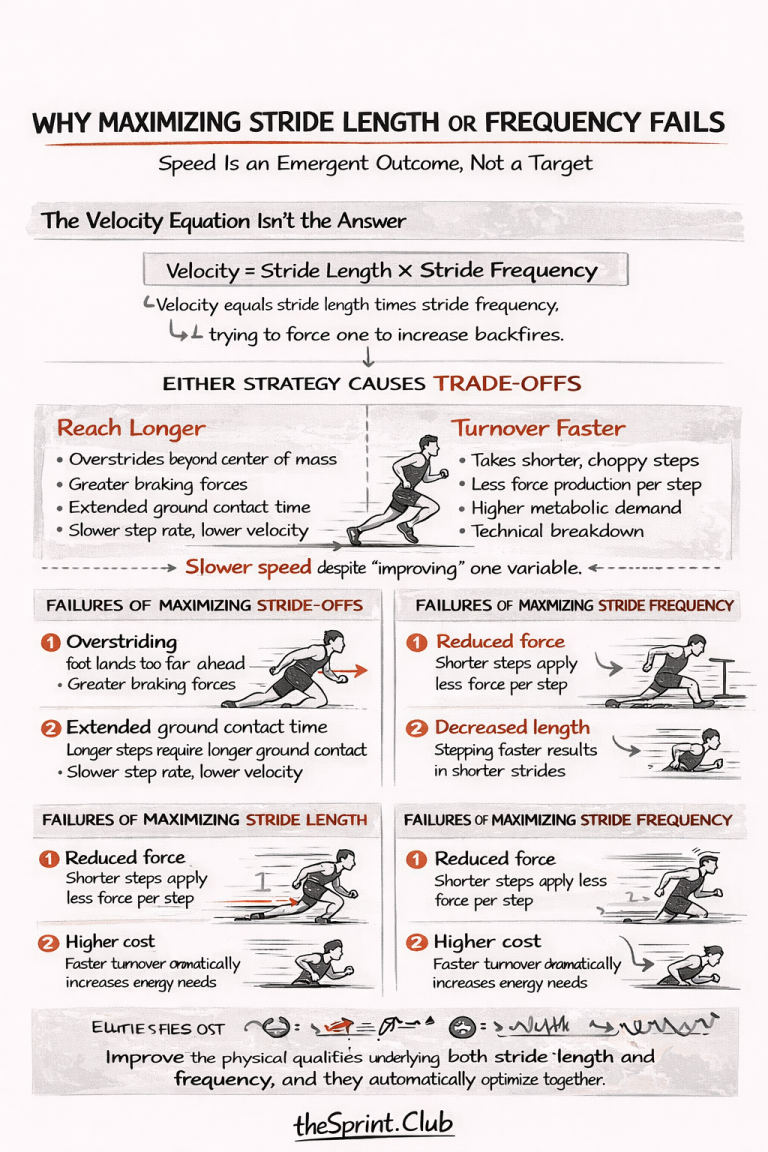
A critical point: stride frequency and stride length are not independent variables. They interact, and excessive focus on one at the expense of the other produces suboptimal results.
Consciously attempting to increase stride length typically leads to overstriding—landing with the foot too far in front of the center of mass—which increases ground contact time and reduces stride frequency. The result is slower sprinting despite longer strides.
Conversely, attempting to artificially increase stride frequency without adequate force production capacity leads to “spinning”—rapid leg turnover without sufficient ground force application—which also fails to increase velocity.
The optimal approach: Develop maximum velocity capacity through high-quality training, and let stride length and stride frequency self-organize to produce the highest possible velocity. Both variables will improve together as force production capacity, ground contact time, and technical proficiency develop.
To improve stride frequency, training should emphasize:
Attempts to “train” stride frequency directly through conscious manipulation (counting steps, forcing faster leg turnover) are generally counterproductive. Stride frequency improves as a result of enhanced physical capacities and technical proficiency, not through direct volitional control.
The bottom line: Stride frequency is a crucial determinant of sprint performance that emerges from the integration of neural drive, elastic qualities, force production capacity, and technical skill. It is trainable through systematic development of these underlying qualities, but cannot be artificially manipulated through conscious effort during sprinting.
Why it matters:
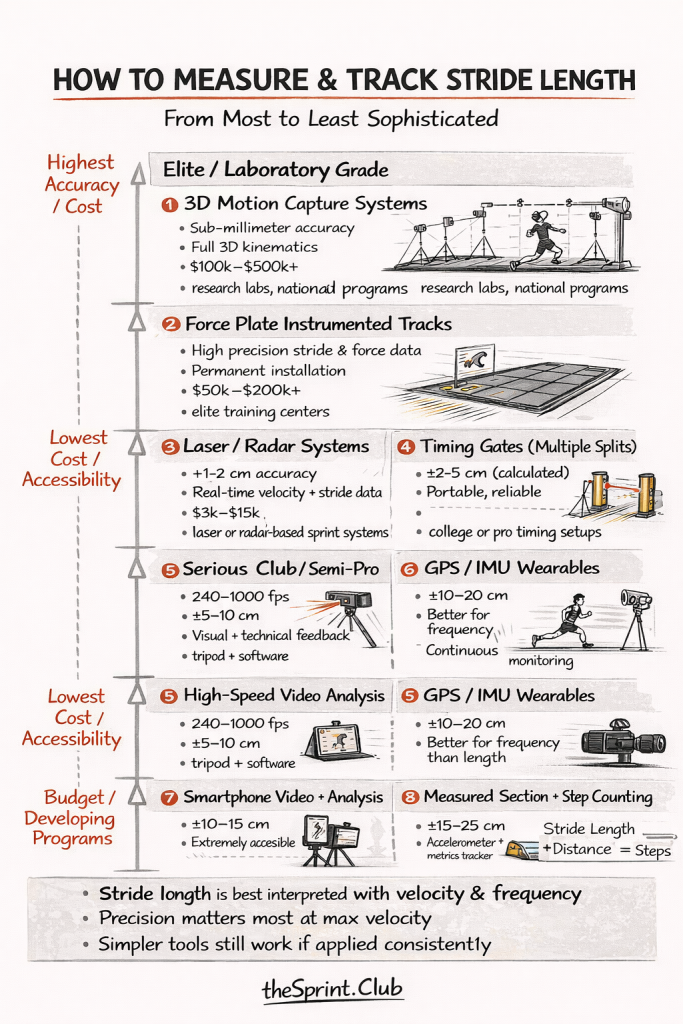
Stride length emerges from force and velocity, not conscious reaching.
Measurement note:
Track alongside frequency. Isolated stride length tracking is misleading.
If you’re an elite/professional athlete or program: Invest in motion capture, force plates, or high-end radar systems. The precision and comprehensive data justify the cost.
If you’re a serious competitive program (college/club): Timing gates or quality radar systems provide excellent accuracy-to-cost ratio. Add high-speed video for technical analysis.
If you’re a developing program or serious individual athlete: Start with smartphone high-speed video. It’s remarkably capable when used properly and provides visual feedback beyond just numbers.
If you’re working with limited resources: Measured track sections with manual counting provide useful baseline data. Focus on consistency of measurement rather than absolute precision.
If you’re just beginning: Use any method that allows you to track changes over time. Even basic methods reveal trends when applied consistently.
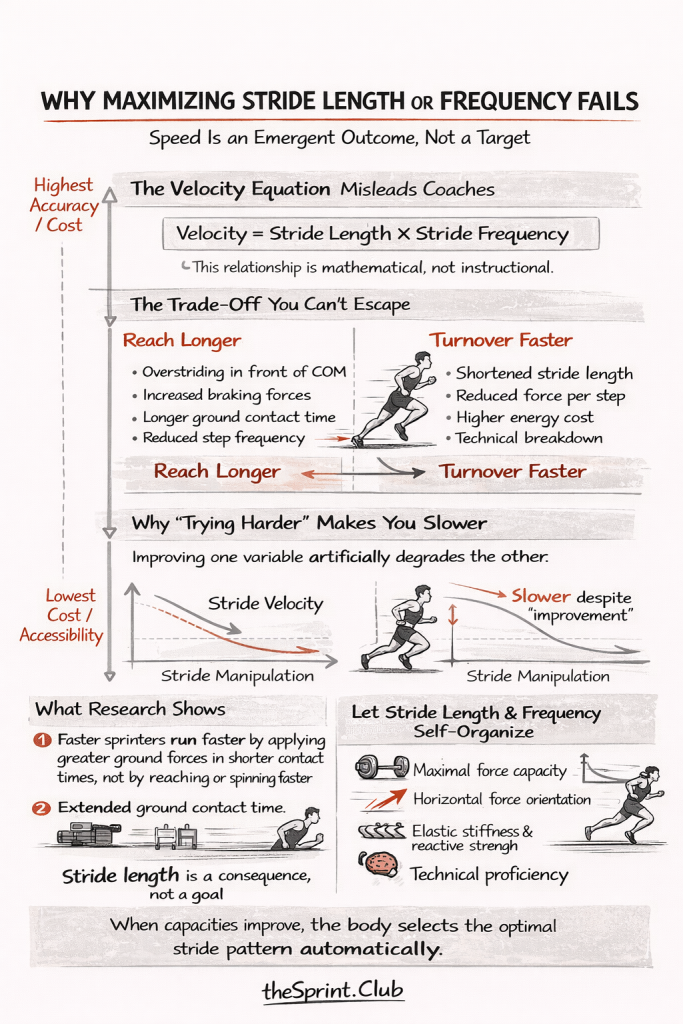
A fundamental misunderstanding in sprint training is the belief that athletes should actively try to maximize either stride length or stride frequency. This approach is not only suboptimal—it’s actively counterproductive to achieving maximum velocity.
While it’s true that velocity equals stride length multiplied by stride frequency, this mathematical relationship misleads athletes and coaches into thinking these variables can be independently manipulated. In reality, they exist in a complex, interdependent relationship constrained by biomechanics and physiology.
Stride length and stride frequency exist in an inverse relationship. Attempts to artificially increase one typically cause a decrease in the other:
The result in both cases: slower overall velocity despite “improving” one variable.
When athletes attempt to consciously lengthen their stride, several mechanical problems emerge:
Research by Weyand et al. (2000) demonstrated that faster sprinters don’t achieve speed through longer strides obtained by reaching—they achieve it through greater ground forces applied during brief contact times. The stride length that results is a consequence of force production, not a target to pursue.
Similarly, attempting to artificially increase stride frequency without the supporting physical qualities creates its own problems:
The most effective strategy is to develop the underlying physical qualities that allow stride length and frequency to optimize themselves naturally:
When these qualities improve, the body automatically finds the optimal combination of stride length and frequency for that athlete’s current capacities and the specific phase of the sprint.
Different athletes naturally exhibit different stride length-frequency profiles even at similar speeds. A taller athlete with longer limbs might have naturally longer strides with lower frequency. A shorter athlete might achieve the same velocity with shorter strides at higher frequency.
Neither pattern is inherently superior. Each represents that athlete’s optimal solution given their physical structure, strength qualities, and neuromuscular characteristics.
Attempting to impose an “ideal” stride length or frequency based on population averages or elite athlete data ignores these individual differences and forces the athlete away from their natural optimum.
During maximum velocity sprinting, athletes should focus on:
They should not think about:
Conscious attention to stride parameters during sprinting interferes with the automatic coordination patterns that produce optimal performance.
Stride length is the distance covered from the point where one foot leaves the ground to when the same foot contacts the ground again. It is one of two fundamental variables that determine sprint velocity, the other being stride frequency. The relationship is expressed as:
Velocity = Stride Length × Stride Frequency
While both variables contribute to speed, it’s critical to understand that stride length is not something to be consciously maximized. Rather, it emerges naturally from an athlete’s force production capacity, technical proficiency, and neuromuscular coordination.
Stride length matters because it directly influences velocity—but only when it emerges from proper force application and mechanics. The key distinction is this:
Research by Weyand et al. (2000) demonstrated that faster sprinters achieve higher speeds through greater ground forces, not through longer strides achieved by reaching. This finding fundamentally changed how coaches and scientists understand stride length optimization.
The practical implication: Athletes should focus on developing the qualities that allow stride length to increase naturally, rather than attempting to manipulate stride length directly through conscious effort.
Stride length is an expression of multiple physical and technical capacities working together:
1. Force production capacity
The magnitude of force an athlete can apply to the ground during the brief contact phase (0.08-0.12 seconds at maximum velocity) directly determines how much the center of mass is propelled forward. Greater force production, when properly directed, results in longer strides without conscious reaching.
This quality is developed through:
2. Horizontal force orientation
As Morin et al. (2011, 2012) demonstrated, the direction of force application matters as much as the magnitude. During acceleration, athletes must apply force at an angle that propels them forward effectively. Athletes who apply force more horizontally (rather than vertically) achieve longer acceleration strides and reach higher velocities more quickly.
This quality improves through:
3. Hip extension power
The hip extensors (glutes and hamstrings) are the primary drivers of propulsion during sprinting. Powerful hip extension during the ground contact phase propels the body forward and contributes directly to stride length.
Development methods include:
4. Elastic stiffness and reactive strength
Appropriate levels of muscle-tendon stiffness allow athletes to apply force effectively during brief ground contacts without excessive deformation. This elastic quality enables efficient energy transfer and contributes to both stride length and frequency.
Training approaches:
5. Technical proficiency
Proper sprint mechanics allow force to be expressed effectively. Key technical factors that influence stride length include:
Poor technique—particularly overstriding—artificially increases stride length while dramatically reducing velocity. The foot landing too far in front of the center of mass creates a braking force that must be overcome, increases ground contact time, and disrupts rhythm.
6. Mobility and range of motion
Adequate hip mobility (both flexion and extension) allows the full expression of stride length that the athlete’s force production capacity makes possible. Limited mobility constrains stride length even when force production is high.
Key areas:
The most common error in sprint training is attempting to increase stride length through conscious reaching or “stretching out” the stride. This approach is counterproductive for several reasons:
The result: Longer strides but slower overall velocity—the opposite of the intended outcome.
Stride length is not constant throughout a sprint. It varies systematically based on the phase of the race:
These changes emerge naturally from the biomechanical requirements of each phase. Attempting to artificially impose a particular stride length at any point is ineffective.
To improve stride length effectively:
Stride length improves as a natural consequence of enhanced physical capacities and technical skill. It cannot be artificially manipulated without negative effects on overall velocity.
The bottom line: Stride length is an outcome, not an input. It emerges from force production, elastic qualities, technical proficiency, and mobility. Training should focus on developing these underlying qualities rather than attempting to manipulate stride length directly. When the system is properly developed, stride length will optimize itself naturally to produce maximum velocity.
Why it matters:
Acceleration performance depends on the direction of force application, not just magnitude (Morin et al., 2011).
How to measure:
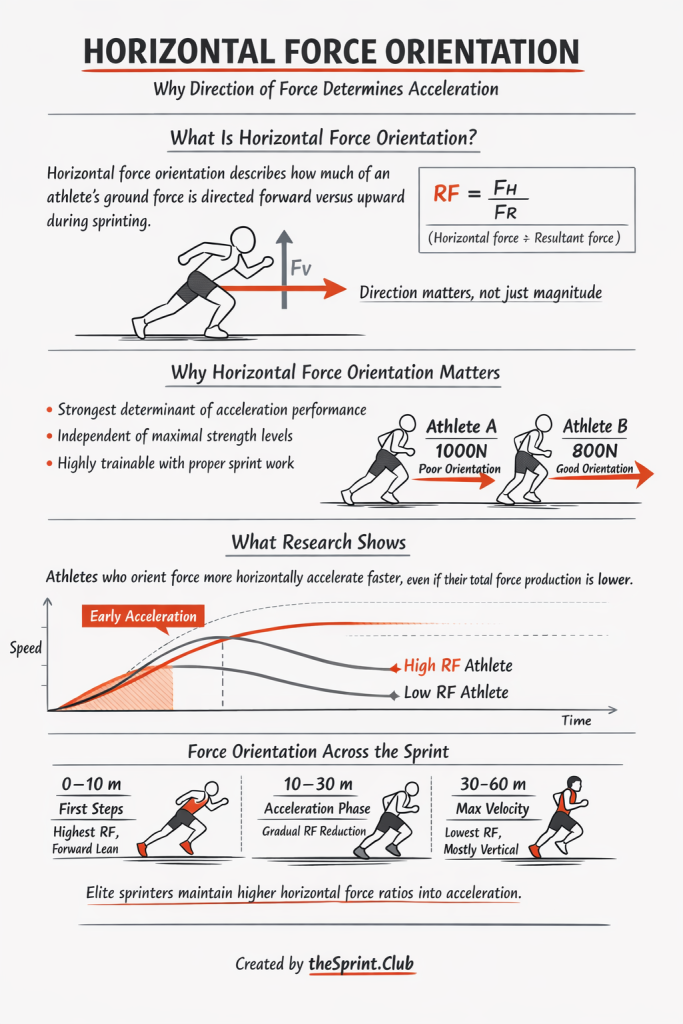
What Is Horizontal Force Orientation?
Horizontal force orientation refers to the direction in which an athlete applies force to the ground during sprinting, specifically the ratio of horizontal (forward-propelling) forces to vertical (upward) forces. It is expressed as a ratio of horizontal force (FH) to resultant force (FR), typically written as RFpeak or DRF (decrease in ratio of force).
When an athlete pushes against the ground, the force vector has both horizontal and vertical components. The horizontal component propels the athlete forward; the vertical component supports the body against gravity. During acceleration, the ability to orient force more horizontally—rather than predominantly vertically—directly determines how effectively an athlete accelerates.
Why Horizontal Force Orientation Matters
Horizontal force orientation is one of the most significant determinants of acceleration performance, independent of an athlete’s maximum force production capacity.
Research by Morin et al. (2011, 2012) fundamentally changed how coaches understand sprint acceleration. Their studies demonstrated that:
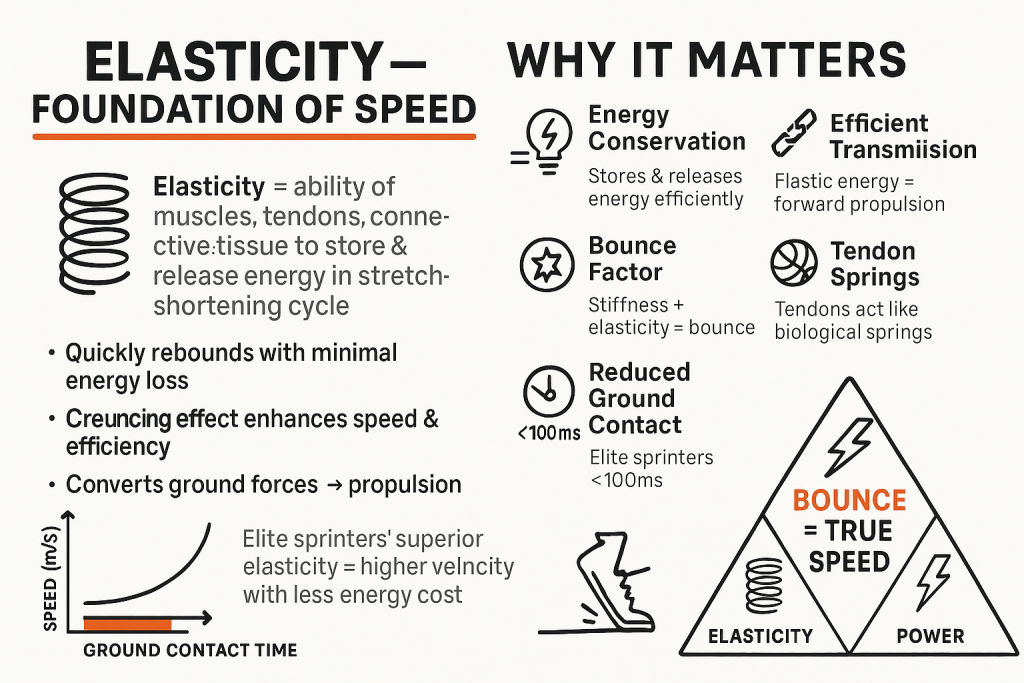
Elasticity in sprinting refers to the ability of muscles, tendons, and connective tissues to efficiently store and release energy during the stretch-shortening cycle. This biomechanical property allows athletes to:
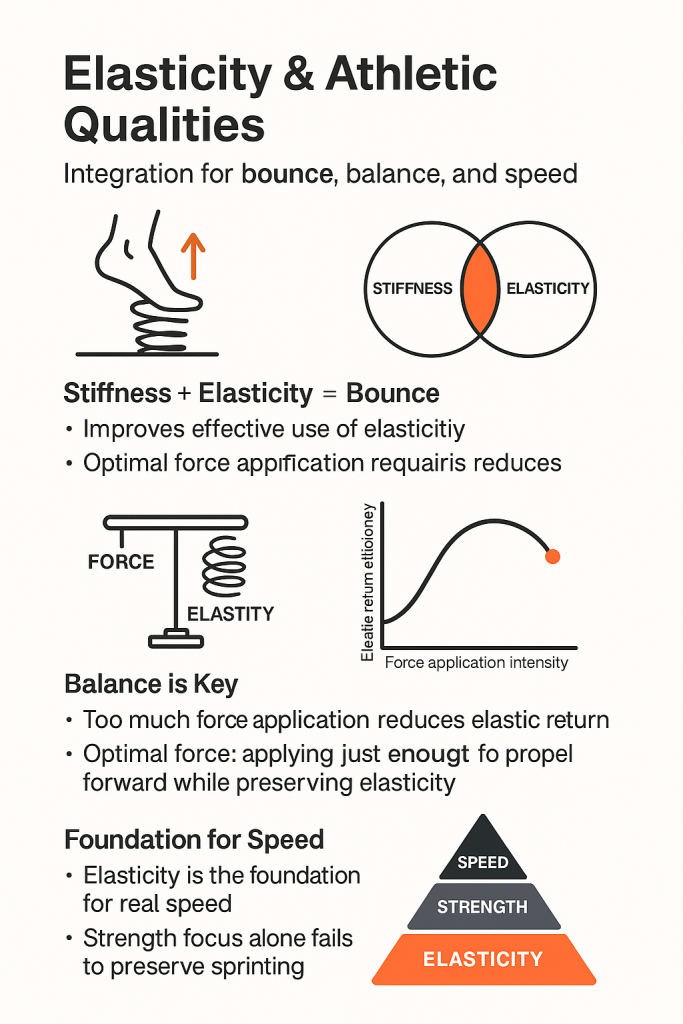
Elasticity doesn’t work in isolation – it functions as part of an integrated system:
Research shows that these methods lead to significant improvements in elastic qualities, which directly transfer to faster sprinting through improved energy storage and release during the stretch-shortening cycle.
Athletes with higher horizontal force ratios accelerate faster—even when compared to athletes with greater overall force production
Technical proficiency in force application matters as much as strength—two athletes with identical squat strength can have dramatically different acceleration abilities based on how they orient force
Horizontal force orientation is trainable—unlike some genetic qualities, force orientation improves with specific training interventions
The practical implication: An athlete who can produce 1000N of force but orients it poorly will accelerate slower than an athlete who produces 800N but orients it effectively in the horizontal direction.
Horizontal force orientation is not constant during a sprint. It changes systematically as velocity increases:
First step (0-10m): Maximum horizontal force orientation—the body is at a forward lean, shin angles are aggressive, and force is directed predominantly forward
Acceleration phase (10-30m): Gradually decreasing horizontal force ratio as the body becomes more upright and velocity increases
Maximum velocity phase (30-60m): Lowest horizontal force ratio—forces become more vertical as the primary task shifts from acceleration to maintaining velocity
Elite sprinters maintain higher horizontal force ratios deeper into the acceleration phase compared to slower athletes. This ability to “push” effectively even as velocity increases is a distinguishing characteristic of superior acceleration performance.
Several technical and postural factors influence how effectively an athlete can orient force horizontally:
1. Body lean and shin angle
During early acceleration, an aggressive forward body lean (approximately 45 degrees at the first step, gradually decreasing) allows the athlete to push backward against the ground effectively. The shin angle at ground contact directly influences the direction of force—a more horizontal shin creates better conditions for horizontal force application.
2. Ground contact position
The foot should contact the ground beneath or slightly behind the center of mass during acceleration. Landing with the foot too far in front creates braking forces that oppose forward motion and reduce the horizontal force ratio.
3. Hip and knee extension coordination
Powerful, coordinated extension of the hip and knee during the stance phase drives horizontal propulsion. Athletes who extend primarily at the knee (without matching hip extension) produce more vertical force and less horizontal force.
4. Posterior chain strength and power
The glutes and hamstrings are the primary drivers of horizontal force production. Athletes with stronger, more powerful posterior chains can maintain better force orientation, particularly in the mid-acceleration phase (10-30m).
Specific training interventions have been shown to improve horizontal force orientation:
1. Heavy sled pushing
Sled loads of 50-80% velocity decrement force athletes into positions that emphasize horizontal force application. The resistance creates an environment where vertical force is ineffective, naturally training horizontal orientation.
Typical protocol: 3-5 sets of 20-30m with 50-70% load
Key emphasis: Maintain forward body lean and aggressive shin angles
2. Resisted sprint variations
Resistance methods (partner resistance, parachutes, uphill sprinting) that don’t exceed 10-20% velocity decrement provide specific stimulus for horizontal force while maintaining sprint-specific coordination patterns.
3. Technical acceleration work
Practicing acceleration from various starting positions (3-point, 4-point, standing, rolling start) with emphasis on:
Aggressive forward body lean
Ground contact beneath or behind center of mass
Powerful hip extension during stance phase
Progressive body angle adjustment as velocity increases
4. Posterior chain strength development
Exercises that specifically target the glutes and hamstrings in hip-dominant movement patterns:
Hip thrusts (heavy and explosive variations)
Single-leg deadlifts
Nordic hamstring curls
Reverse hyperextensions
5. Horizontal plyometrics
Bounding variations, broad jumps, and horizontal jumping exercises train the nervous system to produce force in the horizontal direction:
Single-leg bounds for distance
Alternate leg bounds
Standing broad jumps
Multiple broad jumps
Premature uprighting: Standing too upright too early in the acceleration phase shifts force orientation vertically
Overstriding: Reaching forward with the lead leg creates braking forces and reduces horizontal force ratio
Insufficient hip extension: Failing to fully extend the hip during stance leaves horizontal force potential unrealized
Excessive vertical arm action: Overly vertical arm mechanics can encourage vertical force production rather than horizontal
Understanding horizontal force orientation has several practical implications:
Assessment focus: Evaluate not just how much force athletes produce, but how effectively they orient it
Training emphasis: Include specific horizontal force development work (sleds, bounds, technical acceleration) rather than relying solely on general strength
Technical coaching: Emphasize body positions and movement patterns that facilitate horizontal force (forward lean, shin angles, contact position)
Individualization: Athletes with good maximum force but poor acceleration may specifically need horizontal force orientation work
The bottom line: Horizontal force orientation is a critical, trainable determinant of sprint acceleration performance. It represents the technical ability to apply force effectively, independent of raw strength. Athletes and coaches should assess force orientation (through measurement or technical observation) and include specific training methods that develop the capacity to orient force horizontally during the acceleration phase.
Why it matters:
Effective sprinting requires elastic energy return during very short contact times.
How to measure:
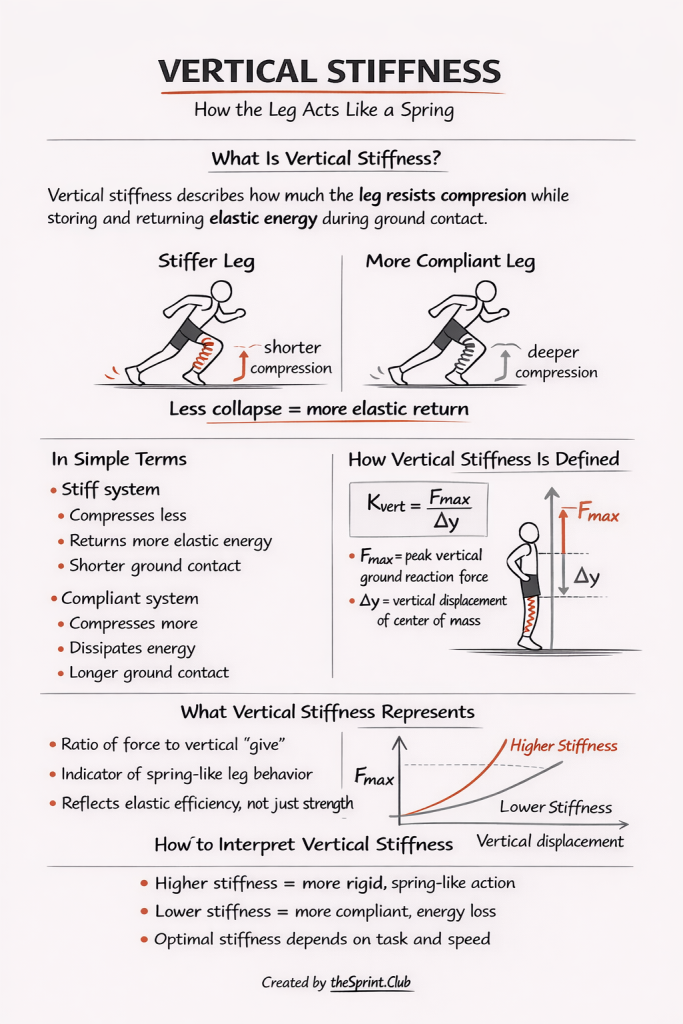
What Is Vertical Stiffness?
Vertical stiffness (also called leg stiffness or lower limb stiffness) refers to the musculoskeletal system’s ability to resist compression during ground contact while maintaining elastic energy storage and return. It represents the ratio of peak vertical ground reaction force to the vertical displacement of the body’s center of mass during the stance phase of running.
In simpler terms: vertical stiffness describes how much your leg “gives” or compresses when your foot strikes the ground versus how much force is generated. A stiffer system compresses less and returns more elastic energy; a more compliant system compresses more and dissipates energy.
Vertical stiffness is calculated as:
Kvert = Fmax / Δy
Where:
Higher vertical stiffness values indicate a more rigid, spring-like leg action during ground contact.
Vertical stiffness is critical for sprint performance because it directly influences how effectively an athlete can store and release elastic energy during the extremely brief ground contact times that characterize high-speed sprinting.
1. Facilitates Rapid Force Application
At maximum velocity, ground contact times are exceptionally short—typically 80-100ms for elite sprinters. There is insufficient time for muscles to actively generate force through traditional concentric contraction. Instead, the musculotendinous system must behave like a stiff spring, rapidly storing elastic energy during the loading phase and immediately releasing it during push-off.
Athletes with higher vertical stiffness can maintain this spring-like behavior more effectively, allowing them to apply greater forces in the minimal time available.
2. Minimizes Energy Loss
When the leg compresses excessively during ground contact (low stiffness), mechanical energy is dissipated rather than stored and returned. This energy loss must be compensated for by additional muscular work, reducing efficiency and limiting maximum velocity.
Higher vertical stiffness minimizes this energy dissipation, allowing a greater percentage of the force applied to the ground to contribute to forward propulsion.
3. Supports High Stride Frequencies
Vertical stiffness enables faster leg cycling and higher stride frequencies. A stiffer leg rebounds more quickly from the ground, reducing ground contact time and allowing the athlete to transition more rapidly into the next stride cycle.
Elite sprinters demonstrate higher vertical stiffness values compared to slower athletes, which correlates with their ability to maintain high stride frequencies (4.5-5.0 Hz) at maximum velocity.
4. Protects Against Injury
Appropriate vertical stiffness helps distribute impact forces effectively throughout the kinetic chain. Too little stiffness can lead to excessive joint motion and soft tissue loading; too much stiffness can result in inadequate shock absorption and increased injury risk to bones and connective tissues.
The optimal stiffness profile varies by individual and must be developed progressively through training.
Several biomechanical and neuromuscular factors determine an athlete’s vertical stiffness:
1. Muscle-tendon unit properties
The mechanical properties of muscles and tendons—particularly the Achilles tendon and calf musculature—are primary determinants of vertical stiffness. Stiffer tendons store and release elastic energy more effectively.
2. Neural activation patterns
Pre-activation of muscles prior to ground contact (approximately 50-80ms before foot strike) increases joint stiffness and prepares the system for impact. Higher levels of pre-activation are associated with greater vertical stiffness.
3. Joint mechanics
Ankle, knee, and hip joint stiffness collectively contribute to overall leg stiffness. The ankle joint is particularly critical, as it undergoes the greatest angular displacement during sprint ground contacts.
4. Body position and technique
Ground contact position, body lean, and limb angles at touchdown all influence how stiffness is expressed. Landing with the foot too far in front of the center of mass or with excessive knee flexion reduces effective stiffness.
Why it matters:
Sprint speed is prepared in the air, then expressed at ground contact.
How to measure:
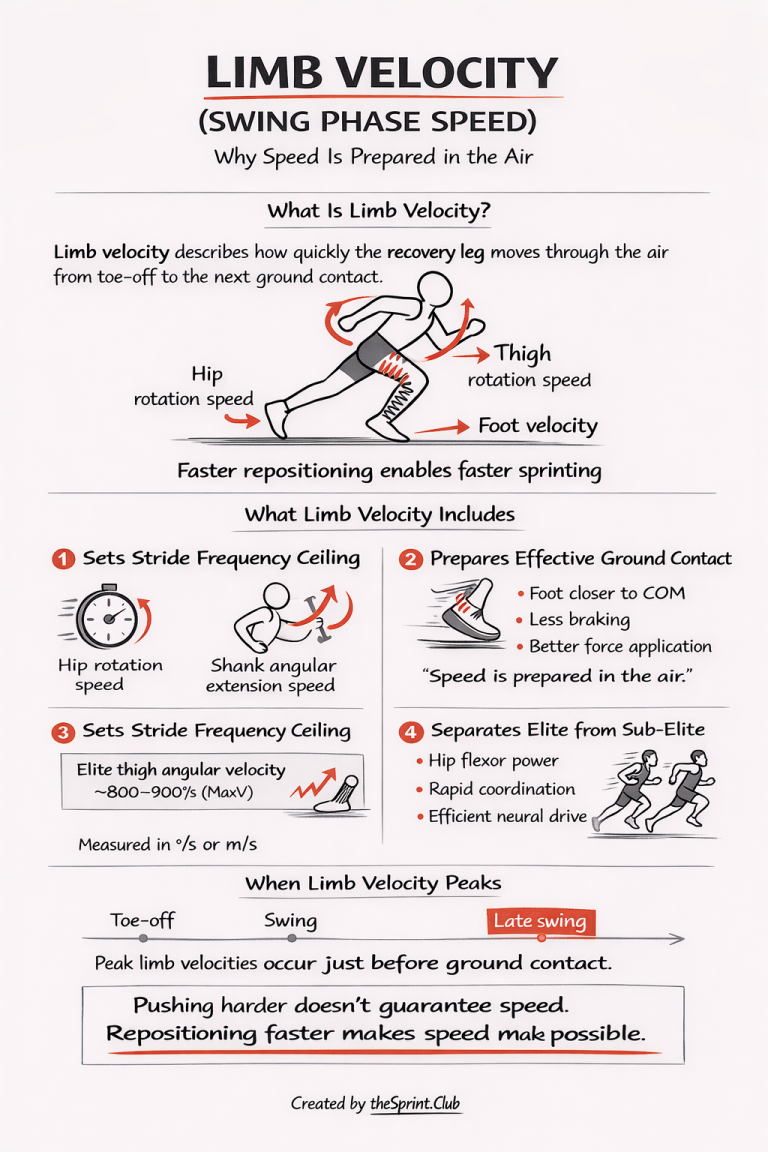
What Is Limb Velocity ?
Limb velocity, often called swing phase speed, refers to the angular velocity of the recovery leg as it travels through the air from toe-off to the next ground contact. It measures how quickly an athlete can reposition their leg during the flight phase of sprinting—specifically, how fast the thigh is brought forward and how rapidly the lower leg extends before ground contact.
In biomechanical terms, limb velocity encompasses:
These velocities are typically measured in degrees per second (°/s) or meters per second (m/s) and reach peak values during the late swing phase, just before the foot strikes the ground.
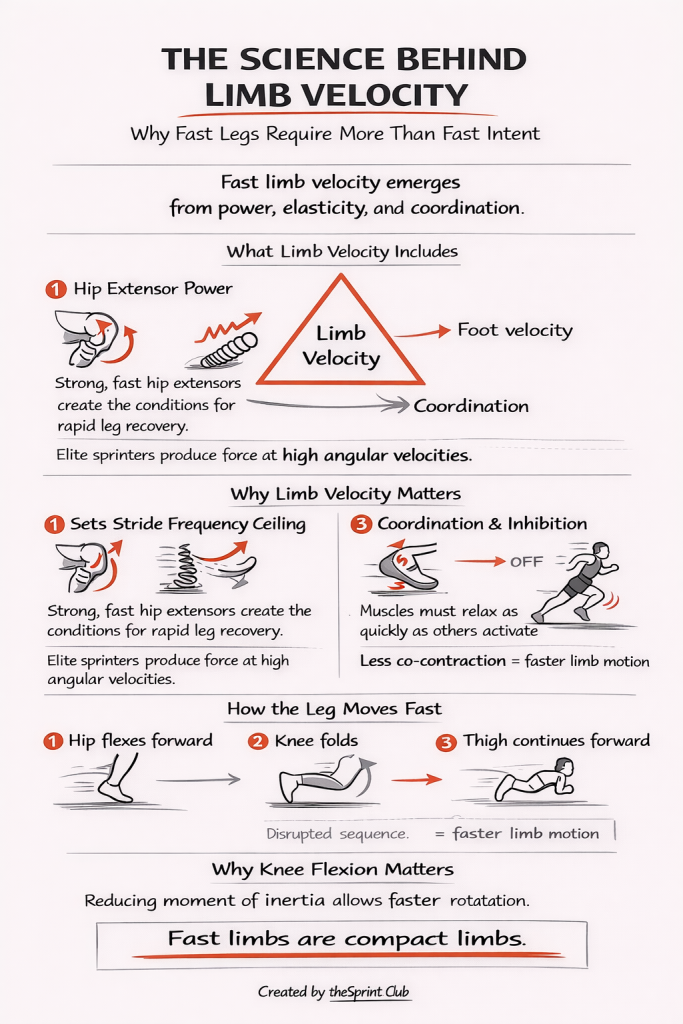
Limb velocity is a critical yet often underappreciated determinant of sprint performance. While ground contact mechanics receive considerable attention, what happens during the flight phase—when the foot is not in contact with the ground—is equally important for achieving maximum velocity.
1. Determines Stride Frequency Potential
Sprint speed is the product of stride length and stride frequency. While much emphasis is placed on generating force during ground contact, stride frequency is largely determined by how quickly an athlete can reposition their limbs during the swing phase.
Athletes with higher limb velocities can complete the recovery cycle faster, enabling higher stride frequencies without sacrificing stride length. Elite sprinters demonstrate thigh angular velocities exceeding 800-900°/s during the swing phase at maximum velocity—significantly higher than sub-elite athletes.
2. Prepares the Leg for Ground Contact
The phrase “speed is prepared in the air” captures a fundamental principle: the positioning and velocity of the limbs during the swing phase directly influence the effectiveness of the subsequent ground contact.
High limb velocity allows the athlete to:
3. Reflects Neuromuscular Power and Coordination
Limb velocity is not simply a matter of “swinging the leg faster” through conscious effort. It requires coordinated activation of multiple muscle groups—particularly the hip flexors, knee extensors, and stabilizers—in precisely timed sequences.
High limb velocities indicate:
4. Distinguishes Elite from Sub-Elite Sprinters
Research consistently shows that one of the primary differences between elite and sub-elite sprinters is limb velocity during the swing phase. Elite athletes demonstrate significantly higher thigh angular velocities and faster leg repositioning speeds, even when matched for ground contact characteristics.
This finding challenges the common misconception that sprint speed is solely determined by how hard an athlete pushes against the ground. Instead, the ability to rapidly reposition the limbs during flight is equally critical.
Several biomechanical and physiological factors explain why limb velocity is such a critical component of sprint performance:
1. Hip Extensor Power Production
The hip extensors—particularly the gluteus maximus and hamstring complex—are the primary drivers of propulsive force during the stance phase. These muscles must generate high forces at high velocities to accelerate the body forward rapidly.
Research using isokinetic dynamometry has shown that elite sprinters possess significantly greater hip extensor strength and power compared to slower athletes, particularly at high angular velocities (240-300°/s). This capacity for high-velocity force production is essential for achieving effective ground contact mechanics and maximum sprint velocity.
2. Stretch-Shortening Cycle of the Hip
The swing phase involves a powerful stretch-shortening cycle at the hip joint. During late stance and early flight, the hip flexors are rapidly stretched as the leg extends behind the body. This eccentric loading stores elastic energy, which is immediately released during the subsequent concentric hip flexion.
Athletes who can effectively utilize this elastic energy through appropriate muscle-tendon stiffness and neuromuscular coordination achieve higher limb velocities with less metabolic cost.
3. Reciprocal Inhibition and Coordination
Limb velocity is influenced by the coordination between antagonistic muscle groups. During hip flexion, the hip extensors (glutes and hamstrings) must relax to allow rapid forward movement of the thigh. This process, called reciprocal inhibition, is mediated by spinal reflexes and higher-level motor control.
Elite sprinters demonstrate more refined reciprocal inhibition patterns, allowing for faster, more efficient limb repositioning. Poor coordination between agonists and antagonists creates “co-contraction,” which slows limb velocity and wastes energy.
4. Kinetic Chain Sequencing
Optimal limb velocity requires precise sequencing of joint movements throughout the kinetic chain. The movement pattern typically follows this sequence:
Initial hip flexion (driven by hip flexors)
Continued forward rotation of the thigh as knee flexion brings the heel toward the glutes
Hip continues forward while the knee extends, bringing the foot forward
Final positioning of the foot just before ground contact
Disruptions in this sequencing—such as premature knee extension or delayed hip flexion—reduce effective limb velocity and compromise stride mechanics.
5. Leg Mass and Moment of Inertia
From a physics perspective, limb velocity is influenced by the mass distribution of the leg. A lighter limb, or one with mass concentrated closer to the axis of rotation (the hip joint), has a lower moment of inertia and can be accelerated more rapidly.
This is why sprinters naturally flex the knee during the swing phase, bringing the heel toward the glutes. This action reduces the leg’s moment of inertia, allowing the hip flexors to rotate the thigh forward more quickly. Athletes who maintain excessive knee extension during recovery have higher moments of inertia and slower limb repositioning speeds.
Improving limb velocity requires specific training interventions targeting the neuromuscular and biomechanical factors that constrain swing phase speed:
1. Hip extensor strength and power development
Specific exercises targeting hip flexor strength at high velocities:
2. Sprint-specific technical drills
Drills that emphasize rapid limb repositioning and proper coordination:
3. Maximum velocity sprinting
The most specific training stimulus for limb velocity is sprinting at or near maximum velocity. The neuromuscular system adapts to the unique demands of high-speed running through repeated exposure, developing the coordination, power, and timing required for rapid limb repositioning.
4. Plyometric training
While plyometrics are often associated with ground contact improvements, certain variations can enhance swing phase mechanics:
5. Mobility and flexibility work
Adequate hip mobility—particularly hip extension range of motion—is necessary to allow full stretch-shortening cycle utilization and optimal limb repositioning:
Why it matters:
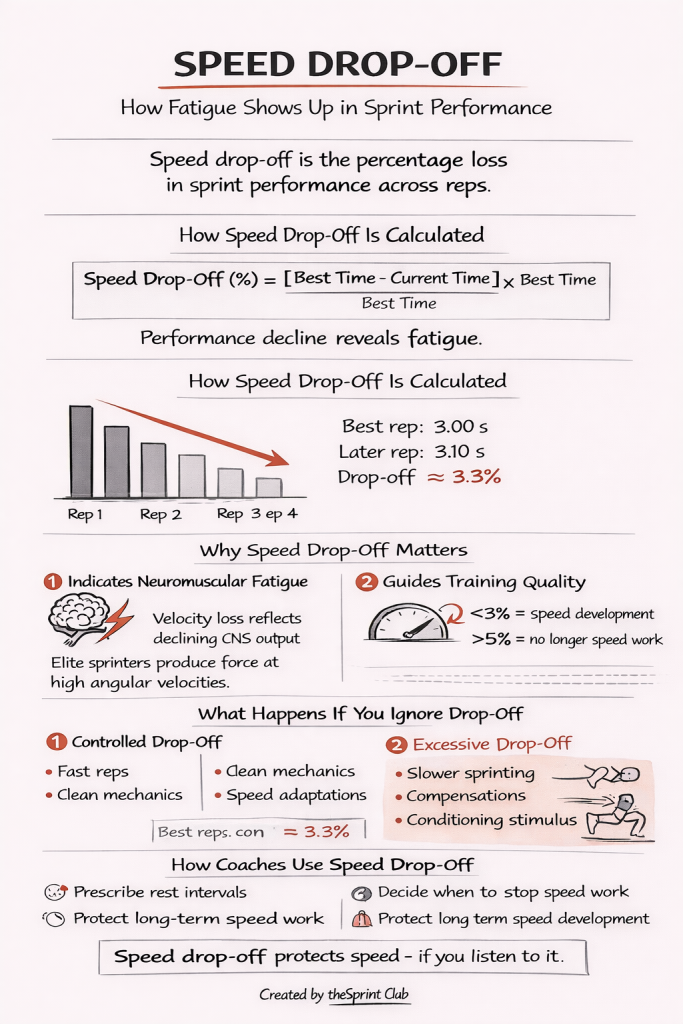
A velocity drop-off greater than ~3 percent indicates neuromuscular fatigue or insufficient recovery.
How to measure:
Speed drop-off is the measurable decline in maximum velocity or sprint performance that occurs as an athlete completes multiple repetitions within a training session. It is typically expressed as a percentage decrease from the athlete’s best (fastest) repetition in that session.
Technical Definition: Speed drop-off = [(Best Time – Current Time) / Best Time] × 100
For example, if an athlete runs their first 30m fly in 3.00 seconds and their fourth rep in 3.10 seconds, the speed drop-off would be approximately 3.3%.
1. Indicates Neuromuscular Fatigue
Speed drop-off serves as a real-time indicator of central nervous system (CNS) and neuromuscular fatigue. When velocity drops beyond a certain threshold (typically 3-5%), it signals that the athlete can no longer maintain the neuromuscular output required for maximum speed development.
2. Guides Training Quality
Maximum velocity training requires high-quality neural drive and muscle fiber recruitment. When drop-off exceeds acceptable limits, continued training shifts from speed development to speed-endurance or conditioning work—fundamentally different training stimuli with different adaptations.
3. Prevents Maladaptive Training
Training in a fatigued state teaches the nervous system to recruit motor units in suboptimal patterns. Repeatedly practicing “slow sprinting” under fatigue can reinforce inefficient movement patterns and potentially impair maximum speed development.
4. Optimizes Recovery Needs
Monitoring drop-off helps coaches prescribe appropriate rest intervals between repetitions and determine when an athlete has recovered sufficiently for the next high-quality effort.
Setting Velocity Thresholds
Coaches establish acceptable drop-off percentages based on training goals:
Session Management
Drop-off monitoring helps coaches make real-time decisions during training:
Periodization Tool
Different training phases utilize different drop-off tolerances:

Use a sprint progress tracker to record times, monitor fatigue, identify trends, and make smarter training decisions that improve sprint performance.
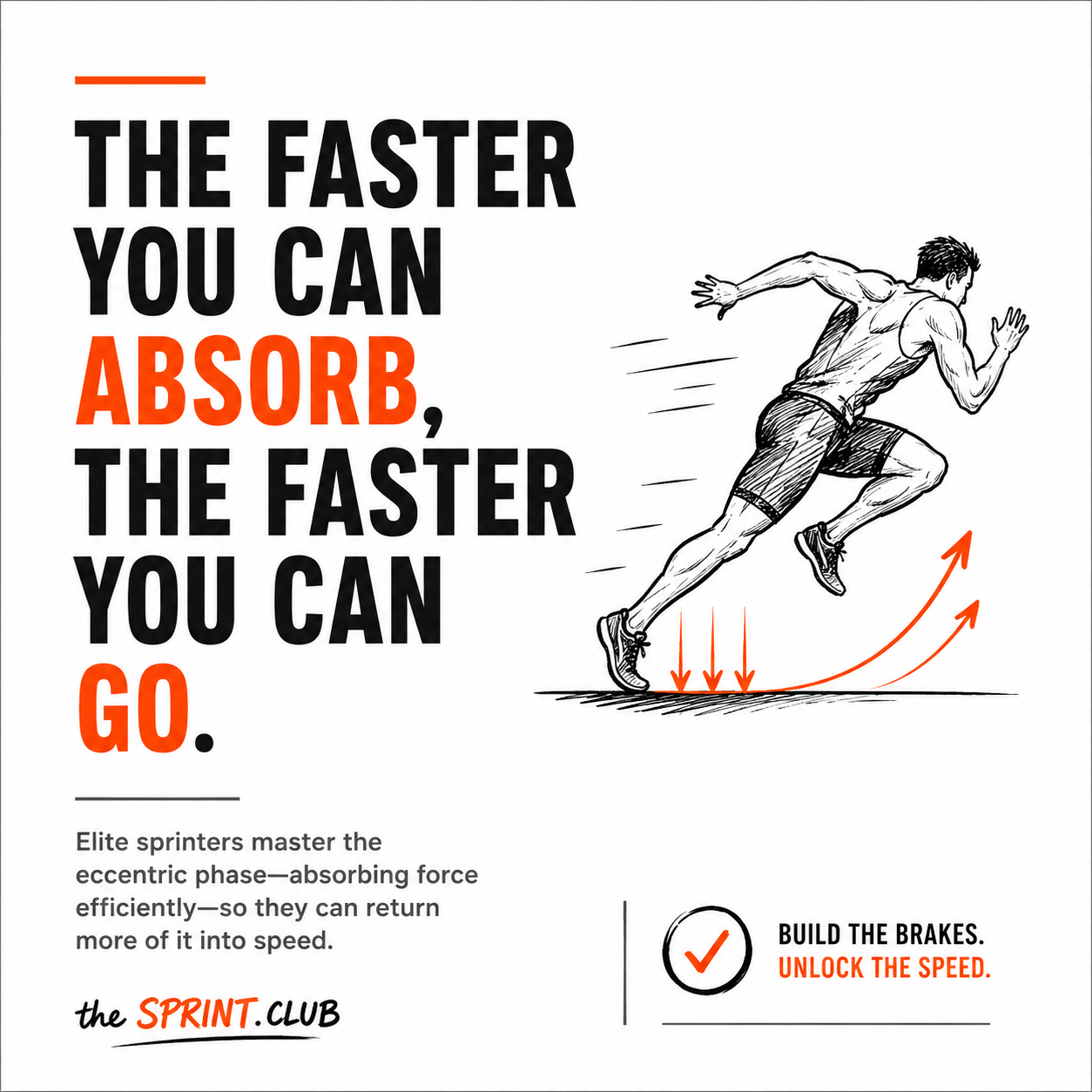
Most athletes focus on producing force. Elite sprinters also master absorbing it. Every sprint step begins with a collision between

Working harder doesn’t always make you faster. In sprinting, excessive training volume can quietly reduce speed by increasing fatigue, disrupting recovery, and degrading mechanics. This “Volume Trap” causes longer ground contact times, lower force production, and slower sprint performances, even when athletes are putting in maximum effort. Learn why quality beats quantity, how overtraining affects the nervous system, and the practical strategies elite coaches use to keep athletes fresh, explosive, and consistently improving. Discover how objective testing, the sprint drop-off method, and smarter recovery practices can help you build speed without burning out.


Train with confidence. Know exactly what to work on and why it matters
Access free tools & calculators built to help coaches and athletes train smarter.

