|
|
|
|
Most sprinters focus on generating power at the hip and knee. They load the weight room, build massive quads and glutes, chase higher vertical jumps.
|
Yet their speed plateaus.
|
The missing link isn't more power. It's how that power gets transmitted to the ground.
|
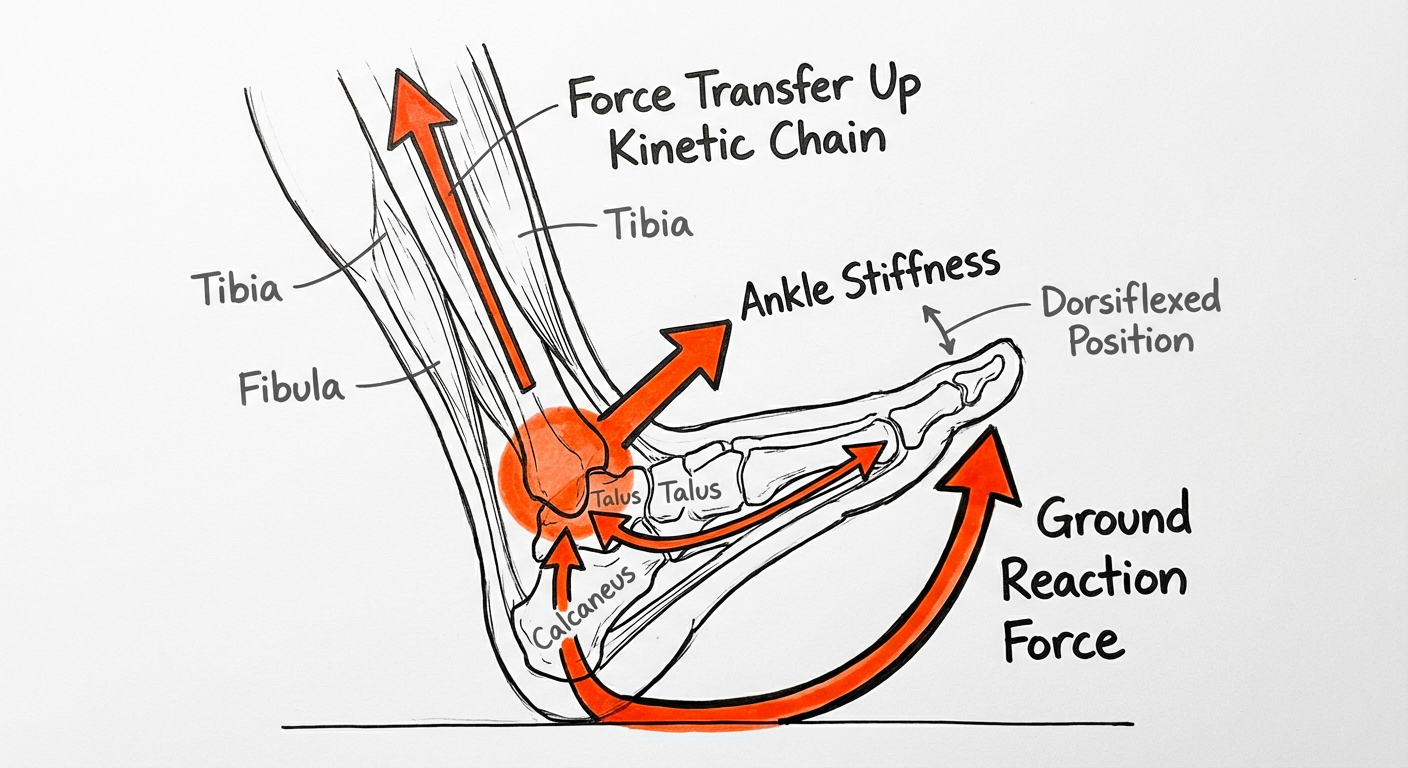
Enter dorsiflexion: the shin moving forward over a planted foot. Not just a position. A force multiplier that determines whether your generated power propels you forward or leaks into the track.
|
|
|
The Transmission Problem
Your hip and knee can generate massive forces. Elite sprinters produce 2.65x bodyweight during the first half of ground contact, reaching peak force in roughly 20-50 milliseconds.
|
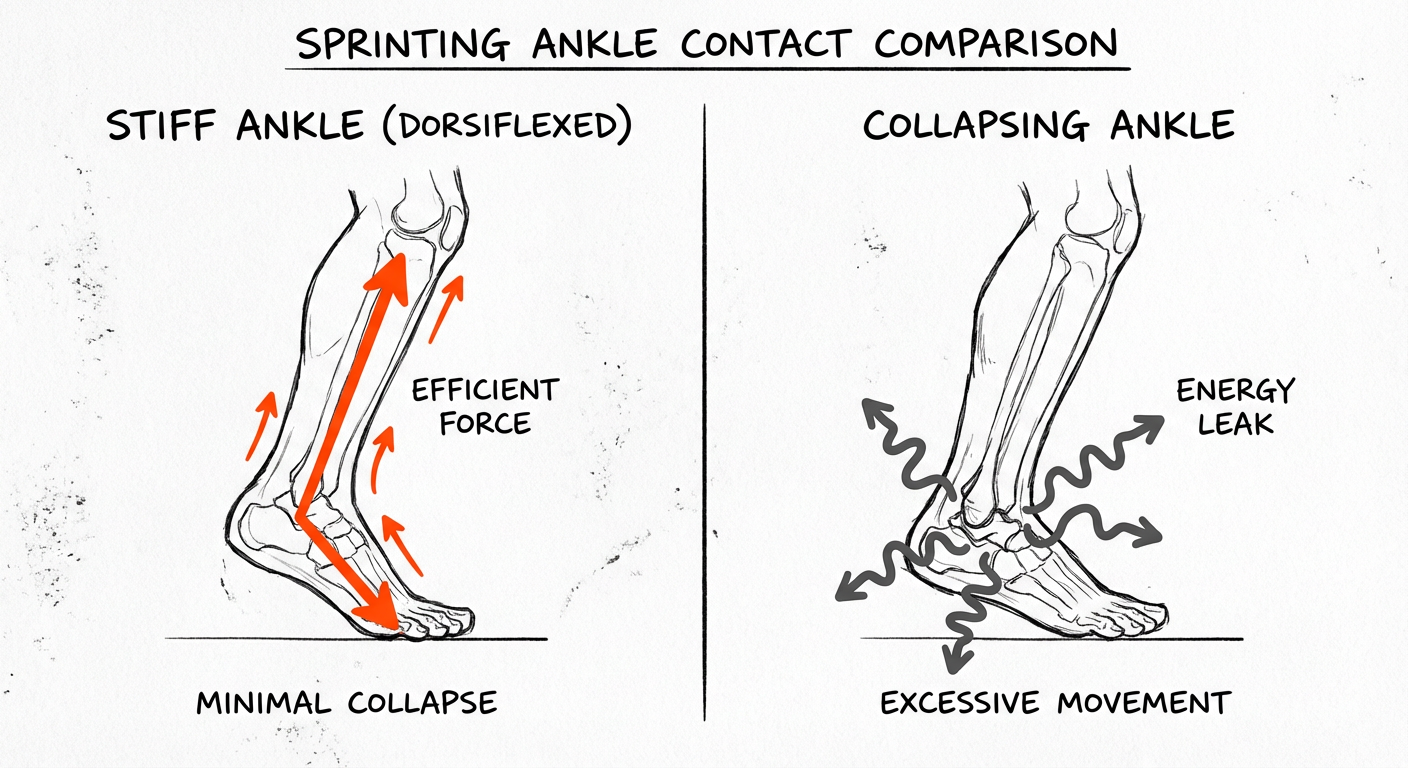
But if the ankle collapses, that force disperses. The foot deforms. The arch flattens. Energy leaks.
|
JB Morin puts it clearly: "If this overdevelopment of quads or overall leg strength does not come with an increase in an athlete's 'ankle and foot strength,' i.e., the capability of ankle stabilizers to transmit the huge force generated at the powerful proximal muscle groups onto the ground (the ability of the foot to resist and not deform during the stance), then much of this force is wasted."
|
The foot-ankle complex contributes 35-45% of total propulsive force in sprinting. Without stiffness here, you're driving a high-powered engine through a worn-out transmission.
|
|
|
|
Why Dorsiflexion Creates Stiffness
Dorsiflexion isn't passive ankle angle. It's active pre-tension.
|
When the shin moves forward over the foot while maintaining ankle stiffness, several mechanical advantages occur:
|
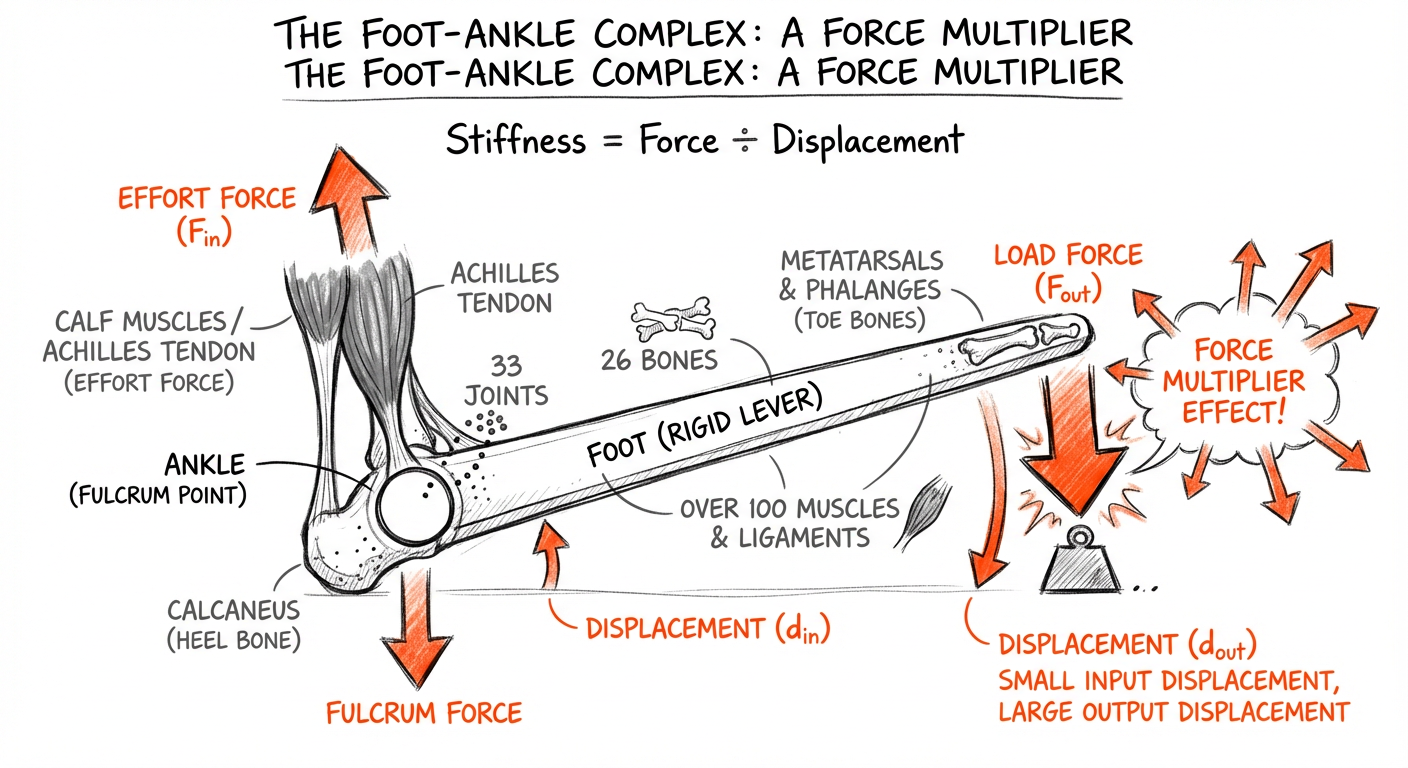
Rigid Lever Creation: The foot transforms from a flexible structure into a stiff lever. All 26 bones, 33 joints, and over 100 muscles, tendons, and ligaments lock into position.
|
Achilles Pre-Load: The Achilles tendon enters a pre-stretched state before ground contact. Sprinters have significantly stiffer Achilles tendons than non-sprinters, with moment arms roughly 25% shorter. This combination allows rapid elastic energy storage and release.
|
Force Vector Optimization: A dorsiflexed ankle positions the lower leg to receive ground reaction forces along the bone structure rather than through soft tissue, minimizing deformation.
|
The result: ground reaction forces transmit up the kinetic chain with minimal energy loss.
|
|
|
The 80-Millisecond Window
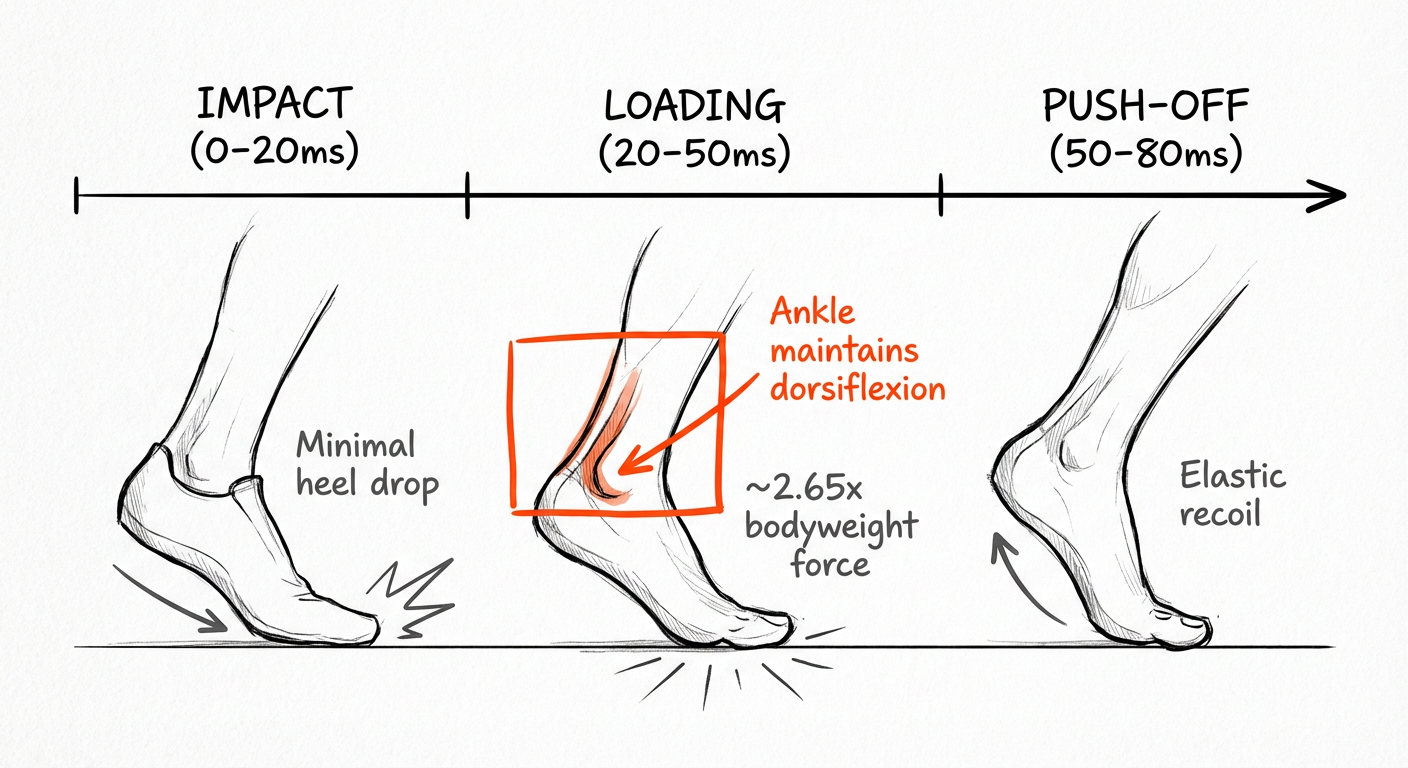
Elite sprinters have roughly 80 milliseconds of ground contact at maximum velocity. Within that brief window:
|
|
0-20ms (Impact): Foot strikes around the 4th-5th metatarsal. The ankle must be stiff on contact to prevent heel drop.
|
|
20-50ms (Loading): Peak forces hit 2.65x bodyweight. The ankle maintains dorsiflexion while the Achilles tendon stretches minimally, storing elastic energy.
|
50-80ms (Push-off): Stored energy releases as the foot rolls toward the big toe. The arch springs back, the Achilles recoils, propelling the body forward.
|
Any excessive ankle collapse during loading extends ground contact time and reduces force output. Research shows faster sprinters maintain higher leg stiffness and shorter ground contact times.
|
|
|
The Stiffness Equation
Stiffness = Force ÷ Displacement
|
Higher stiffness means producing more force with less joint displacement.
|
Elite sprinters exhibit constant ankle joint stiffness across speeds (around 7 N·m·deg⁻¹), while knee stiffness increases from 17 to 24 N·m·deg⁻¹ as speed increases.
|
The ankle's constant stiffness likely depends on tendon properties, which remain consistent across speeds. The foot-ankle complex acts as a biological spring with relatively fixed material properties.
|
This means: you can't adjust ankle stiffness mid-sprint like you can knee stiffness. You must build it during training.
|
|
Common Mistakes
|
Conscious Effort to Minimize Ground Contact Time:
|
Trying to "get off the ground fast" leads to tippy-toe running and cycling without applying force. Ground contact time is an outcome of limb speed and stiffness, not a conscious goal.
|
|
Foot Strike Too Far Under the Hips:
|
Reduces glute and hamstring contribution, limits force application. At maximum velocity, foot strike happens slightly in front of the center of gravity.
|
|
Overemphasis on Mobility Without Stiffness:
|
Excessive ankle mobility without corresponding strength and stiffness capacity creates unstable joints that collapse under load.
|
|
Training Volume Over Quality:
|
Stiffness training requires neural adaptation. Quality over quantity, full recovery between sets (2-3 minutes at least), 48 hours between sessions
|
|
|
|
|
|
|
|
|
|
|
|
|
Thanks for reading. See you soon!
|
|
|
|
|
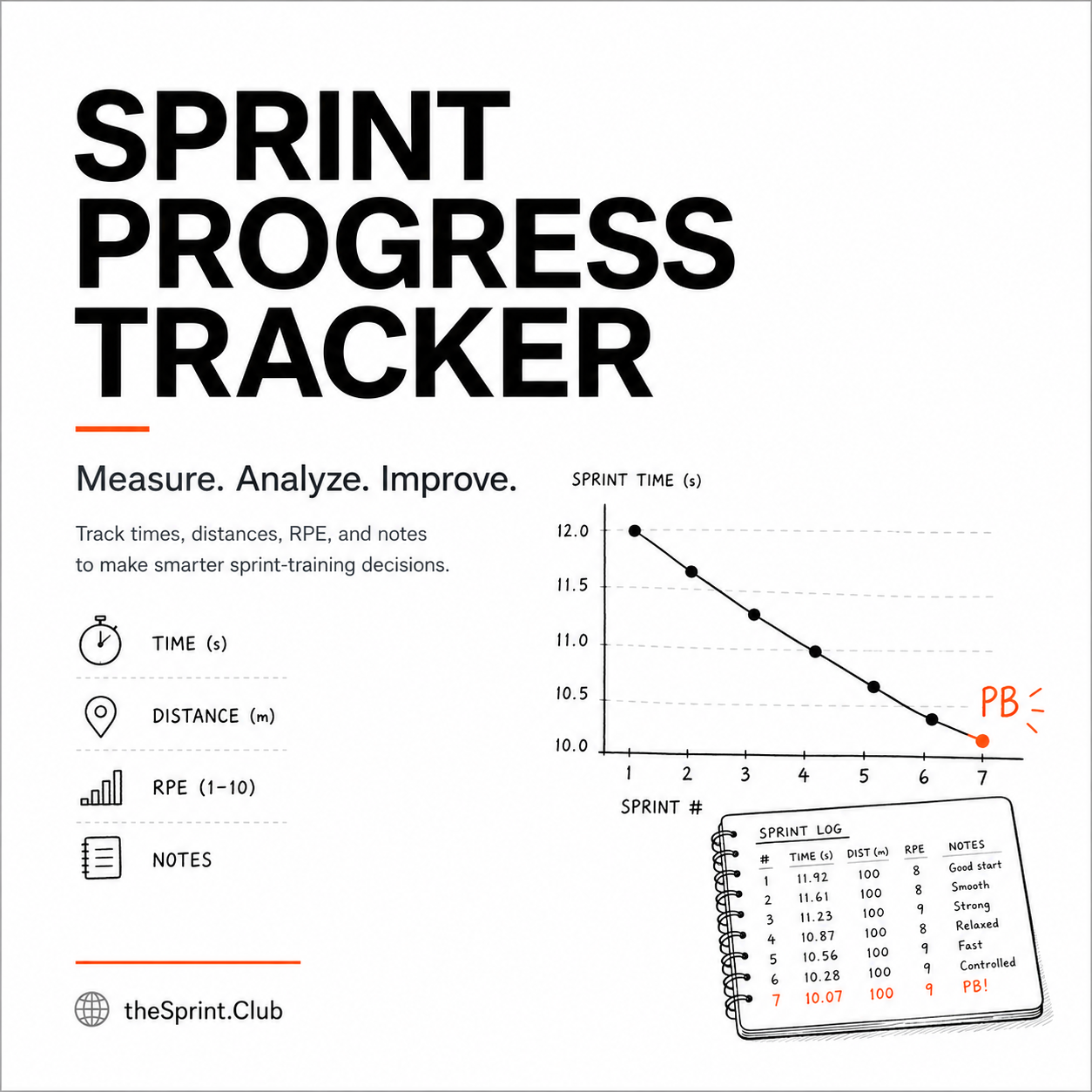
Sprint Progress Tracker: Measure and Improve Your Speed
|
|
|
|
Use a sprint progress tracker to record times, monitor fatigue, identify trends, and make smarter training decisions that improve sprint performance.
|
|
|
|
|
|
|
|
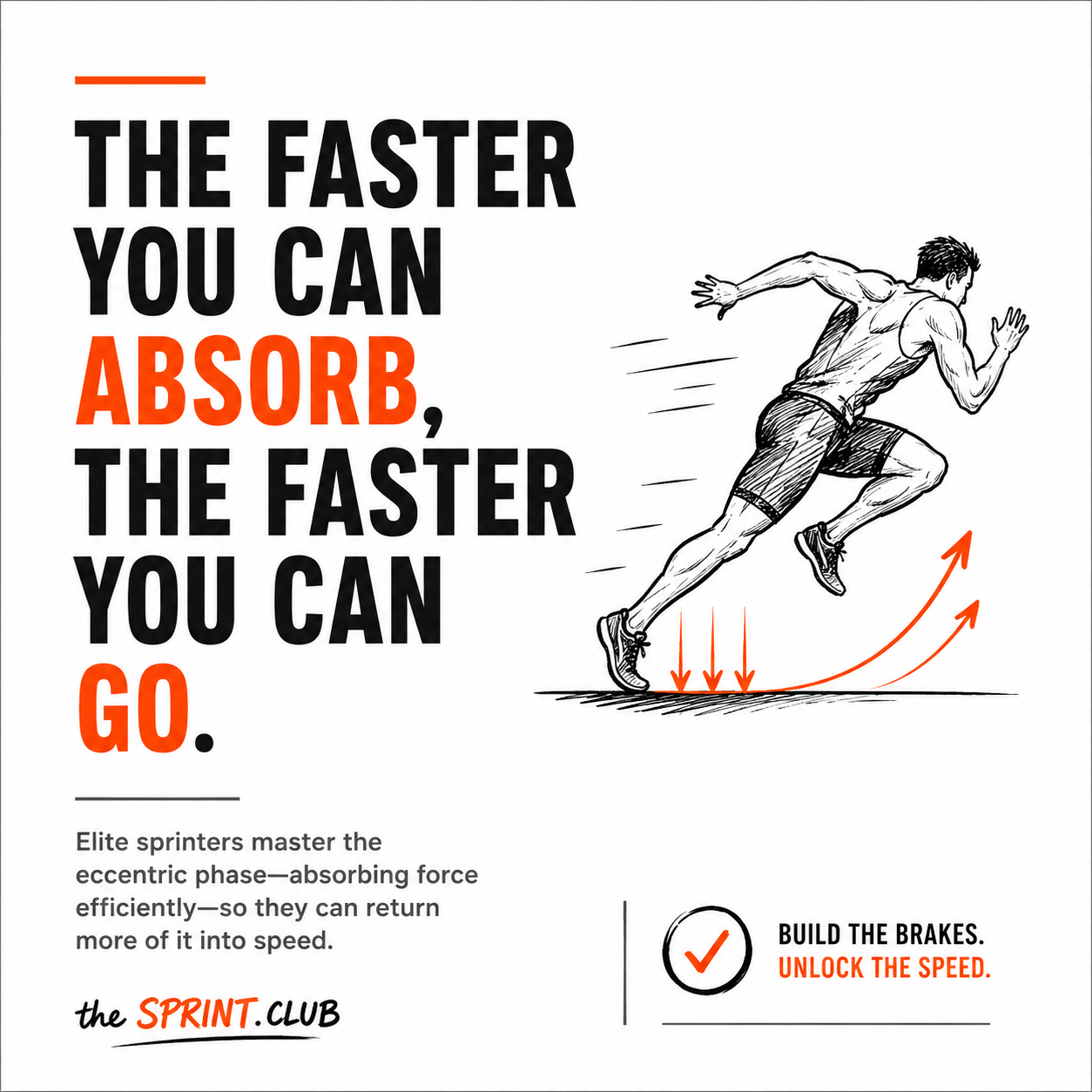
Why absorbing force efficiently is the missing link to faster sprint times, shorter ground contacts, and better performance.
|
|
|
|
Most athletes focus on producing force. Elite sprinters also master absorbing it. Every sprint step begins with a collision between the foot and the ground. Before you can produce force, your body must accept it. Athletes who develop exceptional eccentric strength can absorb larger forces, store more elastic energy, reduce ground contact time, and return more of that energy into …
|
|
|
|
|
|
|
|
|