|
|
|
|
Shock Method Training
|
A lot of programs include jumps, bounds, hops, pogos, hurdle hops, and box jumps. The athletes sweat. The contacts add up. The session looks explosive from across the room.
|
But the question is not whether the athlete jumped.
|
|
The question is whether the program actually challenged the neuromuscular system to absorb, tolerate, redirect, and express force at a higher level than before.
|
That is where shock method training gets misunderstood.
|
In the source notes for this issue, the key idea is simple: progressive overload alone is not always enough to challenge explosive athletes. Verkhoshansky's work was not just about doing harder jumps. It was about arranging exercises in a specific order so their effects could build on each other, with reactive strength and maximal strength forming the foundation before explosive strength was actualized through barbell jumps and shock plyometrics.
|
That distinction matters.
|
|
|
The Big Idea
Shock method training is not a category of exercises.
|
It is a method of intensification.
|
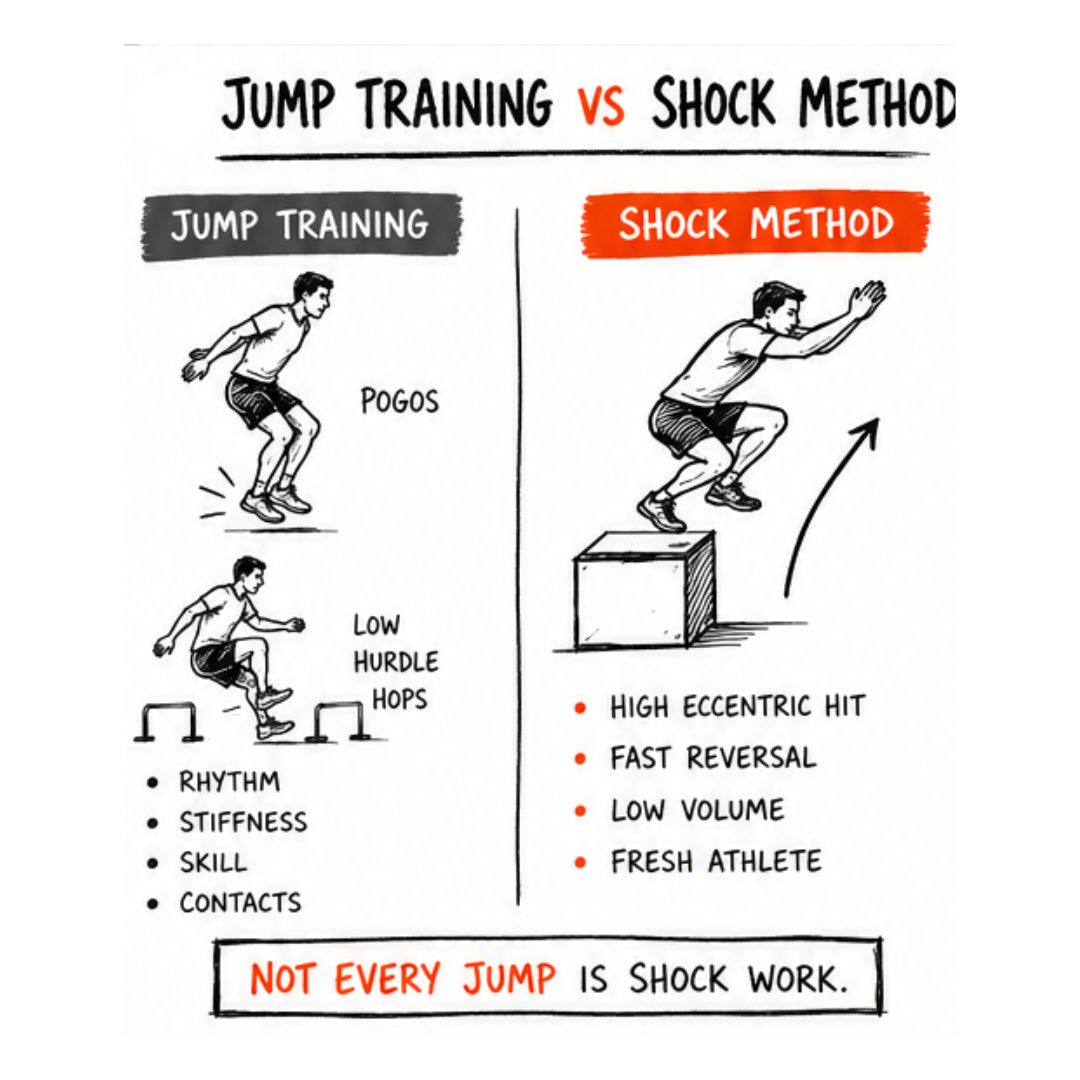
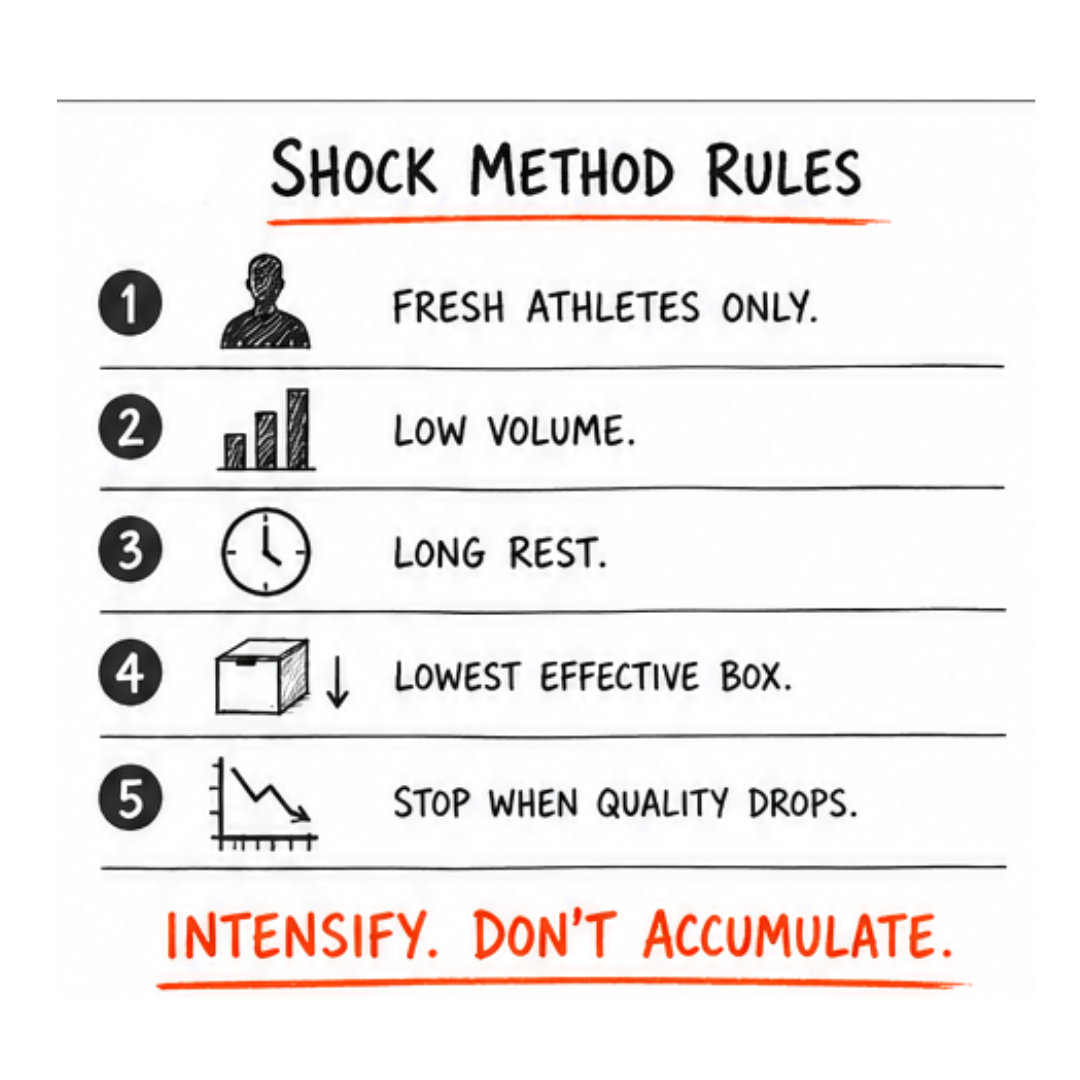
The goal is not to collect more ground contacts. The goal is to expose a prepared athlete to a short, high-intensity eccentric demand, then require them to convert that demand into a fast, explosive takeoff.
|
That is a very different animal from general jump training.
|
A squat jump teaches projection.
|
A pogo teaches rhythm and ankle stiffness.
|
A hurdle hop teaches repeated elastic contacts.
|
|
A depth jump, when used correctly, asks the athlete a more violent question:
|
Can you hit the ground, stay organized, and get out before the system leaks energy?
|
That is why shock work should not be treated like a conditioning circuit, a warmup filler, or a punishment tool for the athletes who showed up late.
|
Depth jumps are not burpees with a Soviet accent.
|
They are high-intensity neural work.
|
|
|
|
|
|
|
Why The Order Matters
One of the most useful ideas from Verkhoshansky's framework is that exercises can have summated effects when placed in the right sequence.
|
That means the training effect of one exercise can prepare, amplify, or organize the effect of another.
|
For sprint coaches and S&C coaches, this should sound familiar.
|
You already know this intuitively from speed work.
|
You do not put your best fly 30s after gassers.
|
You do not teach block starts after a 40-minute leg circuit.
|
|
You do not ask athletes to express precision when their nervous system is already cooked.
|
The same logic applies here.
|
Shock method work needs a place in the program where the athlete is prepared enough to handle it, fresh enough to express it, and developed enough to adapt from it.
|
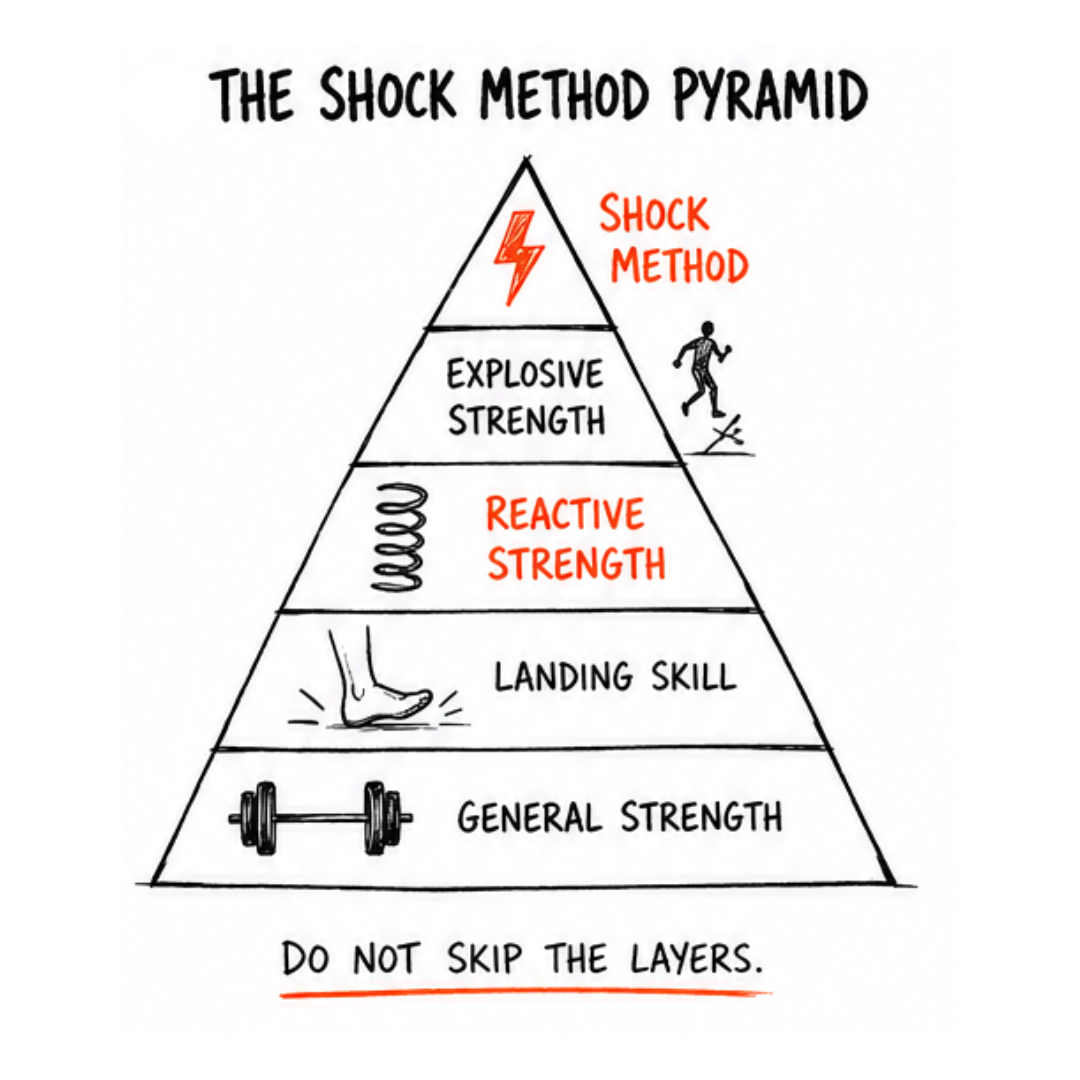
A simple hierarchy looks like this:
|
- General strength: Can the athlete produce force?
- Landing skill: Can the athlete receive force without collapsing?
- Reactive strength: Can the athlete reverse force quickly?
- Explosive strength: Can the athlete express force with intent?
- Shock method: Can the athlete handle a high eccentric hit and turn it into takeoff?
Most bad programs skip the middle.
|
They go from “the athlete can squat” straight to “let's add depth jumps.”
|
That is like seeing someone pass driver's ed and putting them in a Formula 1 car because both involve steering wheels.
|
|
|
|
|
|
|
|
|
|
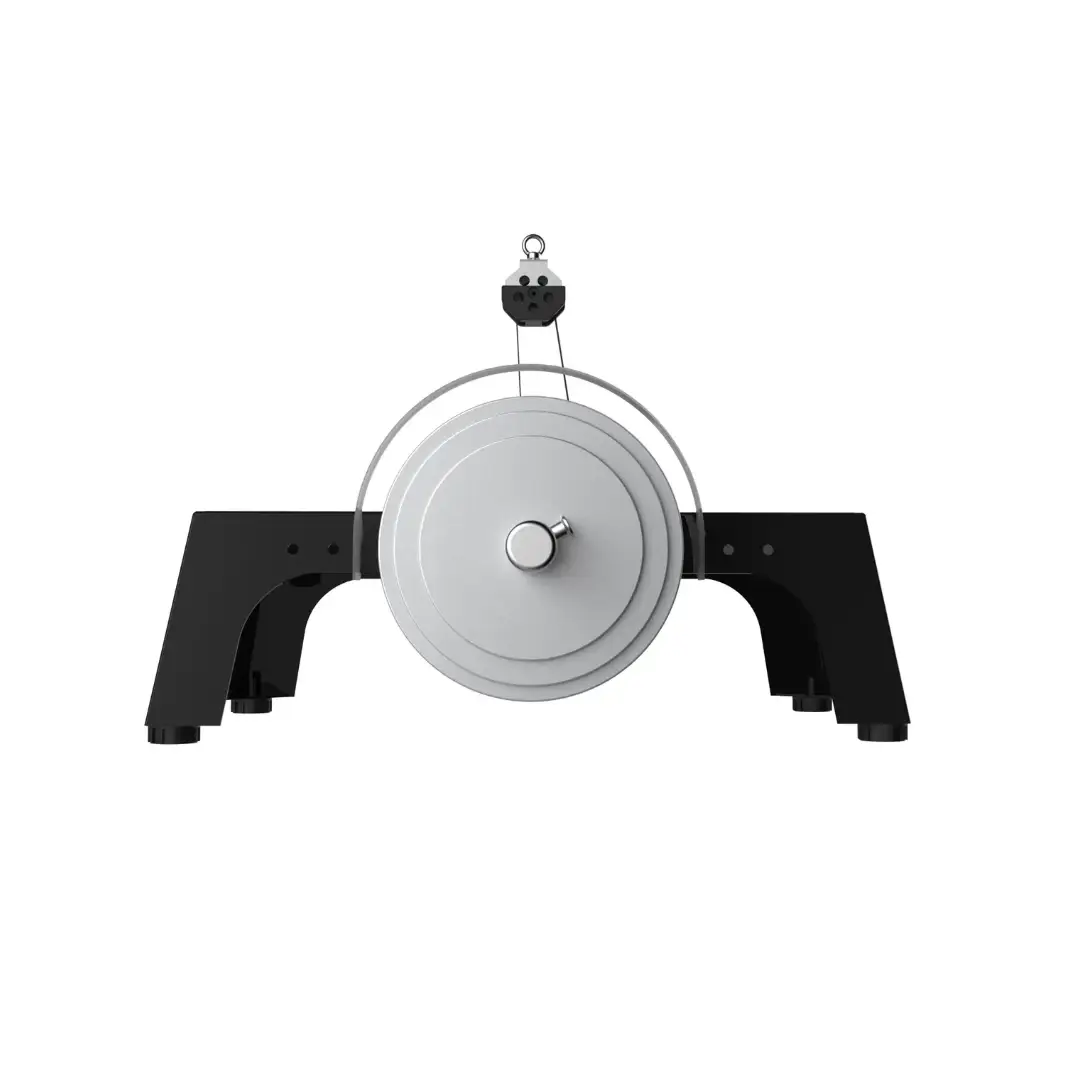
EccentriDisk Flywheel Trainer
|
|
|
Elevate your athletic prowess with the EccentriDisk Flywheel Trainer! Engineered for explosive strength, this versatile flywheel system (with 8", 10", 12" disks) delivers eccentric overload for superior sprint speed, jump height, and power. Featuring a non-slip foot surface, durable braided strap, and accessories like a hand bar and waist belt, it’s ideal for athletes targeting muscle hypertrophy and injury prevention. Compatible with Exxentric flywheels. Shop now at thesprint.club
|
|
|
|
|
|
Verkhoshansky viewed traditional plyometrics less as the pinnacle and more as a foundational quality, especially for athletes already exposed to jumping in their sport.
|
That should change how coaches think about jump training.
|
For a beginner, pogos, skips, rudiment hops, and low-level hurdle hops may be a major stimulus.
|
For an advanced jumper, sprinter, or field sport athlete, those same drills may be preparation, coordination, or tissue conditioning.
|
The exercise does not determine the level.
|
A low box depth jump for one athlete may be a true shock stimulus.
|
For another, it may be nothing more than a slightly spicy warmup.
|
That is why the coach's job is not to worship the exercise.
|
The coach's job is to match the stimulus to the athlete's current capacity.
|
|
|
The Coach's Checklist: Is This Athlete Ready?
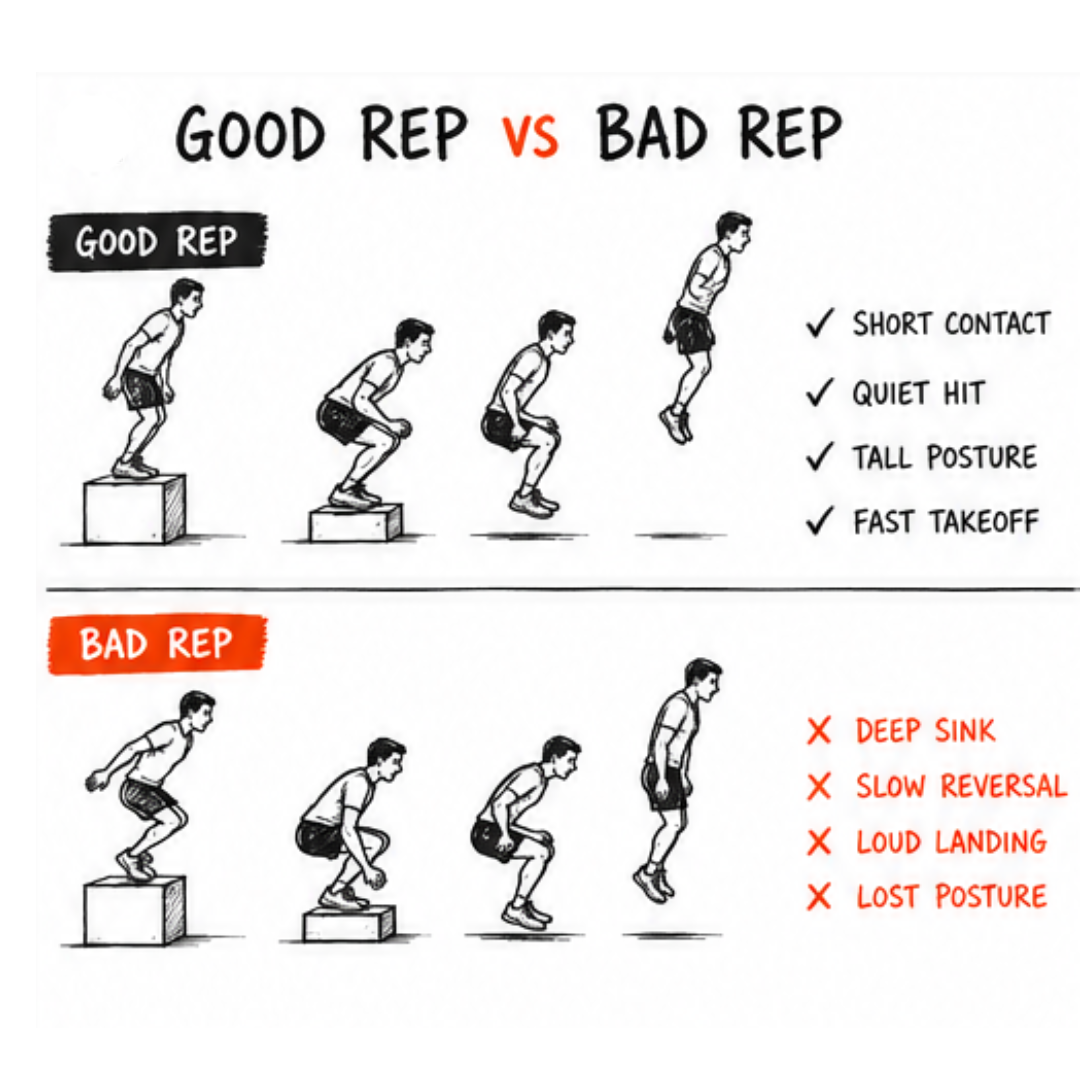
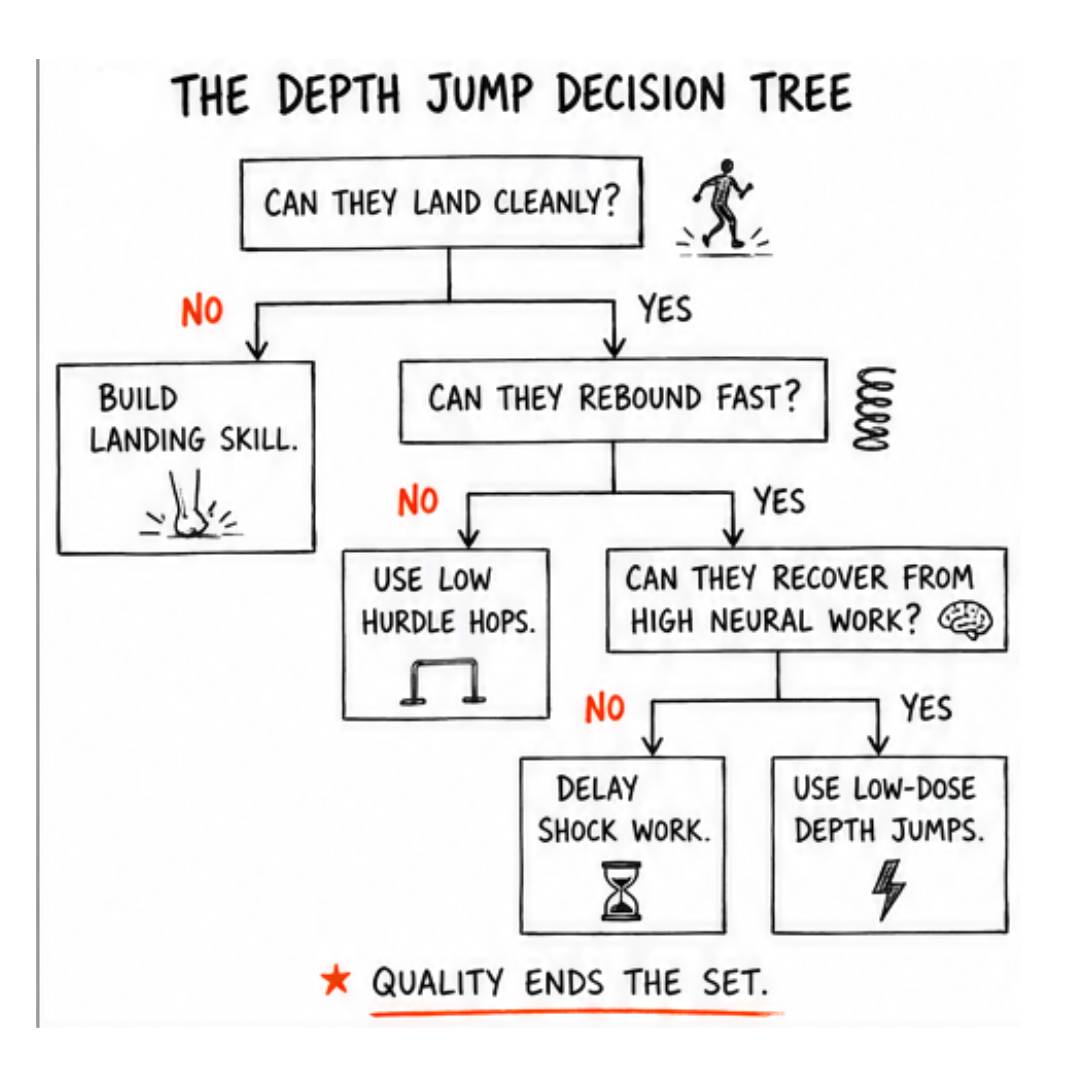
Can they land without noise, collapse, or drama?
|
You are looking for stiffness with control. Not stiffness as in robotic. Stiffness as in the joints do not fold like a cheap lawn chair on contact.
|
- Knees diving in
- Heel slamming
- Chest falling forward
- Excessive sinking
- Long pause before takeoff
- Arms flailing like the athlete is being attacked by bees
Can they jump with intent?
|
Shock work is not for athletes who treat jumps like a box-checking exercise. Every rep needs
|
The athlete should understand that the ground is not a pillow. It is a surface they attack, organize against, and leave quickly.
|
Do they have enough maximal strength?
|
Maximal strength is not the whole answer, but it is part of the foundation. If the athlete cannot produce force, they are unlikely to tolerate large eccentric demands well.
|
Do not reduce this to a single magic squat number. Use a broader picture:
|
- Relative strength
- Single-leg control
- Eccentric strength
- Trunk stiffness
- Prior training age
- Jump and sprint history
- Tendon tolerance
Do they have reactive qualities already?
|
A prepared athlete should be able to perform low and moderate-intensity reactive jumps without losing posture, rhythm, or contact quality.
|
- Pogos
- Rudiment hops
- Low hurdle hops
- Ankling variations
- Drop landings
- Snap-down to jump
- Repeated low box jumps
Can they recover from high-intensity neural work?
|
Shock method work is expensive.
|
|
If an athlete is already struggling with sleep, soreness, tendon irritation, heavy meet schedules, or poor readiness, this is probably not the time to add high-impact depth jumps.
|
|
High-intensity training is not just about what the athlete can survive during the session.
|
It is about what they can absorb and adapt from afterward.
|
|
|
|
|
|
|
|
|
|
|
Thanks for reading. See you soon!
|
|
|
|
|
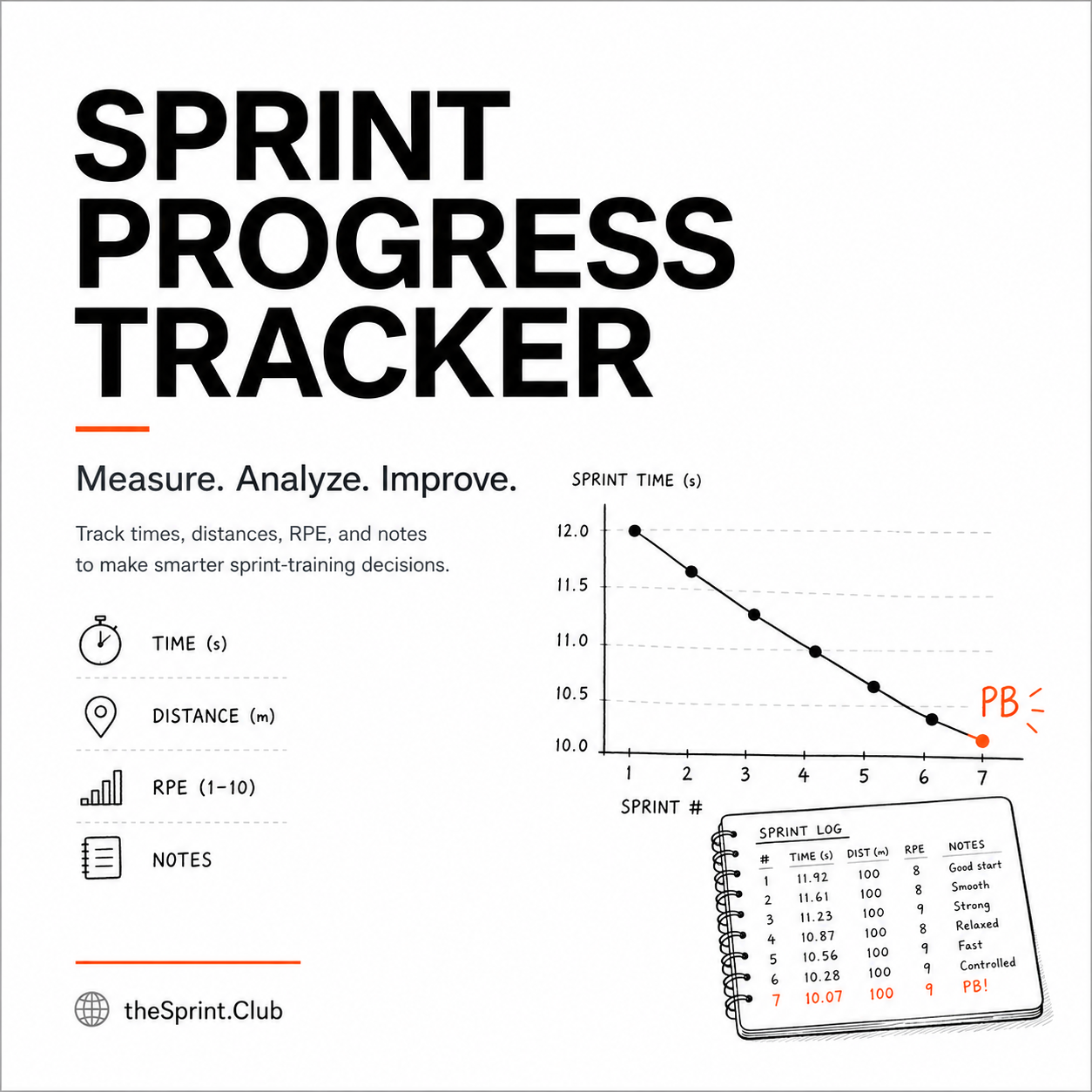
Sprint Progress Tracker: Measure and Improve Your Speed
|
|
|
|
Use a sprint progress tracker to record times, monitor fatigue, identify trends, and make smarter training decisions that improve sprint performance.
|
|
|
|
|
|
|
|
Why absorbing force efficiently is the missing link to faster sprint times, shorter ground contacts, and better performance.
|
|
|
|
Most athletes focus on producing force. Elite sprinters also master absorbing it. Every sprint step begins with a collision between the foot and the ground. Before you can produce force, your body must accept it. Athletes who develop exceptional eccentric strength can absorb larger forces, store more elastic energy, reduce ground contact time, and return more of that energy into …
|
|
|
|
|
|
|
|
|